Pharmacology 3 - Unit 4
Syllabus
3. Chemotherapy
- Urinary tract infections and sexually transmitted diseases.
- Chemotherapy of malignancy
4. Immunopharmacology
- Immunostimulants
- Immunosuppressant Protein drugs, monoclonal antibodies, target drugs to antigen, biosimilars
Scroll to Download
UNIT-IV
- CHEMOTHERAPY *-
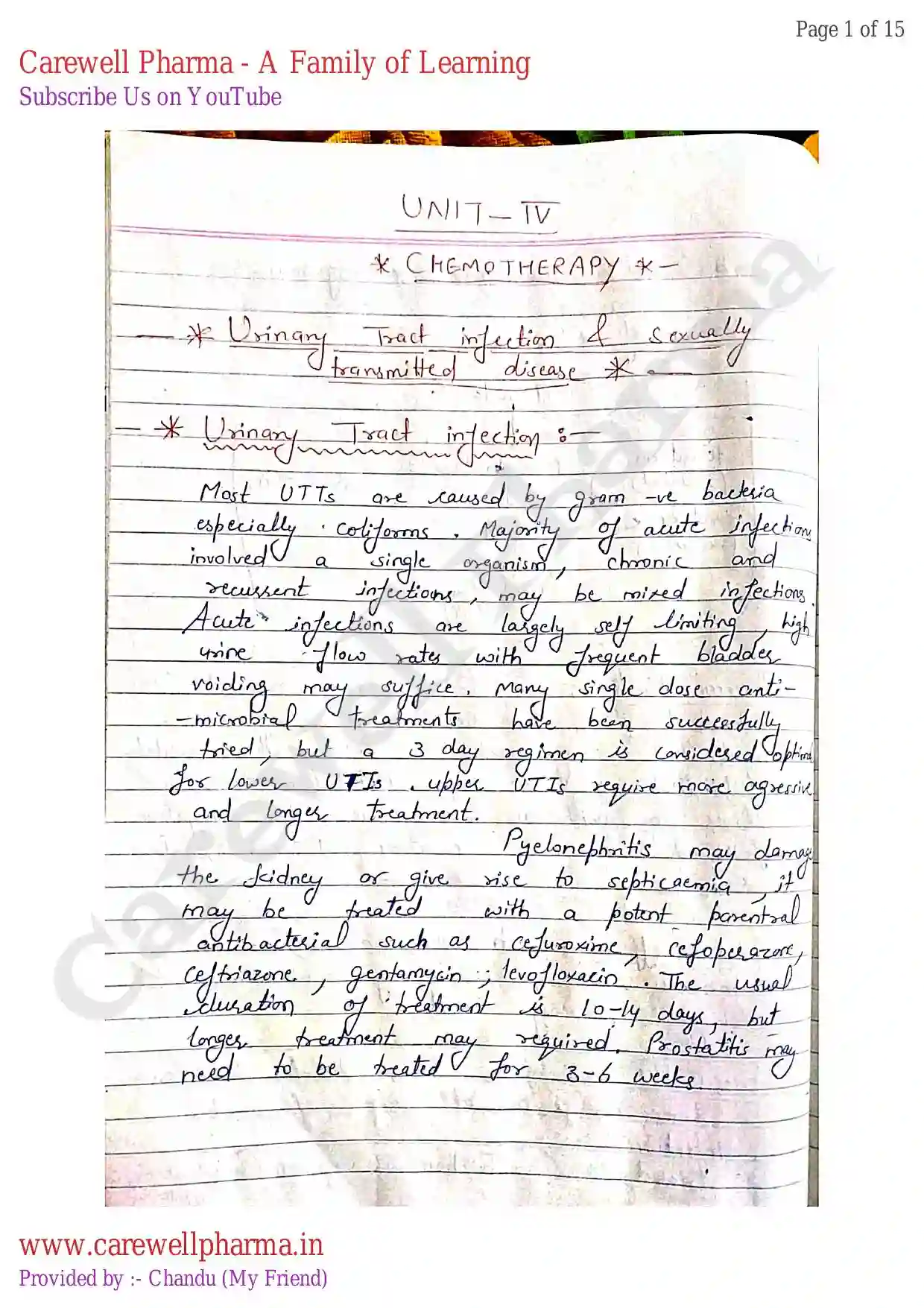
Urinary Tract infection & Sexually
Urinary Tract Infection
- Most UTIs are caused by gram -ve bacteria especially coliforms. Majority of acute infections involved a single organism, and chronic recursent infections, may be mixed infections.
Acute infections are largely self limiting, high urine flow rates with Frequent bladder void suffice many single dose anti-microbial e tried, but 3 day regimen is considered Sophin been successfulle for lower UTIs upper UTIs require more agressive and longer treatment.
Pyelonephritis may dama the kidney or give rise to septicaemia it may bereria treated with a potent parentral lo such as Ceftriaxone, Cefuroxime cefoperazore, gentamycin; levofloxacin. The usual treatment of treatment is 10-14 days, but required. Prostatitis may need to be treated for 3-6 weeks.
The antimicrobial antibiotics in urinary tract infections is Summerized as follows:
1. Cotrimoxazole → A fixed dose combination of trimethoprim and sulfamethoxazole He is called Cotipinoxazole.
Cotrimoxazole be employed empirically without boeingial data in UTI because majority of urinary pathogens, including Chlamydia trachomatis are cavcred by cotrimoxazole...
PABA Sulfonamide (folate synthase) DHFA Trimethoprim (Dihydrofolate Reductase) THFA
2. Quinolones → The first generation fluoroquinolones especially ciprofloxacin ofloxacin and highly effective and the most popular and ausently the cently potent action because of against gram negative bacilli and low cost.
3. Amoxicillin → The antibiotics used in the past were frequently first choiced for as initial treatment of acute infections.
4. Cephalosporins → Use of cephalosporins has increa especially in women. with nosocomial kichi and proteus infections.
- Sexually Transmitted Diseases (STDs)
STDs also known as venereal disease are infections that are passed from one press to another through sexual contact. The causer of STDs are bacteria, parasites, and vinge. These are more than 20 types of STDs including chlamydia, Genital herpes, gonorine, HIV/AIDS, syphilis.
1. Chlamydia → is an STD caused by Chlamydia trachomatis bacterium. It is highly contagious, This bacterium any infects humans It is the most common infectious cause of genital and eye diseases globally.
Treatment → The treatment of chlamydia is very imp., if it left it can cause long tim ling khm health consequences including infertility and ectopic pregnancy.
Take the bills of 1 week. I dose Azithromycin Doxycycline
Some patients, such as pregnant women ma be may given alternative antibiotics, Doxycyline and tetracycline affect the development of baby's bones and teeth. Azithromycin has taken shown to be safe and effective.
2. Gonorrhea → This STD infection usually affects the mucous membranes. The bacterium which is highly contagious, stay in the warm and mast Cavities of the body females may develop pelvic inflammatory disease. Males may develop inflammation of the prostate gland, urethra & epididymis The disease is caused by Neisseria gonorrhoea.
Treatment → Adults with gonorrhoea are treated with antibiotic. The centers of for disease control and Prevention recommends that uncomplicated gonorrhoea be treated only with the antibiotic Ceftriaxone given as injection either combination with azithromycin taken osal antibiotics that are doxocycline other two.
3. Syphilis → Is the result Treponema pallidum, a bacterium. It is transmitted by sexual contact and the person passing on the infection will have a syphilitic lesion.
Treatment → & syphilis are easy to treat with a pencillin. other antibiotics such as; Doxycycline, azithromycin, Ceftriaxone.
Chemotherapy of Malignancy
Malignancy also termed as cancer, it is disease in which abnormal cells divide without control & can inkiade nearby tissues. Cancer cells can also spread to another parts of the body through the blood and lymph systems.
The anticancer drugs ther kill cancer cells or modify their growth.
The treaties sather of malignant diseases. started any after recent developmseases with nitrogen mustard was used, but progress has bar rapid after 1940 when a The latest innovations target growth factor, specific signalling pathways, angiogenesis, tumor antigens etc.
In addition to their prominent role in leukomias and lymphomas drugs are used in conjunction with surgery, radiotherapy and immunotherapy to introduce a different spect.
Anticancer drugs $\downarrow$ Cytotoxic drugs (1)
| Alkylating agents | ||||
|---|---|---|---|---|
| Nitrogen Mustards. | Ethylenimine | Alkylsulfonate | Triazine | Methyl hydrazine. |
| -Mechloroethamine | -Thiotepa | -Busulfan | -Dacarbazine | -Procarbazine |
| -Cyclophosphamide | -Altretamine | -Temozolomide | ||
| -Ifosphamide | ||||
| -Chlorambucil | ||||
| -Melphalan |
| Platinum Coordination Complexes |
|---|
| -Cisplatin |
| -Carboplatin |
| -Oxaliplatin |
| Antimetabolites | ||
|---|---|---|
| folate antagonists | Purine antagonists | Pyrimidine antagonists |
| -Methotrexate | -Azathioprin | -5-fluorouracil |
| -Pemetrexed | -Fludarabine | -Capecitabine |
| -6-Mercaptopurine | -Doxyfluridine | |
| -Cytarabine. |
Nitrosa-ureas. -Carmustine -Lomustine.
Cytotoxic drugs (2)
| Microtubule damuraging agents | Topoisomerase-2 inhibitor | Topoisomerase-1 inhibitor | Antibiotics |
|---|---|---|---|
| Vinca alkaloids | -Etoposide | -Topotecan | -Doxorubicin |
| -Vincristine | -Irinotecan | -Daunorubicin | |
| -Vinblastine | -Idarubicin | ||
| -Vinorelbine | -Epirubicin | ||
| Taxanes | -Bleomycins | ||
| -Paclitaxel | -Mitomycin | ||
| -Docetaxel | |||
| Estramustine |
Targeted Drugs
| BCR-ABL tyrosine Kinase inhibitors | EGF Receptor inhibitors | Angiogenesis inhibitors | Proteasome inhibitor | CD20 inhibitor |
|---|---|---|---|---|
| -Imatinib | -Gefitinib | -Bevacizumab | -Bortezomib | -Rituximab |
| -Dasatinib | -Erlotinib | -Sunitinib | ||
| -Nilotinib | -Cetuximab | -Sorafenib | ||
| -Lapatinib |
Miscellaneous -Hydroxyurea -Arsenic trioxide -Tretinoin
Anticancer Drugs. $\downarrow$ Hormonal Drugs
| Glucocorticoids | Estrogens | SERMS | SER down regulator | Aromatase inhibitors | Antiandrogens | $5\alpha$-reductase inhibitors |
|---|---|---|---|---|---|---|
| -Prednisolone | -Ethinylestradiol | -Tamoxifen | -Fulvestrant | -Letrozole | -Flutamide | -Finasteride |
| -Fosfestrol | -Toremifene | -Anastrozole | -Bicalutamide | -Dutasteride | ||
| -Exemestane |
| GnRH analogues | Progestins |
|---|---|
| -Nafarelin | -Hydroxy-progesterone acetate |
| -Leuprorelin | |
| -Triptorelin |
General toxicity of Cytotoxic Drugs → Cytotoxic drugs have more profound effect on rapidly multiplying cells. Mary normal tissues are growth fraction than cancers have a epithelial lining, bone marrow, reticuloendothelial system and gonads. These tissues are affected in a dose-dependent manner by the Majority of the drugs.
1) Bone Marrow → Depression of bone marrow granulocytopenia, agranulocytosis, thrombocytopenia. This is the more Serious toxicity.
2.) Lymphoreticular Tissue → Lymphocytopenia and inhibition of lymphocyte function results in suppression of cell mediated and humoral immunity.
3) Oral Cavity → The oral mucosa is particularly susceptible to cytotoxic drugs because of high epithelial cell turn over. The gums as well as asal mucosa are regularly subjected to ming trauma, and breaches are common.
4) GIT → Diarrhoea shedding of mucosa, haemol occur due to decrease in the rate of renewal of the gastrointestinal mucosa lining. nausea and vomiting are prominent with mary cytotoxic drugs.
5) Skin → Alopecia occurs due to change to the cells in hair follicles causes.
6) Gonads → Inhibition of gonadal cells causes oligozoospermia and impotence in males, inhibition of ovulation and amenorrhoea. are common in femal.
7) Foetus → All cytotoxic drugs given to pregnant women for foundly demage the developing faetus.
8.) Carcinogenicity → Seccondary Cancers, leukemias, lymphomas and histocytic tumors appear with greater frequency many years after the use of cytotoxica drugs.
Antimetabolites
These are analogues related to the normal components of DNA or Coenzymes evolved in nuclei acid synthesis.
1). Folate Antagonist → Methotrexate: This folic acid analogue is one of the oldest and highly efficacious antineoplastic drugs. which acts by inhibiting dihydrofolate reductase, blocking the conversion to tetrahydrofolic acid.
DHFA dihydrofolate reductase Methotrexate THFA (Tetrahydrofolic acid)
Utilizing to the Folate carrier it enters into cells and to more active polyglutamate form by enzyme folypolyglutamate synthase. Methotrexate has cell cycle specific action-kills cells in S phase.
In addition to DHFRase it inhibits thymidylate synthase, so that DNA Synthesis of RNA and protein also suffer.
Pharmacokinetics → It is absorbed orally 50% plasma protein bound, little metabolized and excreted unchanged largely ed in urine. varied applications as Choriocarcinoma : 15-30 mg/day for 5 days orally, or 20-40 mg/m² i.v. twice weekly. apparently curative in.
2) 5-fluorouracil → Pyrimidine analogues have antineoplastic, antifungal antibiotics.
It is 5 fU 5-UMP Phosphorylation 5-UDP Phosphorylation 5-UTP RNA damage
Daunorubicin, Doxorubicin → These are anthracycline otius having antitumour activity. Doxorubicin is in many solid tumours such as breast, thyroid, ovary, bladder and lung Cancers and neuroblastomas.
These drugs intercalate b/w DNA strands and block DNA as well as RNA Synthesis. There prominent action is to combine with and activate topoisomerase II causing breaks in DNA. Maximum action is exerted at S phase.
Both daunorubicin and doxorubicin produce cardiotoxicity as a unique adverse effect. This can manifest either acutely within 2-3 days. Nausea, Vomiting, alopecia, narrow depression & local tissue clamave.
Doxorubicin → 60-75 mg/m² injection every 3 weeks. BSA slow i.v.
Immuno Pharmacology
Immunostimulants → These are substances that Stimulate the immune system by inducing activation or increasing activity of any of its Components...
Immunostimulants Drugs → Those drugs that stimulate the immune system, Important for the treatment of infectious diseases, tumors and all the immuno deficiencies where the immune system needs a boost.
Classificatication
- Specific Immunostimulants
- Non Specific Immunostimulants.
Specific immunostimulant provide antigenic specific responses in immune system such as vaccine or antigen. Non specific act irrespective of antigenic specificity to augment immune response of other stimulate components of immune without antigenic specificity.
Different types of immunostimulants
1.) Bacterial vaccine
2.) Colony stimulating factors
3.) Interferons.
4.) Interlukins
5.) Vaccine Combinations.
6.) Viral Vaccines
1) Bacterial Vaccines → Bacterial vaccines contain killed or attenuated bacteria that activate the immune system. Antibodies are built prevents bacterial infection later. a particular An eng of bacterial vaccine is the TB vaccine. The bacillus calmette - Guerin (BCG) vaccine is an attenuated less virulent, but still alive mycobacterium bovis strain. This is able to human cells, butte net to induce any pathology production of Igs by B-cell and these behave as a mycobacterium TB.
Uses → BCG (TB) vaccine accine is used in in many countries with a high prevalence of TB to prevent childhood TB mening
2). Colony Stimulating Factors → Colony stimulating factors are glycoproteins that promote production of WBC in response to infection. An administration of exogenous colony stimulating factors stimulates the stem cells in the bone marrow to produce more of the particular WBCs. The new WBCs migrate into the blood and fight the infection.
Uses → Colony stimulating factors are used in patients who are undergoing Cancer treatment that cause low WBC counts puts on the patient at risk of infections.
3). Interferons → Are cytokines produced by host cells in response to viral infections. There are of 3 types ($\alpha, $\beta and $\gamma$) interferons in men. They also have immunomodulating and antiproliferative properties. They inhibit the multiplication of many DNA & RNA viruses.
Mechanism of Action → Interferon alfa - 2b inhibits virus replication in virus infected cells and supresses cell proliferation. it has antiviral inhibitory activity against respiratory syncytial virus, influenza virus and herpes simplex virus.
Adverse Effects → Hypertension, arrhythmias, alopecia headache and arthralgia. It can also cause neurotoxicity resulting in confusion.
Uses → Chronic hepatitis B and C
4). Viral Vaccines → Cenetic way warts caused by papilloma virus injected into the lesion. are interferons.
It contains either inactivated or attenuated (alive but not capable to causing disease) viruses.
Inactivated vaccines contain killed viruses which have lost their ability to replicated and in order for it to bring about a response it contains mox antigen than live vaccines.
Common Side Effects Are
- Blood in the urine or stool.
- Pneumonia
- Inflammation of the Stomach or intestines