Medicinal Chemistry 2 - Unit 1
Syllabus
Antihistaminic agents
Histamine, receptors and their distribution in the humanbody
H1-antagonists: Diphenhydramine hydrochloride\*, Dimenhydrinate, Doxylamines cuccinate, Clemastine fumarate, Diphenylphyraline hydrochloride, Tripelenamine hydrochloride, Chlorcyclizine hydrochloride, Meclizine hydrochloride, Buclizine hydrochloride, Chlorpheniramine maleate, Triprolidine hydrochloride\*, Phenidamine tartarate, Promethazine hydrochloride\*, Trimeprazine tartrate, Cyproheptadine hydrochloride, Azatidine maleate, Astemizole, Loratadine, Cetirizine, Levocetrazine Cromolyn sodium
H2-antagonists: Cimetidine\*, Famotidine, Ranitidin.
Gastric Proton pump inhibitors: Omeprazole, Lansoprazole, Rabeprazole, Pantoprazole
Anti-neoplastic agents
Alkylating agents: Meclorethamine\*, Cyclophosphamide, Melphalan, Chlorambucil, Busulfan, Thiotepa
Antimetabolites: Mercaptopurine\*, Thioguanine, Fluorouracil, Floxuridine, Cytarabine, Methotrexate\*, Azathioprine
Antibiotics: Dactinomycin, Daunorubicin, Doxorubicin, Bleomycin
Plant products: Etoposide, Vinblastin sulphate, Vincristin sulphate
Miscellaneous: Cisplatin, Mitotane.
Scroll to Download
MEDICINAL CHEMISTRY 2 UNIT 1
ANTIHISTAMINIC AGENTS
Syllabus
- Antihistaminic agents: Histamine, receptors and their distribution in the human body.
- $H_1$-Antagonists
- $H_2$-Antagonists
- Gastric proton pump inhibitors
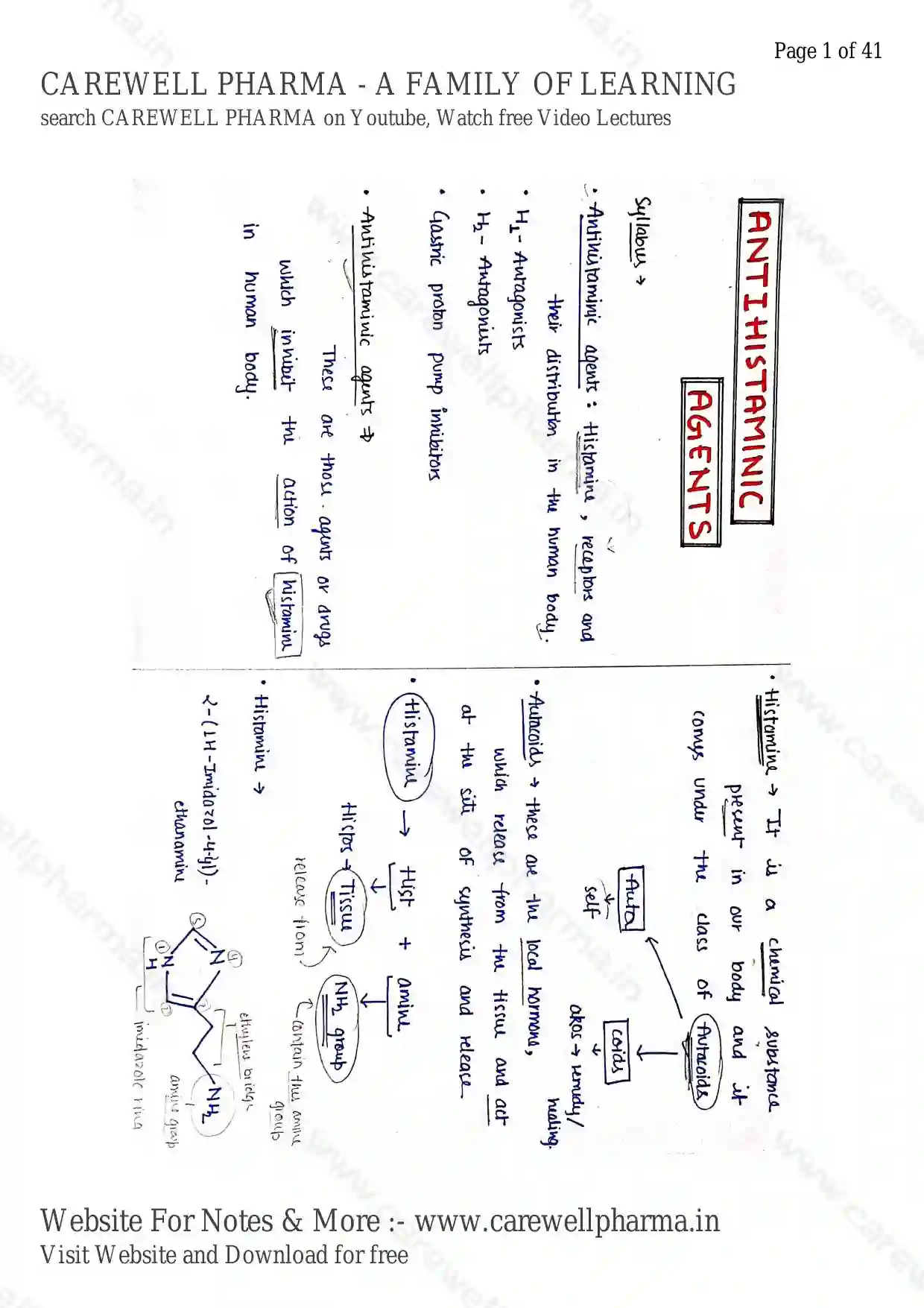
Antihistaminic Agents → These are those agents or drugs which inhibit the action of histamine in human body.
Histamine → It is a chemical substance present in our body and it comes under the class of Autacoids. Auta (self) + coids (akos remedy/healing)
Autacoids → These are the local hormone, which release from the tissue and act at the site of synthesis and release.
Histamine → Hist (Tissue) + amine ($NH_2$ group) release from tissue contain this amine group.
Histamine 2-(1H-Imidazol-4-yl)-ethanamine

- Histamine is discovered by Sir Henry Dale in 1910.
Biosynthesis, Storage, Release and Catabolism of Histamine
Synthesis → Histamine is synthesized by decarboxylation of Histidine which is found in all organs and tissue of the human body.

Storage → Histamine mostly present inside the mast cells and basophiles.
- Both mast cells and basophils are the type of white blood cells and a part of immune system.
- It is also stored in enterochromaffin-like (ECL) cell and a variety of neurons (Histaminergic neurons) in GIT.
- Usually Histamine (mast cells) found in throughout the body, but in high concentration is present in skin, mucosal cell of the lungs, intestine, urinary tract and tissue adjacents to the circulation.
- It's concentration is also found high in mammalian cerebro spinal fluid (brain).

Release
- Histamine is released by the interaction of antigen with IgE antibodies on the surface of mast cells.
- The antigens are proteins or polysaccharides obtained from various source like dust, pollen grains, food stuff, venoms, toxins, detergents and some numerous chemicals. etc...

- There are also some other inflammatory mediators release such as protaglandins, Leukotrienes, Kinins and platelet activating factor.
- After release of histamine from mast cells it performs following physiological effects:-
- Hyper Sensitivity
Itching, Sneezing, Watery eye and running nose
- Contracts smooth muscles of the lungs.
- Tissue injury
- Inflammation - cause pain
- Allergic reactions
Some physiological role of Histamine
- Bronchospam → Hard to breathe cause due to irritation, inflammation, or allergic reaction of the airways.
- Vasodilation → cause hypotension.
- Gastric Secretion → increase HCl secretion eq. Acidity , Ulcers ele...
- Produce aedema → Fluid and plasma protein may come to extracellular fluid.
Catabolism
Histamine inactivate by many reactions which change the structure of histamine. After changing structure, Histamine does not bind with receptor due to change its structure.
HISTAMINE RECEPTORS
There are mainly four receptor, in which histamine bind and give their pharmacological effects:- , , ,

All these receptors are G-protein couple receptor and give their action by the mechanism of GPCR.
Distributions
1). Stimulate phospholipase C (PLC)
Location
- Smooth muscle of respiratory (Lungs) and Intestine (GI tract).
- CNS neurons.
- Vascular Endothelial Cells, in Heart.
- T-cells, B-cells, neutrophills, eosinophills.
Effects
- Pain, Pruritus (Itching), Vasodilation, hypotension, headache, Bronchoconstriction.
- Increased vascular permeability at inflammation sites.
- Triple response,
- oedema formation.
- severe allergic response,
- IgE production.
2). Stimulate adenylcyclase and increase cAMP.
Location → Gastric parietal cells. vascular smooth muscles. CNS, heart and uterus.
Effects → Increase in gastric acid secretion (HCl). vascular permeability, vasodilation.
3).
Location → Mostly found in CNS.
Effects → Inhibition of histamine release (pre synaptic auto receptor). modulates the release of 5-HT, dopamine, NAD, Ach and GABA in CNS by acting as heteroreceptor.
4).
Location → Hematopoietic cells the stem cells that give rise to other blood cells.
Effects → Modulate immune function.
CLASSIFICATION OF ANTIHISTAMINES
$H_1$-Antagonists
- First Generation
- Diphenhydramine HCl*
- Dimenhydrinate
- Doxylamine succinate
- Clemastine fumarate
- Diphenyl pyraline HCl
- Tripelenamine HCl
- Chlorcyclizine HCl
- Meclizine HCl
- Buclizine HCl
- Chlorpheniramine maleate
- Triprolidine HCl
- Phenidamine tartarate
- Promethazine HCl*
- Trimeprazine tartrate
- Cyproheptadine HCl
- Azatadine maleate.
- First Generation
$H_2$-Antagonists
Gastric Acid Inhibitors
- Cimetidine*
- Famotidine
- Ranitidine.
Gastric Proton Pump Inhibitors (PPI)
- Omeprazole
- Lansoprazole
- Rabeprazole
- Pantoprazole.
Second Generation
- Astemizole
- Loratadine
- Cetirizine
- Levocetirizine
SAR OF ANTI-HISTAMINES
for $H_1$-Antagonists
Basic Structure of Antihistamines

Structurally, Substitution (modification) is possible on:-
- Aryl Group
- X = O,C,N
- Ethylene Bridge
- Amine Group
- Aryl Group
Diaryl substitution is essential for activity. Both alkyl group can be phenyl or any one heterocyclic ring which also increase activity.
may be methyl aryl group which show activity.

Substitution of group on aryl ring increase the activity. eg. Bromodiphenhydramine.

Nature of
It can be substituted by three major elements. $X =$ Nitrogen (N), Oxygen (O), Carbon (C).
If , substituted with any other element then activity of drug is less/lost.
Now, they form three types of drugs.

Substitution on Ethylene Chain
- Most of the antihistamines have ethylene chain and which is essential for activity.
- Branching of these ethylene chain can decrease the activity.
- But Promethazine is an exceptional case.
Amine Group
- Amine group is essential for activity.
- The tertiary amine may be a part of heterocyclic ring which increase the activity multitimes. eg. Chlorcyclizine.

$H_1$-Antagonists
Those agents which blocks the receptor and inhibit the action of histamine.
These are of two types!!
I) First generation (sedative)
II) Second generation
I) Antagonists (First generation)
Mechanism
These are competitive inhibitors of histamine at - receptor.
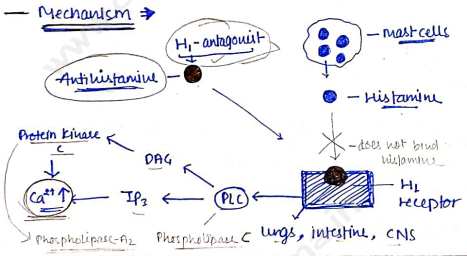
- The histaminergic receptors are G-protein couple type.
- receptor are coupled to phospholipase-C and their activation leads to the formation of Inositol phosphate ($IP_3$) and diacylglycerol (DAG).
- rapid release of from endoplasmic reticulum.
- DAG Activates Protein kinase c.
- Also activates phospholipase .
- Now, H_1$-antagonist bind to the $H_1 receptor and block this receptor. So, Histamine does not bind with receptor and not give any action. These decrease the production of PLC.
- $H_1$-antagonists (first generation) Cause Sedation due to selectivity for CNS neurons.
- Also due to their Lipophilicity. (easily cross BBB).
- Functions
- Competitive inhibitors of histamine at $H_1$-receptor.
- Relaxation of smooth muscles - Bronchodilation.
- Decrease vascular permeability.
- Pain, Pruritus, headache, hypotension decrease.
Various Drugs of First Generation $H_1$- Antagonists
1) Diphenhydramine Hydrochloride
Synthesis

- It is a first generation antihistamins which is mainly used for treating allergies.
M.O.A
It is competitive antagonists of receptor.
It also act on CNS (centrally) and cause Sedation, drowsiness.
It also have some antimuscarinic activity.
Synthesis

Uses
- Used to treat allergic condition like pain, pruritus, rhinitis, hay fever, common cold, rashes, watery eye, cough, runny nose & sneezing ete...
- Easily cross BBB so cause sedation and used to relax and fall asleep (Treat insominia)
- Used in prevention & treatment of motion sickness.
- Also used in treatment of parkinson due to antimuscarinic activity.
2) Triprolidine Hydrochloride

Synthesis

It is also a first generation $H_1$-antagonist.
MOA
- Bind with $H_1$-receptor and block the receptor and also the action of histamine.
Uses
- Used to control the symptoms of histamines. Combined with other cold drugs to provide relief in common cold.
3) Promethazine Hydrochloride → It is the hydrochloride salt form of promethazine. It having antihistaminic, sedative and antiemetic properties.

Synthesis of Promethazine
- Alkylation of phenothiazine with 1-dimethylamino-2-propylchloride give promethazine.

Mechanism of Action
- It act as a receptor antagonists.
- It also inhibit the central histaminergic receptors (dopamine, serotonine).
- It also act as anticholinergic (moderate affinity).
Uses
- Used as sedative for treatment of insomnia.
- Used for medication of allergy like rhinitis and other allergic reactions.
4) Dimenhydrinate

MOA
- The antiemetic property is due to antagonism in the vestibular system, in the brain.
Uses
- Used to treat nausea, vomiting & prevent motion sickness. helps in treatment of ear relieve vestibular disorder.
5) Doxylamine Succinate

MOA
- antagonists (same as other).
Uses
- Treat allergic symptoms allergy, hay fever & common cold.
- Used to treat insomnia.
- Prevent morning sickness in pregnant woman in combination with Vitamin B6 (pyridoxine).
6) Clemastine Fumarate

MOA
- Antagonists (same as other).
Uses
- Treat allergic symptoms (same as others). it also have some anticholinergic activity.
7) Diphenylpyraline Hydrochloride

MOA
- Competitive antagonists for receptor, after binding on receptor it suppress the activity of histamine (cause temporary relief).
Uses
- Same as other.
8) Tripelenamine Hydrochloride

MOA
- Antagonists (same as other). also have little anticholinergic activity.
Uses
- Used in treatment of upper respiratory tract allergic condition like Ashthma, hay fever, rhinitis. other allergic symptoms treatment.
9) Chlorcyclizine Hydrochloride

MOA
- Antagonists (same as other).
Uses
- Treat allergic symptoms like rhinitis, urticaria and pruritus. used for treating hepatitis C.
10) Meclizine Hydrochloride

MOA
- Blocks receptor in vomiting centre. also block muscarinic receptors.
Uses
- Used as an anti-vertigo or antiemetic agent. also act as CNS depressant.
11) Buclizine Hydrochloride

MOA
- Antagonists (same as other). also act as dopamine antagonists & anticholinergic.
Uses
- Used for treating of nausea, motion sickness or vertigo. safely used in the treatment of nausea in pregnancy.
12) Chlorpheniramine Maleate

MOA
- Antagonists (same as other).
Uses
- Relieving allergic symptoms (same as others).
13) Phenidamine Tartarate

MOA
- same. ($H_1$ antagonists)
Uses
- Treat allergic symptoms (same as others).
14) Trimeprazine Tartrate / Alimemazine

MOA
- Same ($H_1$ Antagonist)
Uses
- Treat allergic symptoms (Same as other)
- Act as sedative, hypnotics & antiemetic for motion sickness.
15) Cyproheptadine Hydrochloride

MOA
- Potent Antagonists
- Also have anticholinergic, antidopamenergic and anti serotonergic activity.
Uses
- Treat allergic symptoms (same as others).
- Treatment of akathisia (movement disorder).
- Used as an antiemetic in cyclic vomiting syndrome.
16) Azatadine Maleate

MOA
- Potent Antagonists.
Uses
- Treating the symptoms of upper respiratory mucosal congestion in perennial and allergic rhinitis.
- Relief of nasal congestion and evstachain tube congestion.
II) Antagonists (second Generation)
- Major side effect of first generation antagonist is sedation, drowsiness because they easily cross the BBB.
- But these second generation $H_1$-antihistamines does not cross BBB, So it does not cause sedation.
- They are more selective for peripheral receptors.
- They are hydrophilic in nature. More selective for peripheral receptors.
Mechanism & uses same as first generation but does not give their action on CNS.
Various Drugs
1). Astemizole

MOA
- Reversible blockage of receptor in GIT, Uterus, large blood vessels & bronchial muscles.
Uses
- Used for treatment of allergy symptoms such as rhinitis and conjunctions.
2). Loratadine

MOA
- Competitively antagonist of receptor (peripheral).
Uses
- Used alone or in combination with pseudoephedrine sulphate for relief of seasonal allergic such as rhintis, pruritus and erythema.
3). Cetirizine

MOA
- Acts as receptor antagonist (peripheral).
Uses
- Used to relieve allergy symptoms like runny nose, itching eye, sneezing, itching etc..
4). Levocetirizine
- Levorotatory enantiomers of cetirizine.

MOA
- Active enantiomers of cetirizine which blocks receptor.
Uses
- Similar as cetirizine but more potent.
III) Mast Cell Stabilizers
- It inhibits the release of histamine, leukotrienes and other substances that cause hypersensitivity reactions from the mast cells.
- It is a mast cell stabliser and it have anti-inflammatory activity.
- Inhibit the release of prostaglandins and leukotrienes and inhibit activation of eosinophils, neutrophils, monocytes & platelets.
1). Cromolyn Sodium

MOA
- It inhibit degranulation of mast cells thus preventing the release of histamine and leukotriens.
- It acts by inhibiting calcium influx.
Uses
- Used for the management of bronchial Asthma.
- It's nasal solution is used for allergic rhinitis.
- It's eye drop are used to treat allergic conjunctivitis.
$H_2$-Antagonists
- These are those agents or drugs which block the $H_2$-receptor which present in the stomach.
- These drugs mostly decrease the production of acid in stomach.
- These drugs are used in the treatment of gastric and duodenal ulcer.
Mechanism
- receptor are present in the parietal cells in the parietal layer of Stomach.

- Now, When Histamine release, it bind with receptor.
- Now, receptor are also GPCR, so it activates the cAMP.
- Now this cAMP increase which further increase or activate proton pump and increase the secretion of (exocytosis).
- Which further increase the production of HCl .
- Now, Antihistamine block the receptor so all the mechanism inhibit, and all the action of Histamine reduced.
- HCl decrease .
Various Drugs

MOA
- Antagonist of $H_2$-receptor and decrease the activity of histamine.
Uses
- Used in treatment of gastric and duodenal ulcers.
2). Famotidine

MOA
- More potent competitive inhibitors of Histamine receptor than Cimetidine.
Uses
- Used in treatment of gastric and duodenal ulcers.
3). Ranitidine

MOA
- Same as other.
Uses
- Same as other.
GASTRIC PROTON PUMP INHIBITORS (PPI)
- These are the irreversible inhibitors of gastric parietal cells proton pump.
- Used to control the gastric acidity and duodenal ulcer.
Mechanism
- There are one enzyme ATPase which present in parietal cell of stomach and it is responsible for HCl secretion.
- Now these drugs contain a sulphonyl group in a bridge between substituted benzimidazoles and pyridine rings.
- Now, ion does not secrete out so production of HCl decreases.

- Gastrin hormone produced by G-cell located in pyloric gland which act on gastrin receptor (from blood).
- Now, when PPI Introduce into parietal cells, its sulphonyl group bind with ATPase-SH enzyme then they form Drug enzyme complex. which further metabolize easily & irreversiblly inactivate the proton pump.
1). Omeprazole

MOA
- Selective and irreversible proton pump inhibitors. It supress gastric acid secretion by inhibiting the $H^+/K^+$-ATPase in gastric parietal cells.
- It blocks final step of acid production.
Uses
- Used in the treatment of peptic ulcer, erosive esophagitis and Elison syndrome (damage caused to esophagus by the stomach acid).
2). Lansoprazole

MOA
- Same as other.
Uses
- Used in treatment of duodenal and gastric ulcer.
- Zollinger-Ellison Syndrome (ZE Syndrome). (in which tumors causes the stomach to produce too much acid, resulting in peptic ulcers).
- Treatment of gasteroesophageal reflex (stomach content rise up into esophagus, which cause heart burn, chest pain, vomiting etc).
3). Rabeprazole

MOA
- Same as other.
Uses
- Same as omeprazole & Lonsoprazole.
4). Pantoprazole

MOA
- Same as other.
Uses
- Same as Other.
ANTI-NEOPLASTIC AGENTS
- These are those agents or drugs which are used in the treatment of cancer.
- Anti-neoplastic agents oppose neoplasm (tumor cancer) drugs.
CANCER
It is a group of disease which involve an abnormal and uncontrolled cell division in body cells.


Neoplasm - An abnormal mass of tissue that forms when cells grow and divide more than they should or do not die when they should.
- This leads to the formation of tumor.
- On the basis of Nature, It can be Cancer (tumor)
- Benign at any local part (do not spread).
- Malignant metastases - cancer which spread to other locations in body.
In condition of cancer

- Growth do not follow proper way
- Uncontrolled cell division
- Invade tissue-metastasis (spread)
- No apoptosis (stop cell dealth)
Types of Cancer
- It can be classified as many ways. it is mainly based on where it begins -
I) Carcinomas - It begins in the skin or the tissue that covers the surface of internal organs and glands. eg. Breast cancer, Prostate cancer, Lung Cancer and colorectal cancer etc...
II) Sarcomas - A sarcoma begins in the tissue that supports and connect the body. A sarcoma can develop in fat, muscles, nerves, tendons, joints, blood vessels, lymph vessels, cartilage or bone.
III) Leukemias - Blood cancer.
- It begins when healthy blood cells change and grow uncontrollably.
IV) Lymphomas - It begins in the lymphatic systems.
Reason
- Chemicals - plastic etc.
- Radiations - rays.
- Heredity - genetic.
- Diet (tobacco, etc...)
Treatment
- Radiotherapy burns that tumor (also burn some sideway cells).
- Surgery cut that tumor - most dangerous.
- Chemotherapy through chemicals & medicines - eg. antineoplastic agents.
Anti-Neoplastic Agents
- Specialized drugs used primarily to treat cancer.
- Firstly used in 1940s.
- It can destroy the cancer cells but have some side effects like nausea, hair loss, mouth ulcer and lowering of the blood cells.
- It may also have some severe side effects sometimes.
- They give cytotoxic action for benign cells.
Mechanism
- The main reason of cancer is abnormal & uncontrolled cell division. So, If we control or stop this cell division, then we can control the development of cancer.
- The main mechanism of this agents are to stop or control the cell division.
- Now their also vary with their types

Classification Anti-Neoplastic / Anti-Cancer
1). Alkylating agents
- Mechlorethamine*
- Cyclophosphamide*
- Melphalan
- Chlorambucil
- Busulfan
- Thiotepa
2). Antimetabolites
- Mercaptopurine*
- Thioguanine
- Fluorouracil
- Floxuridine
- Cytarabine
- Methotrexate*
- Azathioprine
3). Antibiotics
- Dactinomycin
- Daunorubicin
- Doxorubicin
- Bleomycin
4). Plant Products
- Etoposide
- Vinblastine sulphate
- Vincristine sulphate
5). Miscellaneous
- Cisplatin
- Mitotane
1). Alkylating Agents
- Those agents which comes under the class of Antineoplastic or anticancer drugs.
- These drugs binds covalently with the structure of DNA which inhibit the replication of DNA resulting in the decreasement of cell division.
Mechanism
- Normally cell division karyokinesis (division of Nucleus) cytokinesis.

- Alkylating agents blocks the replication of DNA.
Alkylating agents are the derivatives of Nitrogen mustards

- Now this alkylating agent alkylate (bind covalent) the DNA at 7th position of guanine.

- Now this alkylating agents again bind with 7th position of Guanine (DNA), on their second side.

- This results in the cross-linking of two nucleic acid chains, Abnormal Base pairing & scission of DNA strand.
- Mismatch the pair of Nitrogenous base pair in DNA.
- Inhibition of DNA synthesis.
- Decrease cell division / cell death.
Various Drugs
1). Mechlorethamine (Mustin)

Mechanism
- It comes under the class of Nitrogen mustards.
- It damages DNA via the formation of cross link.
- Induction of mispairing of the nucleotides leading to mutations.
Synthesis

- In this synthesis, Ethylene oxide react with methylamine to give 2,2-(methylimino) diethanol which further on Chlorinated with gives mustin OR Mechlorethamine.
Uses
- Used in the treatment of Hodgkin's disease. also used for the treatment of metastatic carcinoma.
- Used topically in the treatment of mycosis fugoides (T-cell lymphoma).
2). Cyclophosphamide

MOA
- The active metabolite of cyclophosphamide i.e. phosphoramide mustard forms DNA cross links between and within DNA strands at guinine N-7 position.
- This is irreversible and leads to cell death.
Uses
- Used in the treatment of lymphomas, some solid tumors are some forms of leukaemia.
- It is also active against Hodgkin's disease, breast, ovarian cancer and lung cancer.
- Also used in some various non-neoplastic disease etc..
3). Melphalan

MOA
- Same as other.
Uses
- Used to treat retinoblastoma (retina cancer).
- Used with prenisone in the treatment of amyloidosis.
- Used mainly in the treatment of multiple myeloma and carcinoma of breast and ovary.
4). Chlorambucil

MOA
- Same as other.
Uses
- Used in the treatment of chronic lymphatic leukaemia, malignant lymphomas.
- Used as an immunosuppressive agent for various autommune disorders.
5). Busulfan

MOA
- It is a bifunctional alkylating agent.
- It interacts with the thiol groups of proteins and nucleic acids and forms DNA-protein and DNA-DNA cross links.
- These cross-linkages prevents the synthesis and function of DNA.
Uses
- Used to treat chronic granulocytic leukaemia.
- Also used as a suppressive effect on bone marrow.
6). Thiotepa

MOA
- It acts on 7th position of guanine base of DNA which cause cross-linking with DNA double helix strands which further decrease/stop cell division.
Uses
- Used for treating breast, ovarian and bladder cancer.
- Also used in the treatment of various lymphomas.
2). Antimetabolites
- Metabolites are those important constituents which are responsible for the synthesis of DNA. e.g. purine, pyrimidine, folic acid which are used in the synthesis of DNA.
- Antimetabolite is a substance that replaces or inhibit a specific metabolite of a cells which interfere with normal cellular metabolic functions.
- Antimetabolite has similar structure as metabolite which prevent the biosynthesis of DNA.
Antimetabolites
- Purine analogues
- Pyrimidine analogues
- Folic acid analogues
1). Purine analogues
Mercaptopurine, Thioguanine, Azathioprine.
These analogue have thiol group at position 6 of the purine ring.
- Normally, Inosine Monophosphate Adenine & Guanine (N-Base in DNA).
- Purine analogues they contain purine ring. Cytotoxic & prodrug.
- Now these drugs converted into its its active. Eg - 6-mercaptopurine (6-MP) 6-MPMP (mono-Ribonucleotide) Adenine/Guanine synthesis (stop DNA synthesis). HGPRT Hypoxanthine-Guanine phosphoribosyl transferase.
1). Mercaptopurine

MOA
- It metabolised into 6-MPMP (6-thio inosine) by HGPRT.
- Inhibits conversion of inosine acid to adenylic acid and xanthylic acid.
- Prevent the purine biosynthesis.
Uses
- Used in the treatment of acute monocytic leukaemia.
Synthesis

2). Thioguanine

MOA
- Same as 6MP.
Uses
- Used in the treatment of acute non-lymphocytic leukaemia.
3). Azathioprine

MOA
- It antagonizes purine metabolism. inhibit synthesis of DNA, RNA & proteins.
Uses
- Used as an immunosuppressant.
- Used for preventing renal transplant rejection.
II) Pyrimidine Analogues
Fluorouracil, floxuridine and cytarabine.
- Normally, dUMP dTMP (used in the synthesis of DNA).
- Now, these pyrimidine analogues inhibit this enzyme (TS) Thymidylate synthase which further inhibit the synthesis of thymidine.
- Which further inhibit DNA & cell division.
1). Fluorouracil

MOA
- Inhibit enzyme Thymidylate synthase (same as above).
Uses
- Used for treatment of oesophageal, anal, stomach, pancreatic, breast and skin cancers.
2). Floxuridine

MOA
- Similar as fluoro uracil.
Uses
- Used for treatment of kidney and stomach cancer.
- Used in treatment of colorectal cancer.
3). Cytarabine

MOA
- Inhibit DNA polymerase.
Uses
- Used in acute non-lymphocytic leukaemia.
III) Folic acid analogues Methotrexate
- Normally, Folic Acid Tetra Hydro folic acid (THF) (necessary for the synthesis of purines, thymidine & some amino acids).
- Folic acid analogues (methotrexate) Inhibit the enzymes.
1). Methotrexate

Synthesis

MOA
- Inhibits the enzyme dihydrofolate reductase thus prevent the formation of THF.
Uses
- Used to treat psoriasis, acute lymphoblastic leukaemia.
- Also used as an immunosuppressant.
- Also used to treat breast, neck and lung cancer.
3). Antibiotics
Antibiotics recently recognised as an important class of antineoplastic agents.
Mechanism
- Antibiotics act by binding to DNA and inhibit Cell Replication / transcription of RNA & DNA. Intercalation & strand breakage fitting into the helical lattice b/w specific bases Blocking the DNA.
- Many antineoplastic antibiotics are obtained from fungus streptomyces include bleomycin etc...
Various Drugs
i). Dactinomycin

Uses
- Used in treatment of tumours of testis and uterus, Kaposi's sarcoma, osteogenic sarcoma and other solid tumors.
MOA
- Dactinomycin binds to DNA and blocks the RNA transcription. Decline protein synthesis.
ii). Daunorubicin (Daunomycin)
It comes under the class of anthracyclines. Obtained from streptomyces peucetius.

MOA
- It interacts with DNA by intercalation and inhibit the macromolecular biosynthesis and inhibit the topoisomerase II which relax super coils in DNA transcription.
Uses
- Used in treatment of leukaemia, kaposi's sarcoma etc.
iii). Doxorubicin
It is a cytotoxic anthracycline antibiotic. Obtained from Streptomyces peucetius.

MOA
- Same as daunorubicin.
Uses
- Used in treatment of leukaemia, kaposi's sarcoma, breast cancer, lymphoma, bladder cancer.
iv). Bleomycin
It is obtained from streptomyces verticillus. It consists of bleomycin and bleomycin .

MOA
- Inhibit DNA metabolism. Same as other.
Uses
- Used in the treatment of carcinoma of head, neck, cervix, vulva and penis.
- Also used in treatment of trachea, bronchus and lungs.
4). Plant Products
Plants medicines are important in the prevention and treatment of cancer. Because these are derived from plants so they have less undesirable side effects.
Various Drugs
1). Vinca alkaloids - isolated from the periwinkle plants vinca rosea. Vinblastin, Vincristin.
1). Vinblastine sulphate
2). Vincristine sulphate

Mechanism
- Vinca alkaloids binds Tubuline Tubuline polymerizes into long chains (filaments) that form microtubules enable cells to undergoes mitosis. (Cell division).
Uses
- Used in the treatment of breast cancer, testicular cancer, Hodgkin's lymphomas. Used in treatment of Lymphocytic leukaemia.
3). Etoposide
It is obtained as extracts of may apple plants.

MOA
- Inhibit Topoisomerase enzyme Forms complex Breaking/repairing separate two DNA duplexes breakage of DNA strands leads to apoptosis & cell death.
Uses
- Effective in the treatment of lung cancer, testicular cancer and Hodgkin's disease. Also used to treat leukemia.
5). Miscellaneous
i). Cisplatin

MOA
- Same as alkylating agents.
Uses
- Used in treatment of various cancers include testicular, oesophageal, brain, ovarian, head and neck and breast cancer. Also used in bladder cancer.
ii). Mitotane

MOA
- Still unknown. Peripheral metabolism of steroids and directly suppress the adrenal cortex. But acc to present data, it changes the...
Uses
- Used for treating inoperable adrenocortical tumors and cushing's syndrome.