Physical Pharmaceutics 1 - Unit 5
Syllabus
pH, buffers and Isotonic solutions:
Sorensen’s pH scale, pH determination (electrometric and calorimetric), applications of buffers, buffer equation, buffer capacity, buffers in pharmaceutical and biological systems, buffered isotonic solutions.
Scroll to Download
PHYSICAL PHARMACEUTICS UNIT-5
PH, BUFFERS AND ISOTONIC SOLUTIONS
Sorensen's PH scale, PH determination (electrometric and calorimetric)
- PH → Potential/power of Hydrogen.
- It is given by Sorensen, so it is also Called as Sorensen's pH scale.
- (potenz means power) and $H \rightarrow$ (Hydrogen).
- PH defined as negative logarithm of the hydrogen ion concentration.
- The concentration of the hydrogen ion is a measure of its acidity or basicity of a aqueous sol$^n$ or a specific solution.
- Acidic solution have a higher relative number of Ion.
- Basic/Alkaline solution have a higher relative number of ion.
- PH scale help to measure the acidity and basicity of any solution.
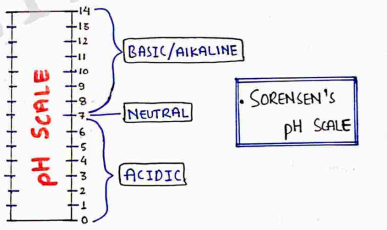
- The PH scale ranges from 0 to 14.
- The scale start with Zero PH indicates that the solution is strongly acidic, and end with 14 (fourteen) indicates that the solution is strongly alkaline (basic).
- The Central point pH in the scale is 7 Indicates that the solution is neutral (neither acidic nor basic).
Three Region
- (0 - below 7) Acidic
- (7) Neutral
- (Above 7 - 14) Basic/Alkaline
Determination of PH
The pH value is determine by following methods:
i) pH paper
ii) Electrometric method
iii) Calorimetric method
i) PH paper
- For routine work pH of a solution is determined by PH paper.
- Take One PH paper and dip into a Sample solution (which we have to determine the pH).
- Then compare the PH paper color (which change in sol$^n$) with standard color of PH paper in which pH number is written with color.
- Acc. to pH value we determined, that the solution is acidic or basic or neutral.
ii) Electrometric Method
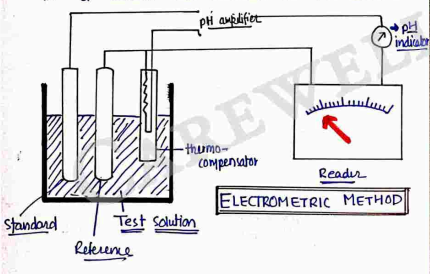
- Apparatus is know as PH meter.
- It consist a voltmeter which connected with two electrodes!
i) standard Electrode known as potential
ii) Special (probe) Electrode which enclosed in a glass membrane that allow migration of ions, and it contain reference solution of dilute HCl.
Working
- The Electrodes (both) are dipped in the solution to be tested.
- If the solution's pH differ from probe solution's pH, then probe passes electric signals to a meter that display the reading in pH units.
- A change in temp can cause an error in the pH reading. To prevent this, a temp. compensation resistance (thermocompensator) include in a circuit and immersed in the solution.
iii) Calorimetric Method
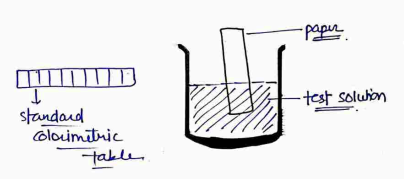
- Take a colorimetric paper and dip into sample solution (which we have to determine the pH).
- Then obtained color is computed with the standard table of colorimetric.
- Then pH value is obtained acc. to their color.
- Acc. to pH value we determined, that the solution is acidic or basic or neutral.
Buffer Solution
- The solution that are able to resist the change in pH value termed as buffer solution.
Types
i) Acidic → Acidic buffers are those buffer solution which is used in acidic solution.
Composition → Weak acid and its salts [weak acid + strong base]
eg. [$CH_3COOH + CH_3COONa$] Acetic acid and Sodium acetate
ii) Basic → Basic or Alkaline buffers are those which used in basic solution.
Composition → Weak base and its salts [weak base + strong acid]
eg. [$NH_4OH + NH_4Cl$]
Ammonium hydroxide and Ammonium chloride
- If Buffer solution is added in any solution, then it resist the change in pH of that solution, whether we add small amount of acid or alkali/base in that solution.
Applications of Buffers
i) Biochemical Assay → Enzyme activity depends on pH, so the pH during enzyme assay must stay constant (Buffer helps).
ii) Maintenance of Life → Most of the biochemical processes work within a relatively small pH range.
The body have its own buffer solution which maintain a constant pH. Eg Blood contain a bicarbonate buffers that keep the pH close to 7.4.
iii) Calibrate pH Meters → Buffer solutions is used to calibrate pH meter.
iv) Textile Industry → Buffer solution also used in textile industry.
Eg Many dyeing processes use buffer to maintain the correct pH for various dyes.
v) Food Industry → Buffers are used in food industry to maintain the acidity of food, and also for microbiological stability of food.
Buffer Equation
It is used to calculate the pH of a buffer solution and the change in pH with the addition of an acid/base.
Acidic Buffer (weak acid & its salts)
The pH of acidic buffer can be calculated from the dissociation constant ($K_a$) of the weak acid and the concentration of the acid and salt used.
- Dissociation of weak acid & salt expressed as
(weak acid)
(its salts)
Common ion effect
By applying law of mass action,
On Rearrange,
and and $$[H^+] = K_a \frac{[\text{Acid}]}{[\text{Salt}]}$$
This relationship is also called as Henderson-Hasselbalch Equation.
Basic Buffer (weak base and its salts)
In similar way Buffer equation for a basic buffer can be written as
Buffer Capacity
The amount of acid or base that must be added to the buffer to produce a unit change of pH.
It helps to know the effectiveness of a buffer on a quantitative basic.
Where, Buffer Capacity, Amount of Acid/Base, Change in pH.
Buffer in pharmaceutical and biological system
Pharmaceutical System
The buffer play an important role in pharmaceutical preparation to ensure pH condition for the medicinally active compound.
- Solubility of compounds : Solubility of compounds can be frequently controlled by providing a medium of suitable pH, and required pH is adjusted by buffers.
- Patient comfort : Injectable and preparations for internal or external use become irritating if their pH is different greatly from that normal. So, it is maintained by buffers.
- eg. Sorensen proposed mixture of salt of Sodium phosphate for pH 6 to 8.
- Mixture of (boric acid and monohydrate solution Sodium carbonate) buffers with pH 5 to 9.
Biological System
- Body fluids in biological system (body) are having balance quantity of acid or base (pH).
- The biochemical reaction that takes place in living system are very sensitive to even small change in pH (acidity or basicity).
- So, the maintenance of the normal pH range within the body fluids become essential.
- The pH value of some body fluids with their buffer system to maintain pH in body:
| Body fluids | pH value | Buffer system |
|---|---|---|
| • Blood | 7.4 - 7.5 | Bicarbonate |
| • Urine | 4.5 - 8.0 | Phosphate |
| • Interstitial fluids | 7.2 - 7.4 | Bicarbonate |
| • Intracellular fluids | 6.5 - 6.9 | Protein and Phosphate |
Buffered Isotonic Solution
Pharmaceutical buffer solution that are meant for applications of body should be adjusted to same osmotic pressure as that of the body fluids.
eg. Blood 0.9% w/v NaCl solution.Their are three types of solutions:-
i) Isotonic → A buffer solution have same osmotic pressure as body fluid (0.9% NaCl).
ii) Hypotonic → A buffer solution have less concentration of solute (osmotic pressure) than 0.9% NaCl.
iii) Hypertonic → A buffer solution have high concentration of solute (osmotic pressure) than 0.9% NaCl.
We have to make buffer isotonic solution, which have same osmotic pressure as body fluids or same conc of solute as 0.9% w/v NaCl.
Method to Determine Isotonicity
i) Cryoscopic method. (Colligative method).
ii) Hemolytic method.
i) Cryoscopic Method
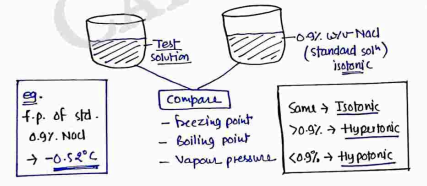
This method is depends upon colligative properties of solution such as their freezing point, Boiling point, vapour pressure and temp. difference.
- Take two solution, one standard isotonic solution (0.9% NaCl) and other is test solution (which we have to determine the isotonicity).
- Now compare their colligative properties with standard solution and determine the tonicity of solution.
ii) Hemolytic Method
The effect of various solution of the drug was observed on the appearance of red blood cells suspended in solution.
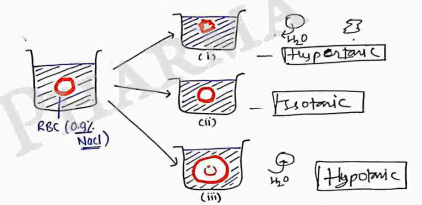
(Acc. to Osmosis, solvent particle move from low concentration to high concentration).
i) → conc of solution > conc of RBC (0.9%)
So, solvent ($H_2O$) move from low to high or RBC to solution, this cause cell shrinkage Hypertonic solution.
ii) → conc. of solution = conc of RBC (0.9%)
So, cell (RBC) remain same or constant. Isotonic solution.
iii) → conc of solution < conc. of RBC cell (0.9%) So, solvent ($H_2O$) move/diffuse from solution to RBC cells, this cause cell swelling.
Hypotonic solution.
Method of adjusting tonicity
i) Class Ist
ii) Class IInd
i). Class I
a) Cryoscopic method (freezing point depression method).
b) Sodium Chloride Equivalent. (E).
a) Cryoscopic Method → This method is used for hypotonic solution. Conc of solution is less than 0.9% NaCl.
Sodium chloride is added to solution to make it isotonic.
where,
amount of adjusting substance
freezing point of 1% solution of unadjusted sol$^n$
freezing point of 1% solution of adjusting sol$^n$
b) Sodium Chloride Equivalent (E) → Used for hypotonic solution and add Sodium chloride in solution to make it isotonic.
where,
Sodium chloride equivalent or amount of NaCl required
value
Molecular weight of drug.
ii) Class-II This method is used for hypertonic solution. Add water in solution to make it isotonic.
a) White-vincent Method →
where,
volume of water added in solution to make it isotonic.
weight of drug in gram.
Equivalent weight of drug (Sodium Chloride Equivalent).
b) Sprowls Method → Simplification of white and vincent method. Here weight of drug (w) is set to constant value of 0.3.