Physical Pharmaceutics 1 - Unit 4
Syllabus
Complexation and protein binding:
Introduction, Classification of Complexation, Applications, methods of analysis, protein binding, Complexation and drug action, crystalline structures of complexes and thermodynamic treatment of stability constants.
Scroll to Download
PHYSICAL PHARMACEUTICS-I UNIT 4
COMPLEXATION AND PROTEIN BINDING
Complexation
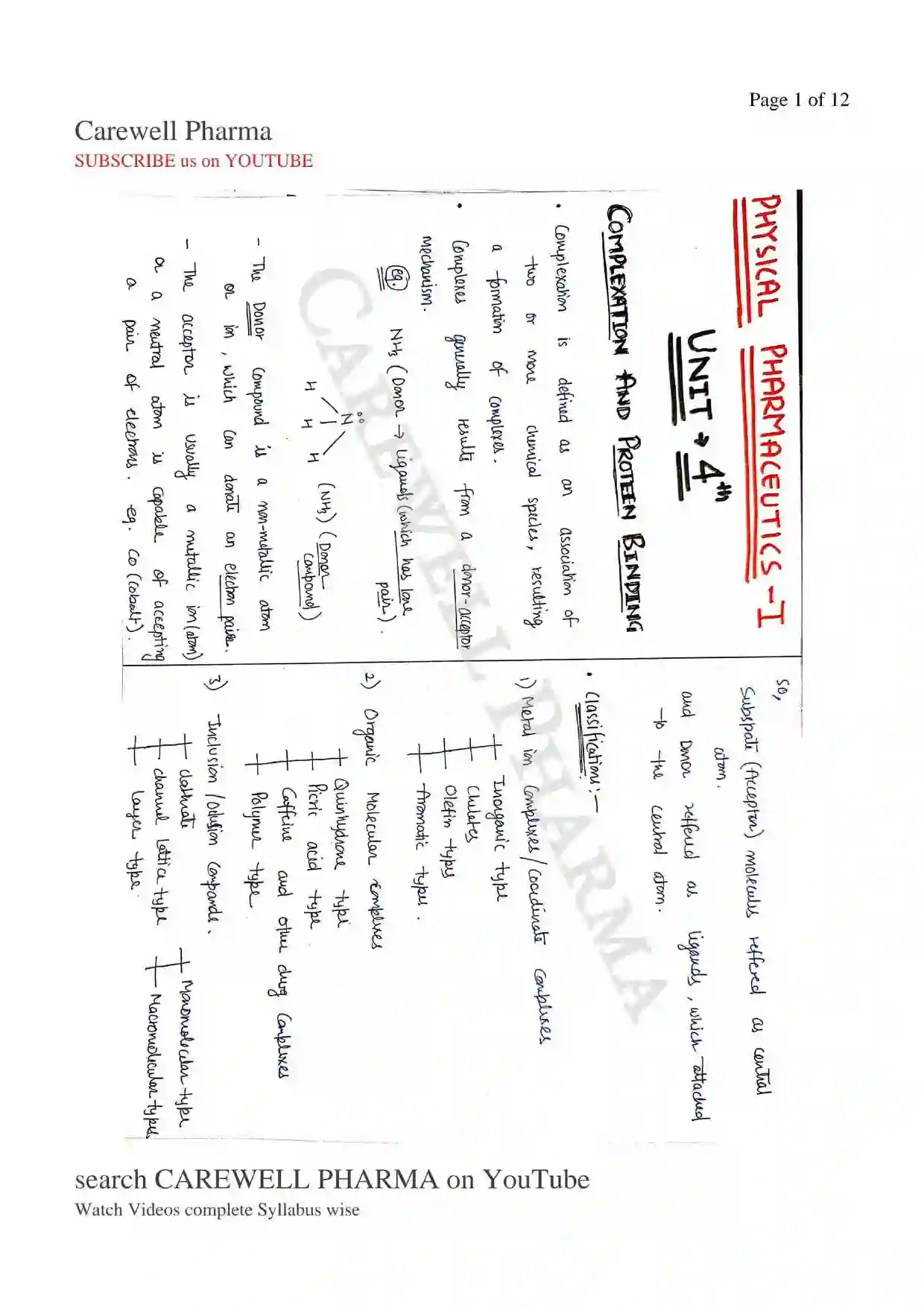
- Complexation is defined as an association of two or more chemical species, resulting a formation of complexes.
- Complexes generally results from a donor-acceptor Mechanism.

- The donor compound is a non-metalic atom or ion, which can donate an electron pair.
- The acceptor is usually a metallic ion (atom) or a neutral atom is capable of acepting a pair or electrons.
Eg. Co (Cobalt)
So,
Substrate (Acceptor) molecules reffered as central atom.
And donor reffered as ligands, which attached to the central atom.
Classifications
- Metal ion Complexes / coordinate complexes
- Inorganic type
- Chelates
- Olefin type
- Aromatic type.
- Organic Molecular complexes
- Quinhydrone type
- Picric acid type
- Caffeine and other drug Complexes
- Polymer type
- Inclusion / occlusion Compounds.
- Clathrates
- Channel Lattice type
- Layer type
- Monomolecular type
- Macromolecular types.
- Donor (Ligands) : Which has lone pair and attached with central atom.
Types of Ligands
i) Monodentate → Which provide only one centre for attachement to the central atom.

ii) Bidentate Ligand → Those ligands which provide two centre for attachement to the central metal ion (atom).

iii) Polydentate Ligand → Those ligand which provide two or more than two centre for attachement to the central atom. (Hexadentate)

Applications of Complexation
i) Physical State → To convert liquid substances to solid complexes and improve its processing characteristics.
ii) Stability of Drugs → Stability of drugs can be enhanced by complexation.
iii) Solubility → Enhancement of solubility by using solid complexes.
iv) Dissolution → Complexation enhances the solubility, thus enhancing the dissolution of drugs.
v) Absorption & Bioavailibility → Complexation helps in increasing the absorption and bioavailability of drug in the body.
vi) Antidote for Metal Poising → Also reduced toxicity of poisons, by making complex with metal poison. So, work as antidote.
1) Metal ion Complexes / Coordinate Complex
In this type, metal ion Constitutes as Central atom and interacts with ligands.
i) Inorganic Complexes → In this complexe, ligand are inorganic in nature, which attached with metal atom.
eg. Ligands (all are inorganic) , , etc.

- Valencies
Primary valencies (1°) → Ionic bond
Secondary valencies (2°) → Coordinate bond
Total no. of ligands attached to central atom.
Coordination number → Maximum number of atom binding to the central atom.
ii) Chelates
A substances containing two or more donor group may combine with a metal ion to form a complex known as chelates.

- Bonds involes may be → ionic, primary covalent type or coordinate covalent types.
- Depending on ligands group, it may be bidentate, tridentate, hexadentate or polydentate.
- When metal atom (central) attached with these ligands, it form cyclic structure (closed). eg EDTA, ethylenediamine etc--
iii) Olefin Complex → Aqueous solution of certain metal ion such as platinum, iron, palladium, silver etc. can absorb olefins such as ethylene to yield water soluble complexes. eg. Silver-Olefin Complexes

iv) Aromatic Complexes
They are formed by interaction of metal ions as acceptors with aromatic molecules such as benzene, toluene & xylene.
- bond
- bond
- Sandwich compound

- Sigma-bond complex of toluene with HCl-AlCH_3
- Sandwich Compound → Sandwich compounds are relatively stable complexes involving a delocalized covalent bond between the d-orbital of a transition metal and a molecular orbital of aromatic ring.

ii) Organic Molecular Complexes → Organic molecular complexes, also known as addition complexes are formed by the union of two organic molecules held together by electrostatic forces, ionic, covalent and also by hydrogen bonded complexes.
- Charge Transfer Complexes
These complexes are generally formed by sharing of $\pi$-electrons. In these types of complexation one of the constituent molecules of the complex polarizes the other resulting in a type of ionic interaction or charge transfer.

(charge-transfer complex between benzene and tri-nitro benzene)
- Quinhydrone Complex (Types) → The molecular complex of this type is obtained by mixing alcoholic solutions of equimolar quantities of benzoquinone and hydroquinone.

Picric Acid Complexes → Picric acid (2,4,6-trinitrophenol), being a strong acids, forms organic molecular complexes with weak bases.
Example → Butesin Picrate


- Caffeine and Other Drug Molecules → Caffeine forms complexes with a number of drugs such as benzocaine, tetracaine & procaine and this enhances the stability and appearance of pharmaceuticals preparation of these drugs.

- It involves dipole-dipole forces/hydrogen bonding.
- Polymer Type Complex → Many pharmaceutical additives such as polyethylene glycols (PEG), polystyrene, Carboxymethyl cellulose (CMC) etc... can form complexes with a large number of drugs.
example → dipole-dipole forces/hydrogen bonding.
iii) Inclusion Complex / Occlusion Compounds → In these complexes, one of the components entrapped (trapped) in the open lattice or cage-like crystal structure of the other.
- These component is know as Guest molecules and open lattice and cage like structure is know as host molecules in which guest molecule trapped.
- No involvement of any type of bond, so also called no-bond complexes.
- Clathrates → Clathrates are Inclusion compounds in which molecules of guest compound get entrapped within the cage like structure formed by association of several molecules of host compounds.

- Channel Lattice Type → Channels are formed by crystallization of the host molecules in which the guest molecules can fit, the guest component is usually limited to long, unbranched straight chain compounds.

- Layer Type → In this type, Guest molecules is diffused between the layers of carbon atom, hexagonally oriented to form alternate layers of guest and host molecules.
eg : clays, montmorillonite

- Monomolecular Complexes → In this complexes, A single guest molecules is entrapped in the cavity of host molecules.
eg most commonly used (employed) are Cyclodextrin.

- Macromolecular Complexes → In this complexes, more than one guest molecules is entrapped in the cavity of host molecules. eg. Cyclodextrin as a host molecules.

Methods of Analysis of Complexation
After Complexation process, we have to know whether the complex is made or not?
for this, we use following methods
i) Method of continuous variation
ii) Distribution Method
iii) Solubility Method
iv) pH titration method
i) Method of Continuous Variation → We know than, when two or more species associated, they formed a complex and due to formation of complex their physical properties changed such as Dielectric constant, refractive index etc..
No Complex formed Physical properties are additives (same as A & B) Complex formed (complexation) Physical properties are differ than A & B
ii) Distribution Method → In distribution method, we find out partition coefficient (distribution coefficient). $K = \frac{\text{X in Oil}}{\text{X in water}}$
Now If, in distribution method complex formed then its solubility increase in oil/water or due to it, its partition coefficient's value change.
Let, when complex is not formed Iodine ($I_2$) in 30 ml & 30 ml water for this, Let Partition coefficient ($K$) = a.
when complex is formed/not formed (check). Iodine ($I_2$) in 30 ml & 30 ml KI for this, Let Partition coefficient ($K$) = b
- If complex is formed in that condition, then a b
- If complex is not formed in condition, then a = b
iii) Solubility Method
In this method, the complex formation is based on the solubility of the components in presence of a complexing agent.
eg. Complexation of PABA (para-amino benzoic acid) by Caffeine.

PABA + Caffeine PABA-Caffeine Complex
If,
K (constant) value increase Complexation
K (constant) value decrease Complexation
iv) pH Titration Method
When complex formed (complexation happened) then also its pH change.
So, firstly we check pH before complexation, then after complexation if the value of pH change means complex formed and if pH not change means complex not formed.
ex chelation of cupric ion by glycine

Protein binding, Complexation and drug action, Crystalline structure of complexes and thermodynamic treatment of Stability constants.
Protein Binding
The phenomena of complex formation of drug with protein is called as protein drug binding (protein binding).

The Proteins which involves in this complexation are: - (Blood protein)
- Albumin (mostly drug attached with albumin)
- $\alpha$-acid glycoprotein
- Lipoprotein
- Globulins
- These proteins are present in blood plasma protein. also their are at some drug which bind with protein of blood cells & protein of extravascular tissue.
- But in maximum cases, drug bind with blood protein.
Mechanism of Protein Binding
i) Reversible → In this type of protein binding, the drug is bind with the protein with very weak forces like hydrogen bonding, weak vander waal's forces of attraction.
- So, they can easily release the drug and drug becomes free, and it binds with the receptor.
- It is responsible for the pharmacological action of the drug.
ii) Irreversible → In this type of protein binding, the drug bind with the protein with strong bond like covalent bond.
- Drug after binding with protein cannot release and drug do not become free so they not give any pharmacological action.
Complexation and Drug Action
- Complexes can alter the pharmacological activity of the agents by inhibiting interaction with receptor.
- Protein binding complex also affect absorption. Metabolism and drug action by interfering with receptor site of action. (inactivate the drug)
- The action of drug to remove toxic metals from human bodies is through complexation reaction.
- In some cases, complexation also lead to poor solubility or decreases absorption of the drugs in the body.
- The irreversible protein binding also inhibit the drug of action by not release the drugs from protein.
example - Complexation of drug in the GIT fluids may alter rate and extent of drug absorption.
Crystalline Structure of Complexes
- A crystalline structure is any structure of ions, molecules, or atoms that are held together in an ordered, three-dimensional arrangement.

Complex compounds cover the range from quite simple inorganic salts to elaborate metal organic hybrid materials.
Their present applications and their potential Uses are diverse due to their Composition, molecular and Crystalline structure and their physical and chemical properties.
Thermodynamic Treatment of Stability Constants
The stability constants of the metal complexes are related to thermodynamic product properties Such as free energy ($\Delta G$), enthalpy ($\Delta H$) and entropy change ($\Delta S$).
where,
standard entropy
Gibbs free energy
Enthalpy
Temperature
- If -ve, then Rate of complexation increases.
and if, Rate of Complexation increases, then stability constant increases.
( -ve Rate of Complexation Stability constant $\uparrow$)
- If +ve, then Rate of complexation decreases, then stability constant decreases.
( +ve Rate of complexation Stability constant $\downarrow$)
- If Temperature -ve
- Temperature +ve
Stability Constant → It is an equilibrium constant for the formation of a complex in solution.
- It is the measure of the strength of the interaction between the reagent that come together to form the complex.