Pharmaceutical Organic Chemistry 2 - Unit 5
Syllabus
Cyclo alkanes*
Stabilities - Baeyer’s strain theory, limitation of Baeyer’s strain theory, Coulson and Moffitt’s modification, Sachse Mohr’s theory (Theory of strainless rings), reactions of cyclopropane and cyclobutane only
Scroll to Download
POC-2 UNIT-5
CYCLOALKANES
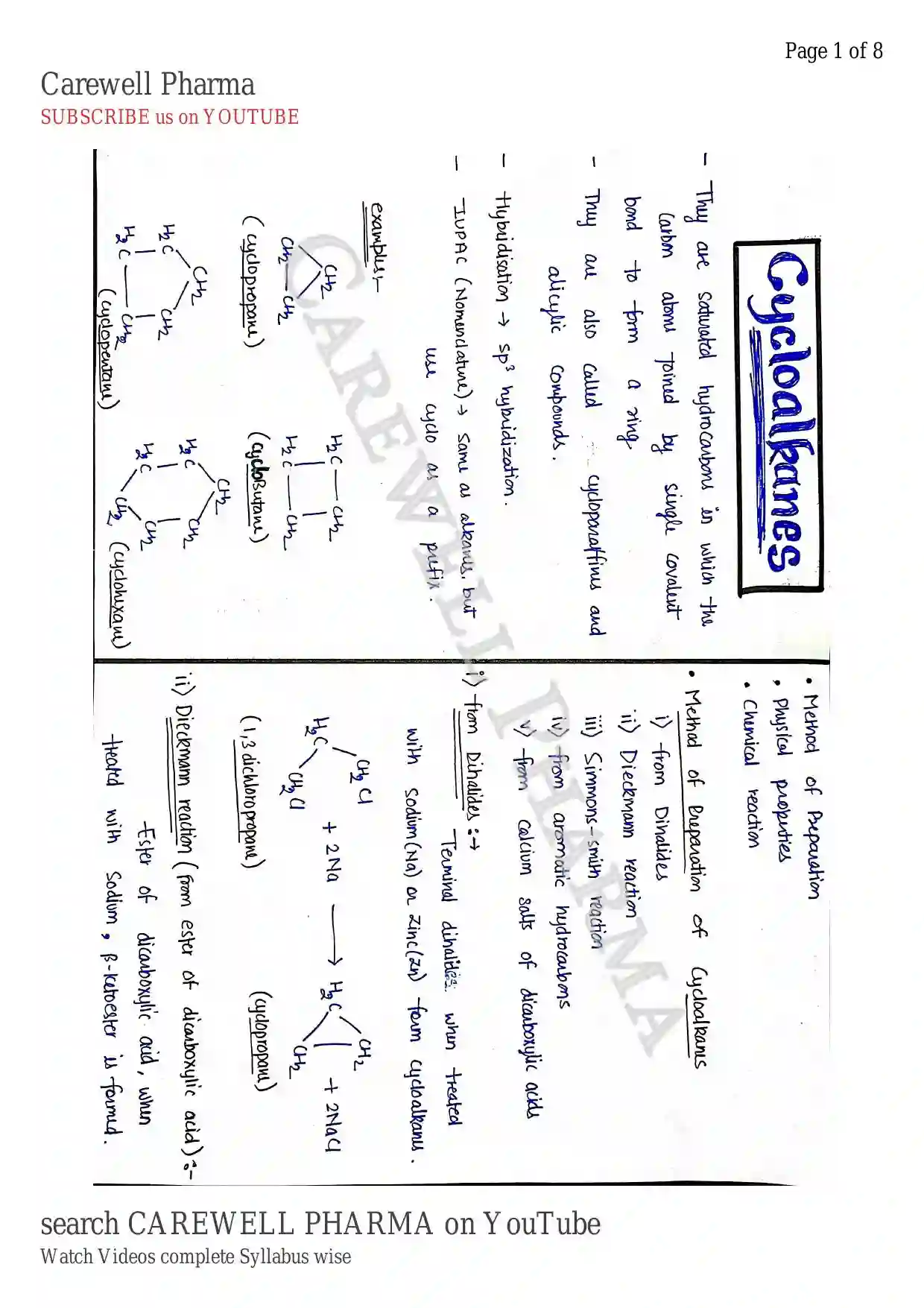
- They are saturated hydrocarbons in which the carbon atoms joined by single covalent bond to form a ring.
- They are also called cycloparaffines and alicyclic compounds.
- Hybridisation → hybridization.
- IUPAC (Nomenclature) → Same as alkanes, but use cyclo as a prefix.

- Method of Preparation
- Physical properties
- Chemical reaction
Method of Preparation of Cycloalkanes
i) From Dihalides
ii) Dieckmann Reaction
iii) Simmons-smith Reaction
iv) From Aromatic Hydrocarbons
v) From Calcium Salts of Dicarboxylic Acids
i) From Dihalides
Terminal dihalides when treated with Sodium (Na) or Zinc (Zn) form cycloalkanes.

ii) Dieckmann Reaction (from ester of dicarboxylic acid)
Ester of dicarboxylic acid, when treated with Sodium, $\beta$-ketoester is formed. Which further on hydrolysis give cyclic ketones, which on clemmensen reduction give Cycloalkanes.

iii) Simmons-Smith Reaction (From Alkenes)
When alkene are treated with Methylene Iodide ($CH_2I_2$) in the presence of a zinc-copper ($Zn-Cu$) couple, cyclopropane derivatives are formed.

iv) From Aromatic Hydrocarbons
Six membered cycloalkanes can be prepared by the Catalytic reduction of benzene and its derivatives.

v) From Calcium Salts of Dicarboxylic Acids
When the calcium or barium salts of dicarboxylic acid are heated, cyclic ketones are formed, then further on clemmensen reduction cyclic ketones converts into cycloalkanes.

Physical Properties of Cycloalkanes
- Cyclopropane and cyclobutane are gases at room temp, remaining are liquids.
- Cycloalkanes are insoluble in water but dissolve in ethanol and ether.
- Melting and boiling points of cycloalkanes shows a gradual increase with the increase in molecular weight.
| B.P°C | M.P°C | |
|---|---|---|
| • Cyclopropane | -32.8 | -127.4 |
| • Cyclobutane | 12.5 | -90.7 |
| • Cyclopentane | 49.3 | -13.9 |
Chemical Reaction of Cycloalkanes
Cycloalkanes gives two reactions
i) Substitution Reaction
ii) Addition reaction (ring opening reaction)
i) Substitution Reaction
In this reaction, one hydrogen atom replaced, but ring does not affected.
Substitute with &
- When cycloalkanes react with chlorine or bromine in the presence of UV light, it gives Substitute products.

- When cyclopropane react with chlorine in the presence of uv light, it gives chlorocyclopropane.

- When cyclohexane react with chlorine in the presence of UV light, it gives chlorocyclohexane.
ii) Addition Reaction (Ring Opening Reaction)
In this reactions, bond break and the ring will open. Higher cycloalkanes does not give the reactions.
Addition of 
• When cyclopropane react with in the presence of Ni (Nickel) at it give propane.
Addition of &

- When cyclopropane react with bromine ($Br_2$) in the dark to give 1,3-dibromopropane ($CCl_4$ used as solvents).
iii) Oxidation
- Cycloalkanes undergoes oxidation in the alkaline presence of potassium permagnate ($KMnO_4$) to form dicarboxylic acid.

Cycloalkanes
Stabilities Baeyer's strain theory, Limitation of Baeyer's strain theory
Baeyer's Strain theory
- Adolf Baeyer proposed in 1885, and he get noble prize for this theory in 1905.
- He explain the relative stability of starting few cycloalkanes.
- His theory is based on the fact that, the normal angle between pair of carbon atom is .
- Now, He assumed that all cycloalkanes are planar.
- Stability of cycloalkanes depends upon angle strain.
Angle strain = Stability
In cycloalkanes the more angle strain, the more unstable.
Angle Strain = [Desired angle - Actual angle] $\rightarrow$ desired angle =
i) Cyclopropane → Actual angle = Angle strain =
ii) Cyclobutane → A.S. = ($1^\circ = 60'$)
iii) Cyclopentane

- A.S. =
iv) Cyclohexane

- A.S. =
| Compound Structure | Desired angle | Actual angle | Angle strain |
|---|---|---|---|
| Cyclopropane | |||
| Cyclobutane | |||
| Cyclopentane | |||
| Cyclohexane |
Limitations
- This theory only applies on the lower cycloalkanes.
- Baeyer was not able to explain the effect of angle strain in larger ring systems.
- Acc. to Baeyer cyclopentane should be much stable than cyclohexane, but practically it is reversed. (cyclohexane is more stable than cyclopentane.)
- So, Higher cycloalkanes do not follow this rule (cyclohexane, cycloheptane are more stable). they do not give ring opening reaction easily like cyclopropane.
Coulson and Moffitt's Modification
- Bent Bond / -Banana bond theory.
- Concept of maximum overlap of carbon orbitals.
- It is also called as banana bond theory, because bond is look like as banana shape.
- This theory also explain the stability of cycloalkanes (why cyclopropane most unstable).
- It is fact based on that, Greater the overlapping of atomic orbital stronger is the bond.
- Stronger is the bond = Stability

- But in cyclopropane bent bond is formed, which is intermediate between sigma & pi-bond. (stronger from pi but weaker than sigma)

- Due to formation of bent bond, the cyclopropane C-C bond weaker than normal C-C sigma bond.
- So, due to weaker bond cyclopropane is unstable and it can give ring opening reaction easily.
- In cyclopropane, C-C-C bond angle is decreased slightly from to .
- This decrease in overlap results in weakening of the bond and this for partially explain the instability of cyclopropane.
- Bent bond is formed in cyclopropane, due to their less angle ($60^\circ$) than .
- Cyclobutane is more stable than cyclopropane but less than cyclopentane.
Sachse-Mohr Theory (Theory of Strainless Rings)
- Sachse & Mohr proposed this theory in 1918 to explain about the stability of cyclohexane and higher cycloalkanes.
- Acc. to Baeyer's Members higher than cyclopentane should be increasingly unstable (limitation).
- But. Acc. to Sachse-Mohr theory. Cycloalkanes are not in a plane (co-planar).
- Sachse Mohr's theory proposed that higher member ring can free from strain if all the ring carbon are not forced into one plane. They exhibit in two non-planar 'folded' or 'puckered' conformation both of which are completely free from strain.
- These are strainless as the carbon atom lie in different planes and the normal angle ($109^\circ 28'$) is retained.
Examples
CYCLOHEXANE

- Chair form is more stable than boat form.
- (chair form two type positions of the H)
- Axial position (perpendicular to the plane of ring).
- Equatorial position (around the plane of the ring).