Pharmaceutical Organic Chemistry 2 - Unit 4
Syllabus
Polynuclear hydrocarbons:
- Synthesis, reactions
- Structure and medicinal uses of Naphthalene, Phenanthrene, Anthracene, Diphenylmethane, Triphenylmethane and their derivatives
Scroll to Download
POC-IInd UNIT-4th
POLYNUCLEAR HYDROCARBONS
- Synthesis, Reactions, Structure and Medicinal use of Naphthalene, Phenanthracene, Anthracene, Diphenylmethane, Triphenylmethane and their derivatives.
- Polynuclear Hydrocarbons
Polynuclear hydrocarbons Poly + Nuclear (Multiple aromatic rings) + Hydro + Carbons (Carbon + Hydrogen)
- Polynuclear hydrocarbons ( Polynuclear aromatic hydrocarbons) are organic compound which contain only hydrogen and carbon, which further composed in the form of multiple aromatic rings.
Eg. Naphthalene, Anthracene, Phenanthracene etc.
1) Naphthalene
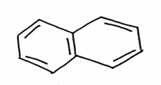
Structure of Naphthalene
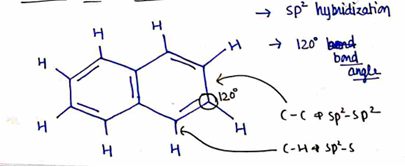
- A common shorthand representation of naphthalene
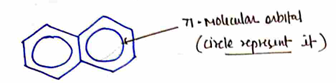
- According to the resonance theory, naphthalene is considered to be a hybrid of the three form.
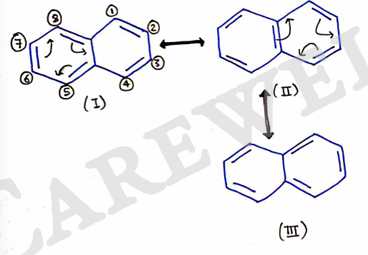
- But in naphthalene, bond length between C-C is different at different position, generally & .
- Naphthalene is less aromatic (more reactive) than benzene.
Synthesis (Method of Preperation)
1) From Petroleum → When petroleum fraction are passed over copper ($Cu$) catalyst at , naphthalene & methylnaphthalenes are formed.
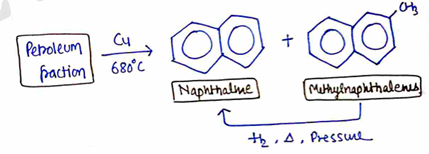
- After this, methylnaphthalenes are separated and further converted into naphthalene by heating with hydrogen under pressure. (This rxn called dealkylation).
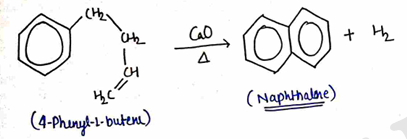
2) From 4-phenyl-1-Butene → When 4-Phenyl-1-butene is passed over red hot calcium oxide, naphthalene is obtained.
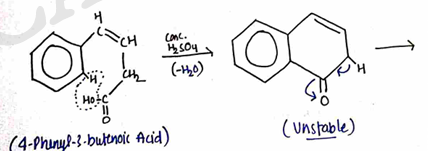
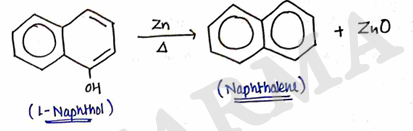
3) From 4-Phenyl-3-Butenoic Acid → When 4-Phenyl-3-butenoic acid is heated with concentrated sulfuric acid ($H_2SO_4$), 1-naphthol is formed, this on distillation with zinc dust give naphthalene.
4) By Haworth Synthesis → This reaction contain five steps
- STEP-1st → (Friedal-craft acylation)
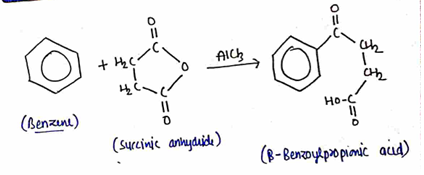
- Benzene and succinic anhydride are heated in the presence of aluminium chloride to form $\beta$-benzoylpropionic acid.
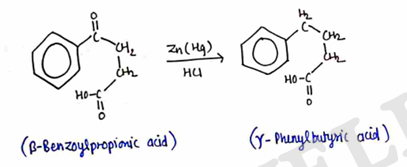
- STEP-2nd → (Clemmensen Reduction)
- $\beta$-Benzoylpropionic acid is treated with amalgamated zinc in the presence of hydrochloric acid ($HCl$) to give $\gamma$-phenylbutyric acid. $\beta$-Benzoylpropionic acid $\gamma$-phenylbutyric acid
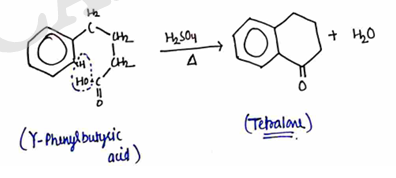
- STEP-3rd → (Ring closure reaction)
- \gamma$-phenylbutyric acid is heated with conc. $H_2SO_4 or polyphosphoric acid to form $\alpha$-tetralone.
- STEP-4th (Clemmensen reduction)
- $\alpha$-Tetralone is heated with amalgamated zinc and hydrochloric acid to give tetralin.
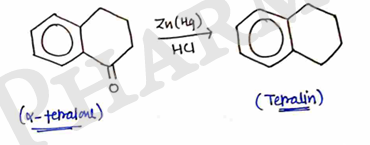
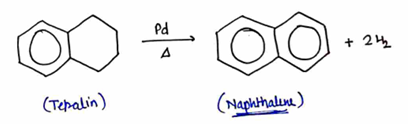
- STEP-5th (Aromatization reaction)
- Tetralin is heated with palladium to yield naphthalene.
Physical Properties of Naphthalene
- It is a colorless crystalline solid.
- Melting point & Boiling point
- Insoluble in water, but soluble in ether, benzene, and hot ethanol.
- It has a characteristics 'moth ball' odor.
Reactions of Naphthalene
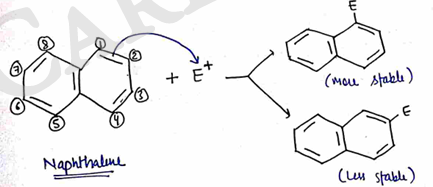
- Naphthalene also give electrophilic substitution reaction.
- On reaction attach on different structure and make different structure.
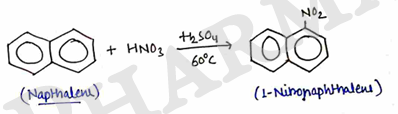
i) Nitration → Naphthalene undergoes nitration with concentrated nitric acid in the presence of sulfuric acid at to produce 1-nitro naphthalene.
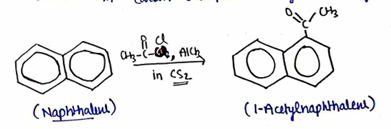
ii) Friedal-Craft Acylation → Naphthalene undergoes acylation with acetyl chloride and aluminium chloride in carbon disulfide to give 1-acetyl-naphthalene.
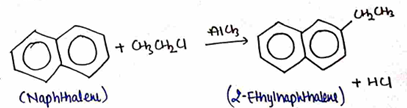
iii) Friedal-Craft Alkylation → Naphthalene undergoes alkylation with alkyl halides in the presence of aluminium chloride to give 2-alkyl naphthalene (methyl halides do not react).
Some Other Reactions
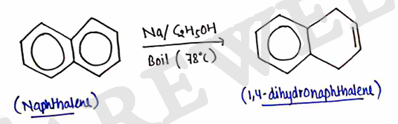
iv) Reduction→ Naphthalene undergoes reduction more readily than benzene, when it react with sodium and ethyl alcohol (bp $78^\circ C$) it gives 1,4-dialin (1,4-dihydronaphthalene).
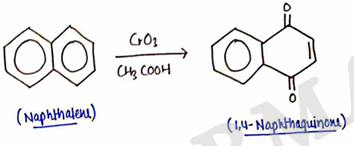
v) Oxidation → Naphthalene is much more easily oxidized than benzene, when it react with chromium trioxide in acetic acid at room temp., it gives 1,4-naphthaquinone.
Medicinal Use of Naphthalene
- Naphthalene is used in manufacture of 'moth balls' to protect wooden goods, recently p-dichlorobenzene replaced it due to its less obnoxious odor.
- Used in manufacture of phthalic anhydride, carbaryl for Insecticides.
- Also used in dyes and several medicinal products.
Derivatives
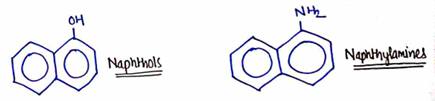
- The hydroxy derivatives of naphthalene. Naphthols
- The amino derivatives of naphthalene. Naphthylamines
2) Anthracene
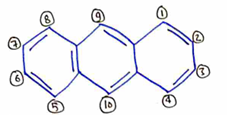
Structure of Anthracene
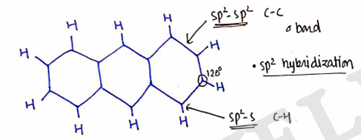
It has hybridization, and the hybrid orbitals overlap with each other and with orbital of the ten hydrogen atom forming and bonds.
A common shorthand representation of anthracene.
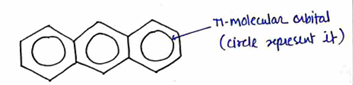
- According to the resonance theory, anthracene is considered to be a hybrid of the following four canonical form.
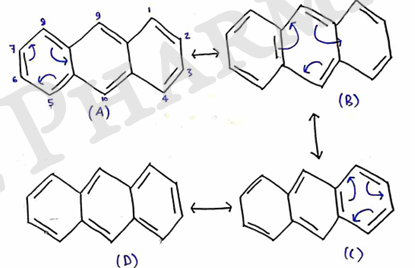
- There are different bond length between carbon-carbon bond.
- Resonance energy of anthracene is . (average per ring), which is lower than benzene ($36 \text{ kcal/mole}$).
- So, Anthracene is much less aromatic than benzene.
Synthesis (Method of Preparation)
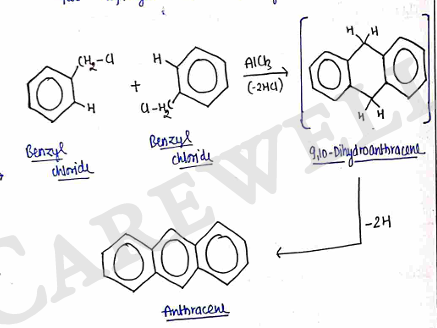
i) By Friedal-Crafts Reaction → Benzene chloride reacts with itself to form 9,10-dihydroanthracene, which readily loses two hydrogen atoms to yield anthracene.
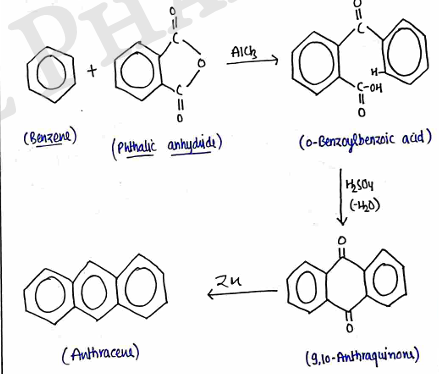
ii) By Haworth Synthesis → This involves the treatement of benzene with phthalic anhydride in the presence of aluminium chloride to form o-benzoylbenzoic acid. Then o-benzoylbenzoic acid heated with concentrated sulfuric acid ($H_2SO_4$) to give 9,10-anthraquinone. Now, distillation of the anthraquinone with zinc dust yield anthracene.
iii) By Elbs Reaction → The conversion of a diaryl ketones containing a methyl or methylene group to the carbonyl function is known as the Elbs Reaction.
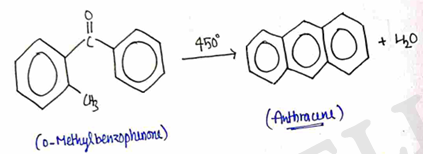
Eg. When o-methylbenzophenone is heated at , anthracene is formed.
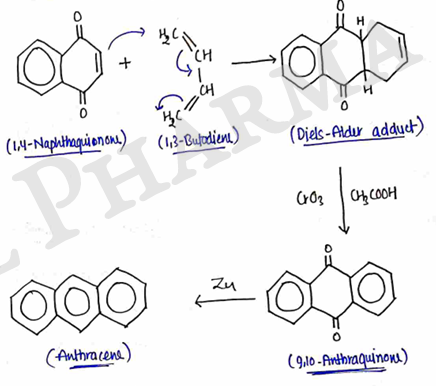
iv) By Diels-Alder Reaction → This involves the reaction of 1,4-naphthaquinone with 1,3-butadiene. The product (Diels-Alder adduct) of this reaction is oxidized with chromium trioxide in glacial acetic acid to form 9,10-anthraquinone. Now, Distillation of the anthraquinone with zinc dust yields anthracene.
Physical Properties of Anthracene
- It is colorless solid.
- Melting point , Boiling point .
- Insoluble in water and dissolve in benzene.
Reactions of Anthracene
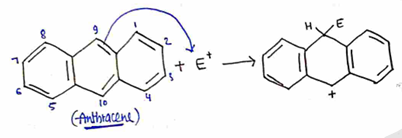
It also give electrophilic substitution reaction. These reactions preferentially occurs at the C-9 and C-10 positions.
i) Nitration
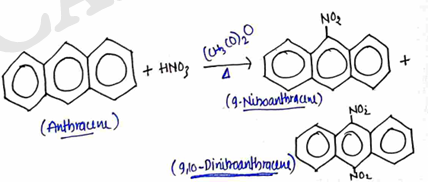
Anthracene react with concentrated nitric acid in acetic anhydride ($H_2SO_4$ not used here) at room temperature to yield a mixture of 9-nitroanthracene and 9,10-dinitroanthracene.
ii) Friedal-Crafts Acylation
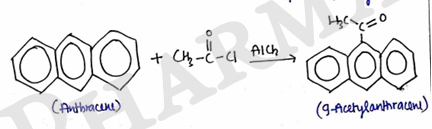
Anthracene undergoes acylation with acetyl chloride and aluminium chloride to form 9-acetylanthracene.
Some Other Reactions
iii) Reduction
Anthracene undergoes reduction with sodium and ethyl alcohol to form 9,10-dihydroanthracene.
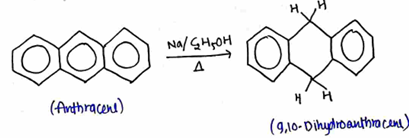
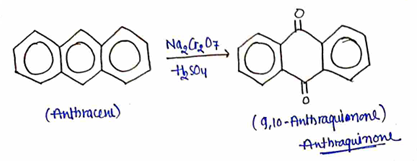
iv) Oxidation
Anthracene undergoes oxidation with sodium dichromate and sulfuric acid to form 9,10-anthraquinone.
v) Diels-Alder Reaction
Anthracene undergoes a Diels-Alder reaction with maleic anhydride to yield the corresponding adduct.
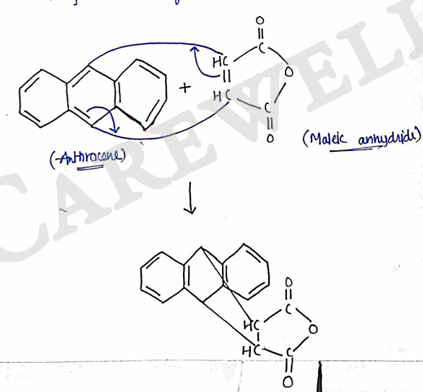
Uses of Anthracene
- Anthracene is used in the manufacture of anthraquinone.
- Anthraquinone is used in the manufacture of alizarin and several other dyes.
- Used as a preservative in wood and used as an insecticide for crops.
- Used in some drugs, Purgative drugs - Senna, Rhubarb, Cascara. Dithrol - Antifungal.
- Anthraquinone are also used as anticancer agent.
Derivatives of Anthracene
- Most important derivative of anthracene is anthraquinone (9,10-anthraquinone), which is prepared by Oxidation of anthracene.
- Uses are written above
3) Phenanthrene
PHENANTHRENE
- Phenanthrene is an isomer of anthracene. It may be obtained, along with anthracene, from the green oil fraction of coal-tar.
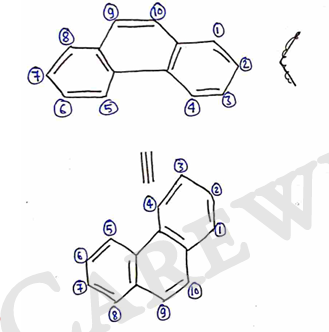
STRUCTURE OF PHENANTHRENE
- It is also a planar molecules like anthrance and phenanthrene
- All fourteen carbon atoms are hybridized.
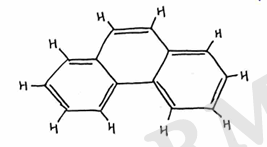
- The orbitals overlap with each other and with s-orbital of ten hydrogen atom to form C-C and C-H bonds.
- Each carbon atom also possesses a p orbital, and overlap of these p orbital produce a molecular orbital.
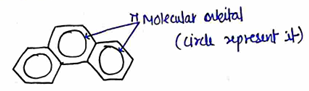
According to resonance theory, phenanthrene is considered to be a hybrid of the following five resonance form:
(The resonance energy of phenanthrene is .)All these (Anthracene, naphthalene, phenanthracene) are aromatic and follow huckle rule.
SYNTHESIS OF PHENANTHRENE
- It is obtained by Haworth Synthesis:
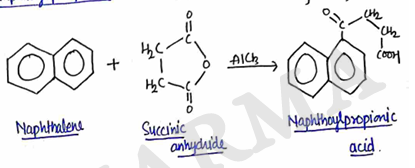
1) This involves the treatement of naphthalene with succinic anhydride in the presence of aluminium chloride to form Naphthoylpropionic acid. (Friedal craft acylation).
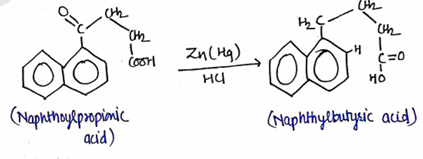
2) Then, Naphthoylpropionic acid treated with amalgated zinc in the presence of hydrochloric acid ($HCl$) (Clemmensen reduction) to give Naphthylbutyric acid.
3) Now, Naphthylbutyric acid heated with to give 1-keto-1,2,3,4-tetrahydrophenanthrene (Ring closure rxn).
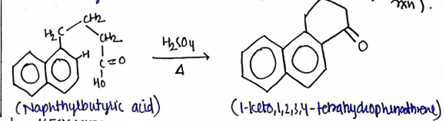
4) 1-keto-1,2,3,4-tetrahydrophenanthrene is treated with amalgated zinc in the presence of to give 1,2,3,4-Tetrahydrophenanthrene. (Clemmensen reduction)
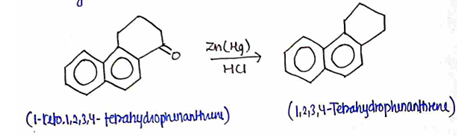
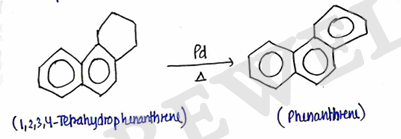
5) Now, 1,2,3,4-Tetrahydrophenanthrene heated with palladium ($Pd$) to yield phenanthrene.
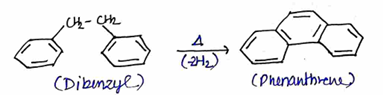
From Dibenzyl
- Phenanthrene can be obtained by passing dibenzyl through a red hot tube.
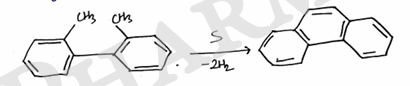
- From 2,2 Dimethyl-Diphenyl
- Phenanthrene can also be obtained by cyclodehydrogenation of 2,2 dimethyl-diphenyl using sulphur.
PHYSICAL PROPERTIES OF PHENANTHRENE
- It is a colorless solid.
- Melting point .
- It is insoluble in water, but dissolve readily in ethanol, benzene and ether.
REACTIONS OF PHENANTHRENE
- It undergoes oxidation, reduction, addition and electrophilic substitution reaction.
- As with anthracene, these reactions preferentially occur at the C-9 & C-10 position.
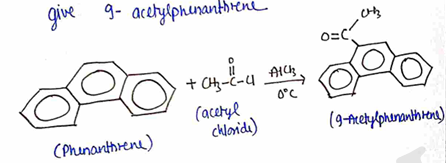
i) Friedal Craft Acylation → Phenanthrene undergoes acylation with acetyl chloride in the presence of aluminium chloride at to give 9-acetylphenanthrene.
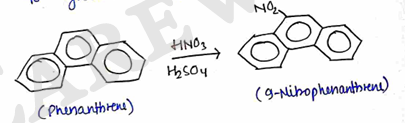
ii) Nitration → Phenanthrene undergoes nitration with concentrated nitric acid and sulfuric acid to yield 9-nitrophenanthrene.
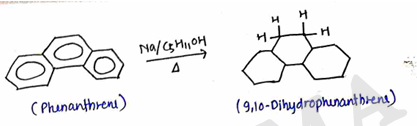
iii) Reduction → Phenanthrene undergoes reduction with sodium and isopentanol to form 9,10-dihydrophenanthrene.
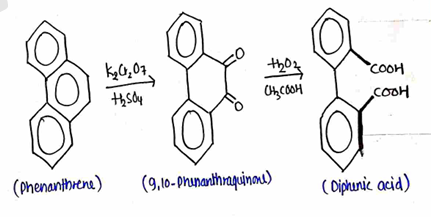
iv) Oxidation → Phenanthrene undergoes oxidation with potassium dichromate and sulfuric acid in acetic acid to form 9,10-phenanthraquinone. Further oxidation of this with hydrogen peroxide in acetic acid give diphenic acid.
Uses of Phenanthrene
- It is used to make dyes, plastic and pesticides, also used in explosives and drugs.
- Also used to make bile acids, cholesterol & steroids.
4) DIPHENYL METHANE
SYNTHESIS (Method of preparation)
i) Friedal-Craft's Reaction
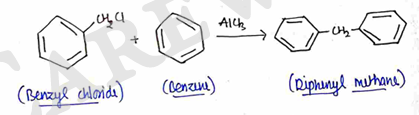
- Diphenyl methane is prepared by Friedal-craft's condensation between benzyl chloride and benzene.
ii) From Benzene
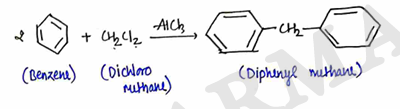
- Diphenyl methane is also prepared from two moles of benzene and dichloromethane in the presence of aluminium chloride. (Friedal-craft's condensation).
iii) From Benzophenone
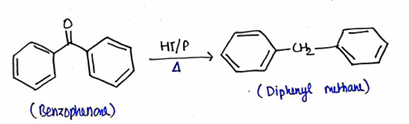
- Diphenyl methane is prepared from benzophenone, which is reduced in the presence of red hot phosphorus and hydroiodic acid.
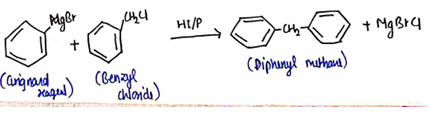
iv) From Grignard Reagent
- Diphenyl methane is prepared by Grignard reagent.
REACTIONS
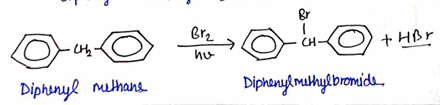
i) Halogenation → Diphenyl methane in the presence of bromine and UV light gives diphenyl methyl bromide.
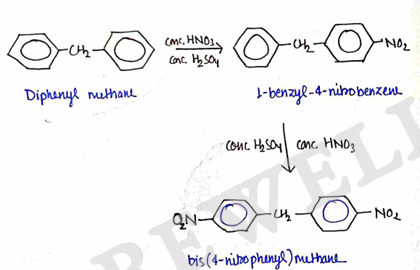
ii) Nitration → Diphenyl methane in the presence of concentrated nitric acid gives bis(4-nitro phenyl) methane.
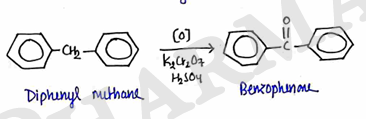
iii) Oxidation → Diphenyl methane upon oxidation in the presence of potassium dichromate and sulphuric acid gives benzophenone.
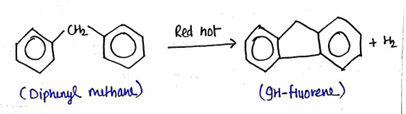
iv) Cyclization → When diphenyl methane is heated it gives 9H-fluorene.
Physical Properties
- It is a colourless oil.
- Melting point
- Boiling point
- Molecular formula
Uses
- It is used in the synthesis of methylene diphenyl diisocynate, which is used in the manufacture of polyurethane and industrial strength adhesive.
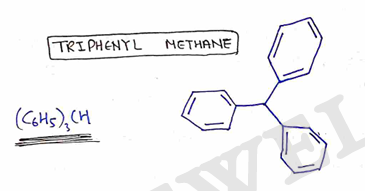
5) TRIPHENYL METHANE
Synthesis (Methods of Preparation)
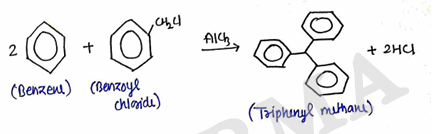
a) Friedal-craft's reaction It is prepared by the condensation between benzyl chloride and benzene.
b) The condensation between benzene and chloroform gives triphenyl methane.
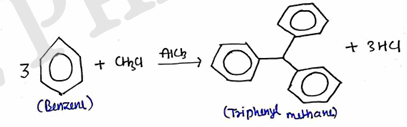
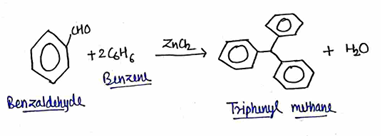
c) The condensation between benzaldehyde and benzene also gives triphenyl methane.
Physical Properties of Triphenylmethane
- A colorless solid.
- Melting point
- Boiling point
Uses
- Triphenyl methane is used as a backbone of synthetic dyes.
- Triphenyl methane has also been shown to inhibit 3-methylcholanthrene - induced neoplastic transformation of loti cells.