Pharmaceutical Organic Chemistry 2 - Unit 3
Syllabus
Fats and Oils
- Fatty acids - reactions.
- Hydrolysis, Hydrogenation, Saponification and Rancidity of oils, Drying oils.
- Analytical constants - Acid value, Saponification value, Ester value, Iodine value, Acetyl value, Reichert Meissl (RM) value - significance and principle involved in their determination.
Scroll to Download
POC-IInd UNIT-3RD
FATS & OILS
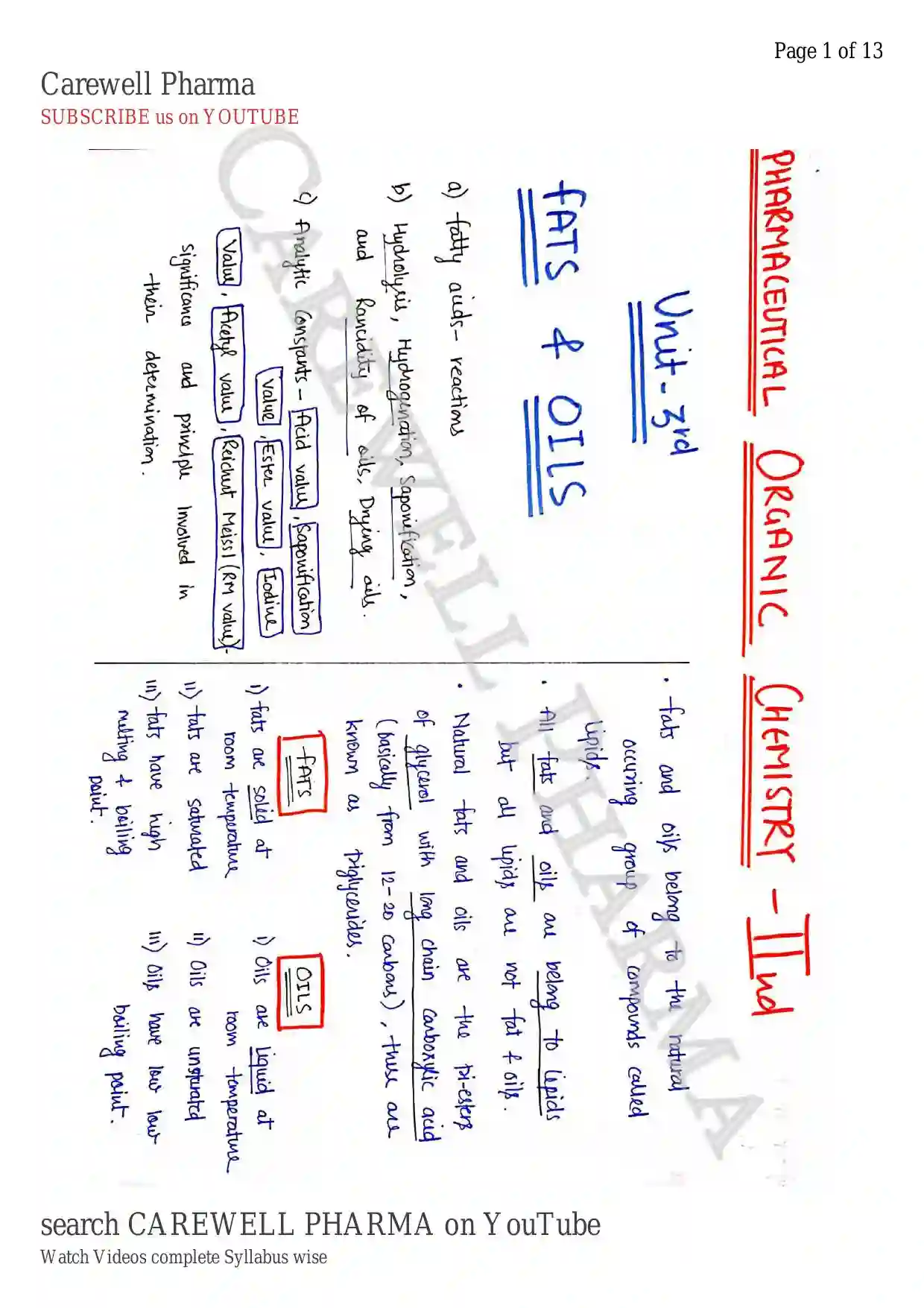
a) Fatty acids - reactions.
b) Hydrolysis, Hydrogenation, Saponification, Rancidity of oils, Drying oils.
c) Analytic Constants - Acid value, Saponification Value, Ester value, Iodine Value, Acetyl value, Reichert Meissl (RM value) significance and principle involved in their determination.
- Fats and oils belong to the natural occuring group of compounds called Lipids.
- All fats and oils are belong to lipids but all lipids are not fat & oils.
- Natural fats and oils are the tri-esters of glycerol with long chain Carboxylic acid (basically from 12-20 carbons), these are known as Diglycerides.
| OILS | FATS |
|---|---|
| I) Oils are Liquid at room temperature | I) Fats are solid at room temperature |
| II) Oils are unsaturated | II) Fats are saturated |
| III) Oils have low boiling point. | III) Fats have high melting & boiling point. |
| IV) Oils are found in both animal and plants (vegetables). | IV) Fats are found in animals |
Definitions
Fatty Acid
Long chain of carboxylic acids are known as fatty acids.
[Long chain of carbon + Carboxylic Acids]

Saturated Fatty Acid (Single bond)
- Stearic acid
Unsaturated Fatty Acid (Double bond)
- Oleic acid
Glycerol

Lipid
- Tri-esters of long chain of fatty acids with glycerol.

Fats and Oil
Triesters of long chain of fatty acids with glycerol.
Fats Saturated fatty acids with glycerol E.g., Wool fat
Oils Unsaturated fatty acids with glycerol E.g., Olive oil
- Fats and oils are esters (fatty acid + glycerol)
- Fats and oils are able to saponify but Steroids are not.
Signification
- Fats and oils are able to form salts or soap with alkali (NaOH or KOH).
Properties
- Saponification: fats and oils are able to form salts or soap with alkali ($NaOH$ or $KOH$).
- Colourless, odourless, tasteless.
- Insoluble in water.
Important
- Source of energy
- Source of nutrients
- These are the storage form of energy in adipose tissue

Fatty Acid Reactions
I) Hydrolysis
- In this reaction, triglycerides (tri-esters) are easily hydrolysed by enzymes called Lipase (catalyst) in the digestive tract of animals to give fatty acid and glycerol.
- So, the fatty acids so produced play an important role in the metabolic process in the animal body.

II) Hydrogenation (Reduction process)
- Unsaturated glycerides react with hydrogen in the presence of a metal catalyst (usually nickel) to give saturated glycerides.
- Vegetable oils are triglycerides of unsaturated fatty acid such as oleic acid and after reaction it form saturated glycerides with solid form.
- Also called Hardening.
- Used for manufacturing of vegetable ghee (Dalda).

III) Saponification
- When triglycerides are hydrolysed (saponified) by alkalis ($NaOH$ & $KOH$), Glycerol and salts of fatty acids are produced.
- And these sodium & potassium salts which are obtained termed as soap.
- So, formation of soap and salts from fats and oils (triglycerides) with alkali ($NaOH$ & $KOH$) is known as saponification.

IV) Rancidity of Oils (Rancidification)
- When fats and oils are left exposed to moist air, they develop foul smell and sour taste.
- It occured when fats and oil exposed for any length of time.
- Rancidity is by hydrolysis of the ester link.
- And oxidation of double bond of the triglycerides.

- Hydrolytic rancidity can be reduced by refrigeration.
- The rancid smell is due to the release of fatty acids.
V) Drying Oil
- When highly unsaturated oil are exposed to air, they undergo oxidation and polymerization to form a thin waterproof film.
- These oils are called drying oil.
- And reaction and process is known as drying.
- Eg. Linseed oil, which is rich in Linolenic acid, is a common drying oil used in oil based paints.

Analytic Constant
Acid value, Saponification Value, Ester Value, Iodine Value, Acetyl value, Reichert Meissl (RM Value).
- Significance and Principle in their determination
I) Acid Value : (Neutralization Number)
- It is used to measure the free fatty acid present in fats and oils.
- And free fatty acids in fats and oils are harmful for human.
Principle
- It is determined by directly titrating the oil/fat in an alcoholic medium against standard potassium hydroxide/Sodium hydroxide solution.
Method
Dissolved 10gm of Sample in 50 ml of mixtures of equal volume of ethanol (95%) and ether, then previously neutralised with and add phenolphthalein solution as a indicator.
Where,
burette reading
Sample weight.

Significance
- The value is a measure of the amount of free fatty acid which have been liberated by hydrolysis from the glycerides due to the action of moisture, temperature or lypolytic enzyme Lipase.
- Therefore, Oils with increased acid number are unsafe (harmful) for human consumption.
II) Saponification Number
- Saponification Value, Koettstorfer number
- It is the number of mg (milligrams) of KOH required to saponify one gram of a fats and oils.
- It is the measure of average molecular weight of the fatty acids presents.
Principle
- Saponification is the process by which the fatty acids in the triglycerides or fats are hydrolyzed by an alkali to give glycerol and potassium/sodium salts of fatty acids.
- A known quantity of fats or oil is refluxed with an excess amount of alc. KOH.
- After saponification, it titrate against a standard acid.
- Sample is used titrated with (a).
- Perform blank titration (b).
- Phenolphthalein sol^n used as a indicator.
Where, weight of sample

Significance
The magnitude of saponification value gives an idea about the average molecular weight of the oils and fat.
Molecular weight of fat =
- Acc to this, Saponification value = Molecular weight .
III) Ester Value
It is the number of mg of KOH required to saponify the ester present in 1gm of the substances.
Ester value = Saponification value - Acid Value
Principle
- It is determined by titrating the sample of oil & fat in alcoholic medium with against .
Method
- Weigh accurately about 2gm of sample. Add 25 ml of ethanoic KOH.
- And boiled under reflux condenser on a water-bath for 1 hour.
- Then, add 20 ml of water in it. then, titrate the excess of alkali with using a further of phenolphthalein indicator.
- Repeat the operation without sample (blank reading).
- The difference b/w the titrations represents the alkali required to saponify the esters.
Significance
E.V = S.V - A.V
- The ester value shows the amount of alkali consumed in the saponification of the ester and is possible to identify and differentiate the fats with this value.
IV) Iodine Value
- It is the number of grams of iodine that would add to present in 100g of the fats and oil.

Principle
- The oil/fat sample taken in carbon-tetrachloride is treated with a known excess of iodine monochloride solution in glacial acetic acid.
- The excess of iodine monochloride is treated with potassium iodide.
- Now, this sample is titrate against Sodium thiosulphate solution, starch solution used as a indicator for estimation of liberated iodine (a):
- Then perform a blank titration (b).

Significance
The iodine value is a measure of the amount of double bonds (unsaturation) in a fats.
Iodine Value = No. of double bond
Unsaturated Lipids are more susceptible to rancidity.
V) Acetyl Value
It is the number of mg of KOH required to neutralize the acetic acid liberated by the hydrolysis of 1g of the acetylated substances.
Principle
- It is determined through Saponification Value.
- Boil the 10g of sample with 20ml of acetic anhydride for 2 hours.
- Add 600 ml water and boil for 30 min.
- Separate and wash the acetylated product.
- Determine the saponification value of the acetylated substances (b ml).
- Determine the saponification value of the substance (a ml).
Where,
saponification value of the substance
Saponification value of the acetylate substance
Significance
- It is the measure of hydroxy ($-OH$) acids in lipids.
- Acetyl value = more amount of free fatty acids.
VI) Reichert-Meissl number (value) [RM Value]
- It is useful in testing the purity of butter, since it contains a good concentration of volatile fatty acids (butyric acid, caproic acid, and caprylic acid).
- So, It is defined as the ml of required to completely neutralize the soluble volatile fatty acids distilled from 5g fat.
Principle
- Fat is saponified using glycerol-alkali sol^n and acidified by sulphuric acid to liberate free fatty acids.
- The liberated fatty acids are steam distilled and the steam volatile fatty acids are collected as condensate.
- The cooled condensate of the volatile fatty acids is filtered for separation of water soluble and water insoluble fatty acids.
- The water soluble fatty acids is titrated with alkali to give RM Value.
Volatile fatty acid (water soluble fatty acids) Neutralized by sol^n (mls)
- Eg. Butter (short chain fatty acids) RM value (25-30) while RM value is less than 1 for more other edible oils.
Principle
- Thus, adulteration of butter can be easily tested by this sensitive RM number.
Significance
- It is a measure of water soluble steam volatile fatty acids specially butyric and caproic acids present in oil or fat.
- Butter fat contain butyric acid glycerides, and no other fat contain it, so RM value is high for Butter fat.
- These determination have been used principally for analysis of butter.