Pharmaceutical Organic Chemistry 2 - Unit 2
Syllabus
Phenol* - Acidity of phenols, effect of substituents on acidity, qualitative tests, Structure and uses of phenol, cresols, resorcinol, naphthols
Aromatic Amines* - Basicity of amines, effect of substituents on basicity, and synthetic uses of aryl diazonium salts
Aromatic Acids* - Acidity, effect of substituents on acidity and important reactions of benzoic acid.
Scroll to Download
POC-II UNIT-2ND
PHENOLS
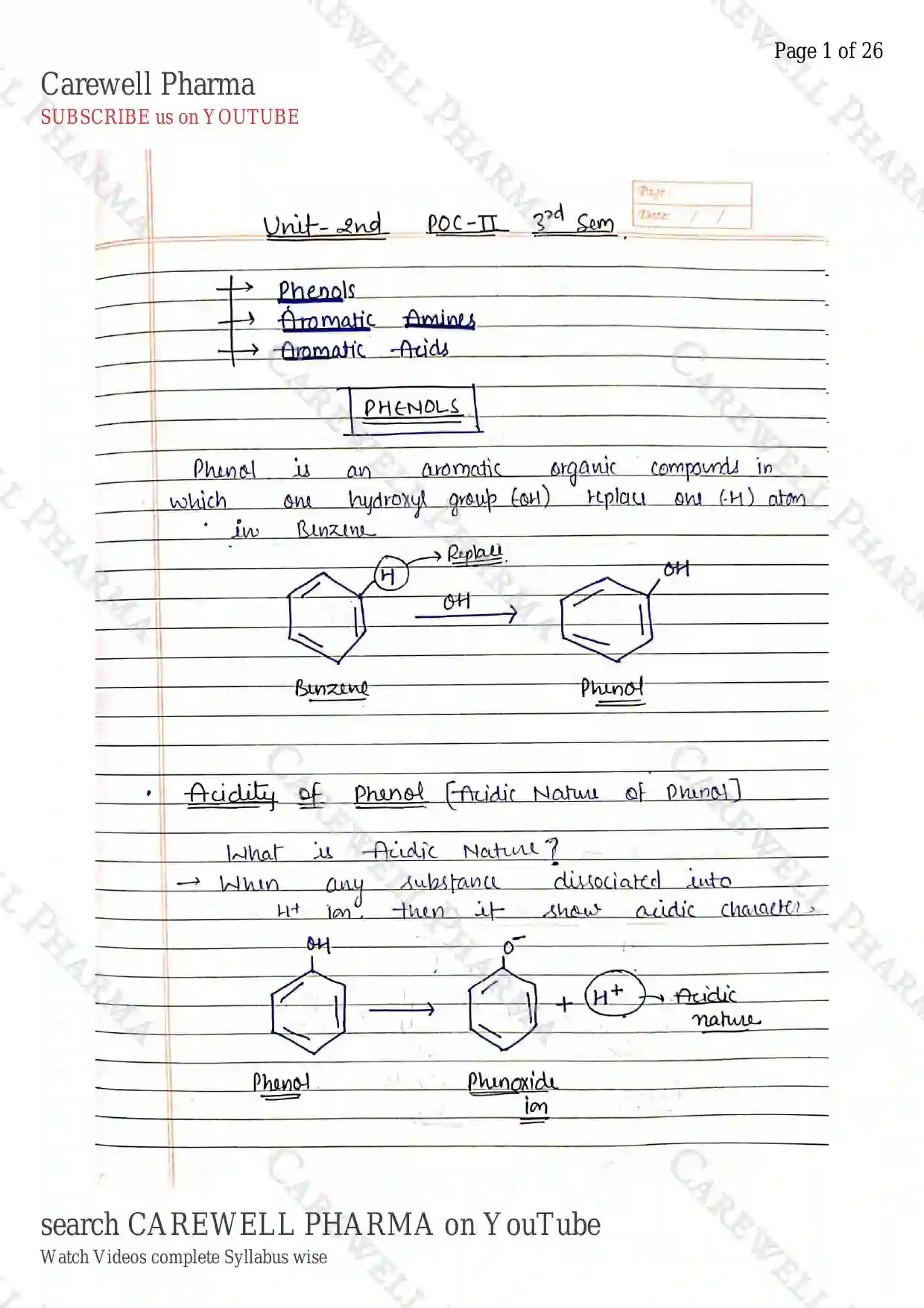
Phenol is an aromatic organic compounds in which one hydroxyl group (OH) replace one hydrogen (H) atom in Benzene.

Acidity of Phenol (Acidic Nature of Phenol]
What is Acidic Nature?
When any substance dissociated into ion then it show acidic character.

So, When phenol dissociated it break into two in which one is . So, Phenol show acidic nature.
- The Substance or Compound which release more or quick have more acidic nature.
- The Substance which is more stable after release of has more acidic nature.
- So, Phenol is more acidic.
The condition or situation which show acidity or stability is "Resonance" character.
Resonance


So, phenol has resonance, so it is Stable due to resonance. So, it is Acidic in nature.
% S Character
- So phenol has 3 sigma ($\sigma$) bond. So it has hybridisation.
- In Which % s character is = 33.33% which is more than alcohols.

Effect of Substituent on Acidity of Phenol
There are two types of Substituents (group) which will add or attached on phenol.
i) Electron Donating Group
- Which has ability to donate electrons.
- Eg: , , , etc.
ii) Electron Accepting (Withdrawing) Group
- Which has ability to accept (gain) electrons.
- Eg: → -Cl, $-NO_2, , etc.
After Dissociated
- Phenoxide ion
Electron Donating → It increase electron density Unstable Acidity
Electron Accepting (Withdrawing) → It decrease Electron density Stability Acidity
Qualitative Tests For Phenols
i) Litmus test
ii) Libermann's test
iii) Ferric chloride test
iv) Bromine water test
v) Phthalein dye test
i) Litmus Test → Phenol turns blue litmus paper into red, this shows that phenol is acidic in nature.
ii) Libermann's Test → When phenol is reacted with and conc. , a deep green colour is obtained which change into red when we dilute with water. When a little amount of added to it, the solution becomes deep blue colour.

iii) Ferric Chloride Test → Aqueous solution of phenols reacts with freshly prepared ferric chloride solution gives coloured complex.
Mostly phenols gives dark color.

iv) Bromine Water Test → Take aqueous solution of phenol and add excess of bromine water. A yellowish white precipitate is obtained.

v) Phthalein Dye Test → (Flourescein Test)
- Phenol on heating with phthallic anhydride in the presence of concentrated Sulfuric acid ($H_2SO_4$) it form colourless condensation compound called phenolphthalein.
- On further reaction with dil. Sodium hydroxide ($NaOH$) it gives pink colour fluorescent compound called fluorescein.
- (Which indicate that substance is phenol).

vi) Solubility Test
- Phenol when dissolved in sodium hydroxide solution and when it dissolved in Sodium bicarbonate solution it does not produce Carbon dioxide.
Method of Preparation of Phenol

i) From Benzenesulphonic Acid
- When sodium salts of aromatic sulphonic acids are fused with Sodium hydroxide, sodium derivatives of phenol is obtained which on acidification yield phenol.

ii) Dow's Process
- When chlorobenzene is heated with excess of aq. at 623 K and 300 atm it formed Sodium phenoxide, which further hydrolysed by dil it formed phenol.

iii) From Cumene (Cumene process)
- Cumene is oxidized using air to give cumene hydroperoxide, which on acidification yield phenol.

iv) From Benzenediazonium Salts
- Benzene diazonium chloride salt is heated (boil) with water it produce phenol with liberation of gas.

Physical Properties of Phenol
- Colorless, crystalline
- Melting point & Boiling point
- Soluble in water
- Used as disinfectants.
Chemical Peactions of Phenol
i) Formation of Salts → Phenol react with Sodium hydroxide to form Salts.

ii) Electrophilic Substitution (Nitration) → Phenol react with dil. to give a mixture of o-nitrophenol and p-nitrophenol.

iii) Kolbe's Reaction → Phenol react with sodium hydroxide to form Sodium phenoxide, which !react with Carbon dioxide ($CO_2$) to form salicylic acid.

iv) Reimer Tiemann Reaction → When phenol is treated with chloroform ($CHCl_3$) in the presence of Sodium hydroxide ($NaOH$), Ortho-hydroxybenzaldehyde (salicylaldehyde) formed.

v) Reduction Reaction → When phenol is distilled with zinc dust, low yield of benzene is obtained.

Structure and Uses
i) Phenol

Uses
- Used as raw material for drug manufacturing like Salol, Aspirin etc.
- Used as preservatives, antiseptic (Dettol) etc.
ii) Cresol (Hydroxytoluene)

Uses
- They are strong germicides, so they are used in disinfectants and antiseptics.
- They are also used in low concentration as wood preservatives.
- m-cresol is used in making photographic developer and explosives.
iii) Resorcinol

Uses
- Used in manufacturing of resins.
- Also used as topical antiseptic in skin disorders.
- It is used to treat acne, eczema, psoriasis and other skin disorders.
iv) Naphthols

The monohydroxy derivatives of naphthalene are called naphthols. Uses
- Used as insecticides and also making for dyes.
- Sometimes it is also used in perfumery.
Aromatic Amines
- Basicity of amines, Effect of Substituents on basicity.
- Synthetic uses of Diazonium Salts.
- These are those organic compounds in which Amine ($-NH_2$) group replace one Hydrogen atom in benzene ring and formed Aromatic amines.

- It is of three types:
- Primary Amines
- Secondary Amines
- Tertiary Amines
i) Primary Amines (1° amines): Aniline

ii) Secondary Amines (2° amines): N-methylaniline

iii) Tertiary Amines (3° amines): N,N-Dimethylaniline

AROMATIC AMINES
- Method of Preparation of Aromatic Amines
- Chemical Reaction of Aromatic Amines
- Physical properties of Aromatic Amines

Method of Preparation of Aromatic Amines
i) By Reduction of Nitrocompound
ii) Reduction of Nitriles
iii) By Ammonolysis of Chlorobenzene
iv) Hoffman Rearrangement Reaction
i) By Reduction of Nitrocompound
- When nitrobenzene is react with (gas pass) in the presence of catalyst Ni/Pt it gives Aniline (aromatic amines).

ii) By Reduction of Nitriles
- When aromatic nitriles undergoes reduction reaction with reducing agent like it produce aromatic amines (Benzyl amine).

iii) By Ammonolysis of Chlorobenzene
- When chlorobenzene undergoes ammonolysis (react with ammonia) in the presence of Copper dichloride ($CuCl_2$) at high temperature it produce Aromatic amine (aniline).

iv) Hoffman Rearrangement Reaction
- When acetamide is treated with Sodium hypobromide ($NaOBr$), Ammonia group in acetamide is rearrange their position and shift toward ring and produce aniline (Ar. Amines).
Physical Properties of Aromatic amines
- Normally they are colorless liquid or solid, but in the presence of light they undergoes oxidation and turn into brown color.
- They are polar compounds and can form intermolecular hydrogen bonding.
- They are not readily water soluble due to presence of bulkier phenyl group.
- They are highly toxic substance and some are Carcinogens.
Chemical reaction of Aromatic amine
i) Formation of Amides
- When aromatic amine (Aniline) react with acyl chloride it produced Benzyl amide with the formation of amide linkage.

ii) Formation of Salts
- When aromatic amine (aniline) treated with it produced Benzenaminium chloride (amine salt).

iii) Acetylation (Acetylation of Aniline)
- When aromatic amine (aniline) react with acetic anhydride it formed acetanilide.

iv) Carbyl Amine Reaction
- When aniline react with chloroform ($CHCl_3$) and potassium hydroxide ($KOH$) it produce Carbylamines (isocyanide).

v) Oxidation
- When aromatic amine (aniline) undergoes oxidation in the presence nitric acid ($HNO_3$) it produce nitrobenzene.

Basicity of Amines
Lewis Concept
Those element which accept lone pair Called Acid. And those which donate lone pair Called Base.
So, Ammonia contain lone pair so it is basic in nature.
So, All of their derivatives are also basic in nature.
^I+^ Electron Releasing group (donating grp) Electron density Basicity
Eg: Alkyl group, , etc.^I-^ Electron withdrawing group (accept electron) Electron density Basicity
Take an eg
But their are exception. that in 3° amines $3^\circ < 2^\circ$ ??! $\downarrow$ Stearic hindrance which does not allow to donate lone pair.
But in Aromatic Amines Lone pair of Ammonia is delocalised in benzene ring so it can not donate lone pair..

- So, due to Resonance, Electron density is decrease so, basicity decrease.
| Basicity |
|---|
| Aliphatic amines > Aromatic Amines. |
| 2° Amines > 1° Amines > 3° Amines > Aromatic Amines. |
Effect of Substituent on Basicity of Aromatic Amines.
In aromatic amines, Benzene has resonance but it is less stable so, it is basic.
Basicity Stability
Depend upon nature of substituents:
Nature
- E donating group
- E withdrawing group
Electron Donating Group
If this group attached with aromatic amines, it increase the electron density, which further increase the basicity.
Eg. etc.Electron Withdrawing Group
If a substituent which acts as an electron withdrawing group is attached, it decreases the electron density, which further decreases the basicity.
Eg.
| E-donating | E-withdrawing |
|---|---|
| E-density | E-density |
| Stability | Stability |
| Basicity | Basicity |
Resonance
- Resonance increase the stability of benzene ring.
- So, the more resonance the more Stability.
- So, Any group which increasing resonance, increase Stability, which decrease basicity.
- Stability
- Resonance Any group which decrease resonance, decrease Stability, which increase basicity. Resonance Stability Basicity
Synthetic Uses of Aryl diazonium Salts
Those compounds which contain aromatic ring with chloride Salt it is called Aryl diazonium salts. eg. Benzenediazonium chloride.
Diazonium compounds are standard reagent used in synthesis of organic compounds, especially aryl derivatives.
Diazonium salts are Light sensitive and break down under near UV or violet light, so due to this it use in document reproduction.
In this, paper or film is coated with diazonium Salt. $\rightarrow$ They play a major role to produce dye fabrics.
AROMATIC ACID
Aromatic Acids
- When Carboxylic acid replaced one hydrogen atom in Benzene ring, then it form Aromatic acids.

- Note: Phenylacetic acid (and other similar compounds in which the carboxylic acid group is not directly attached to the aromatic ring) Called side chain aromatic acid.
Acidity of Aromatic Acid
Acid
Those substance which release ion on dissociation. $R-COOH \rightleftharpoons R-COO^- + H^+$
So, in aromatic acid,

- As, we know that the compound which has more resonance has more stable and more Stable = more acidic. Stability Acidity
- In Aromatic acids, After dissociation it release ($H^+$) charge (ion) and it become acidic.

- Now, Benzoate ion have one negative charge and it want to be become stable.
- But this negative charge did not delocalised into benzene ring, because is attached with (Carbon) atom.
- So, it delocalised (-) charge into both Oxide ion through sharing.

- So, Benzoate ion become stable and Benzoic acid also release ion.
- So, It proof that, Aromatic acid are acidic in nature.and it is also stable even after dissociation. So it is strong acidic in nature. And, Benzene ring has also more resonance so it is more stable and acidic.
Effect of Substituent on Acidity
Substitute: Which replace any hydrogen in benzene.

These group are probably to join two types of
I) +I [Electron Donating group]
II) -I [Electron withdrawing group]
I) Electron Donating Group : When it attached it increase electron density and the more electron density, the compound more unstable, Acidity decreases. eg etc.

II) Electron Withdrawing Group : When it attached, it receive electron from aromatic acid and decrease electron density, so compound is stable. And more stable = more acidic. eg. etc.

- The more electronegative atom attached it increase more acidic.
Eg: acidic
Important Reactions of Benzoic Acid
In which, we formed other Compounds, with the help of benzoic acid.
i) Sodium Benzoate Salt Formation
- When benzoic acid react with any base it form salts, react with NaOH.

ii) Ester Formation
- It reacts with alcohols, in the presence of concentrated Sulphuric acid it form ester.

iii) Formation of Acyl Halide
- When it react with phosphorus pentachloride it form benzoyl halides and give phosphoryl chloride.

iv) Reduction to Benzyl Alcohol
- When it reacts with Lithium aluminium hydride and undergoes reduction it give Benzyl alcohol.

v) Decarboxylation
- When Benzoic acid reacts with Calcium oxide in the presence of NaOH then after decarboxylation it gives benzene and release .