Pharmaceutical Engineering - Unit 1
Syllabus
Flow of fluids: Types of manometers, Reynolds number and its significance, Bernoulli’s theorem and its applications, Energy losses, Orifice meter, Venturimeter, Pitot tube and Rotometer.
Size Reduction: Objectives, Mechanisms & Laws governing size reduction, factors affecting size reduction, principles, construction, working, uses, merits and demerits of Hammer mill, ball mill, fluid energy mill, Edge runner mill & end runner mill.
Size Separation: Objectives, applications & mechanism of size separation, official standards of powders, sieves, size separation Principles, construction, working, uses, merits and demerits of Sieve shaker, cyclone separator, Air separator, Bag filter & elutriation tank.
Scroll to Download
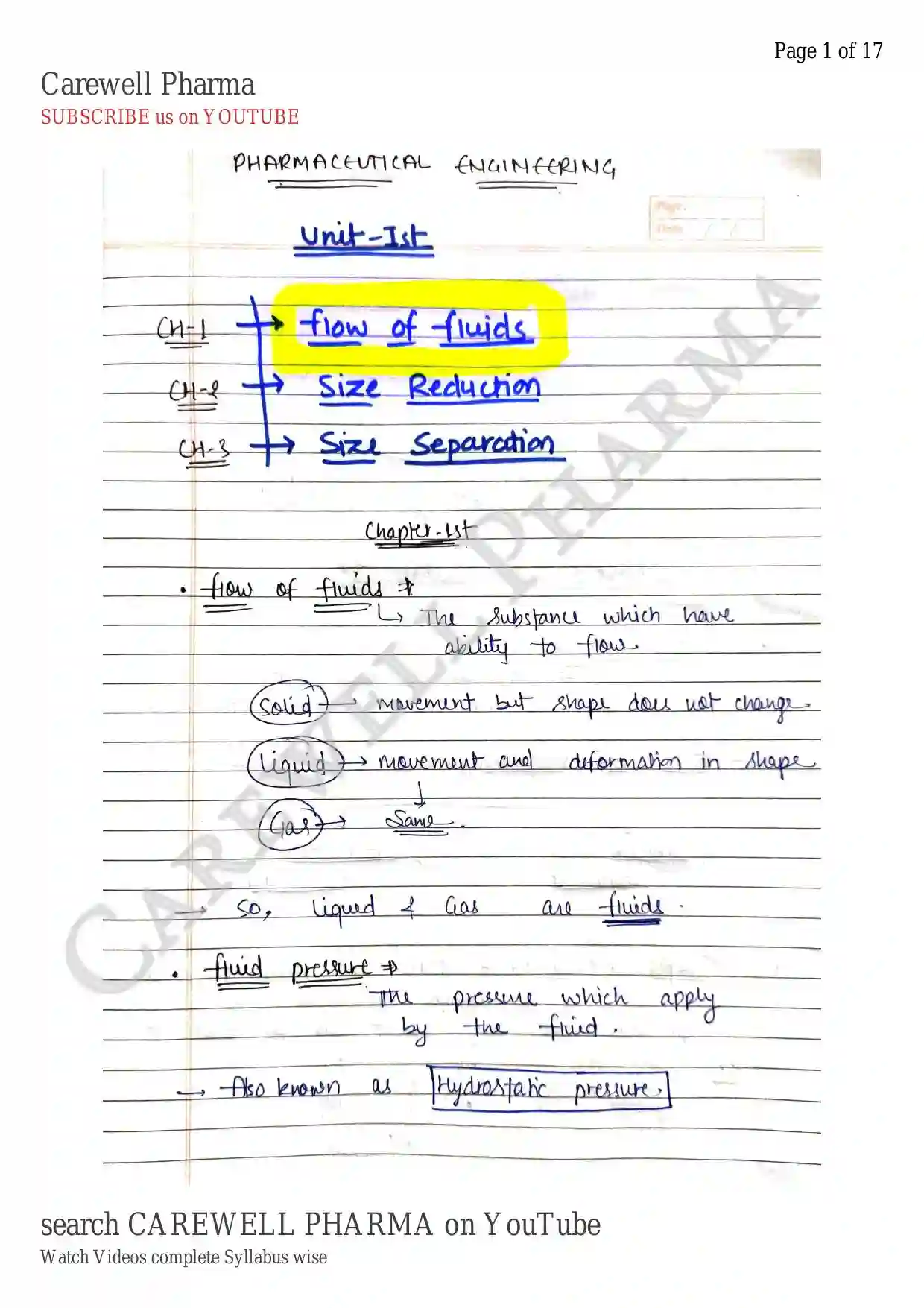
PHARMACEUTICAL ENGINEERING
Unit-Ist
- CH-1 flow of fluids
- CH-2 Size Reduction
- CH-3 Size Separation
Flow of Fluids
The Substance which have ability to flow.
- Solid → movement but shape does not change Cart Same.
- Liquid → movement and deformation in shape.
- Gas → Same
→ So, Liquid & Gas are fluids.
Fluid Pressure
The pressure which apply by the fluid.
- Also known as Hydrostatic pressure.
Pressure 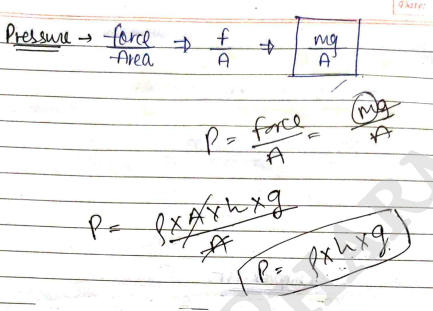
Manometer
It is a device which is used to measure pressure difference.
Types of manometer:
- Simple Manometer
- Differential Manometer
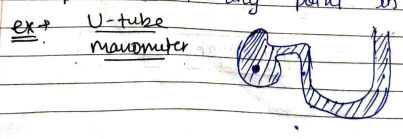
1) Simple manometer → These are those manometer which measure the pressure at any point in a tube etc.
Ex → U-tube manometer
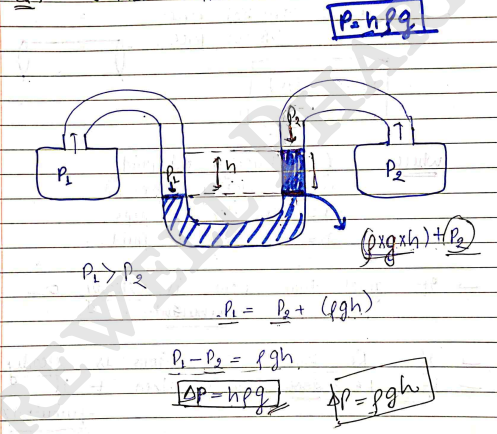
11) Differential Manometer → These are those manometers which used to measure the differential pressure difference b/w any two gases/liquids.
Ex → U-tube manometer
Flow
- Steady Flow → liquid flow constantly
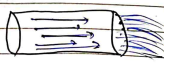
- Turbulent Flow → Not in constant flow
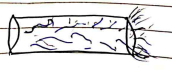
Reynald's number
It is the ratio of inertial forces (which increase reynolds no.) & viscous forces (which resists).
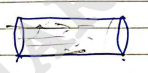
where,
density of fluid.
velocity (speed)
diameter of pipe.
viscocity of fluid.
It gives that flow is steady Turbulent
- If then flow is steady.
- If approx, then it is turbulents.
So, it is used to predict the nature of fluid (flow). also used to study the Sedimentation rate.
Bernoulli's Theorem
The total mechanical energy of the moving fluid comprising the gravitational potential energy of elevation, the energy associated with the fluid pressure and kinetic energy of the fluid motion remains constant.
Where,
pressure exerted by the fluids
velocity of the fluid
density of the fluid
height of the container
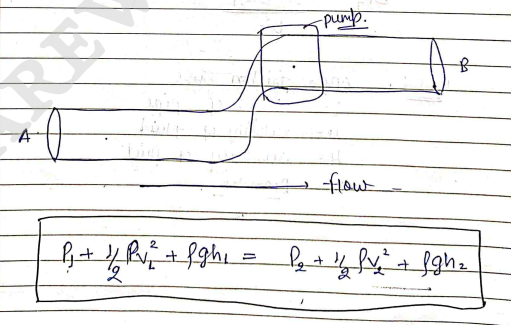
flow pump. $$P_1 + \frac{1}{2}\rho v_1^2 + \rho gh_1 = P_2 + \frac{1}{2}\rho v_2^2 + \rho gh_2$$
Energy Loses
Some energy lose during flow.
1) Frictional → During flow of fluids in pipe some friction apply on fluid by the walls of pipe. and it oppose the flow and during this some energy loss.
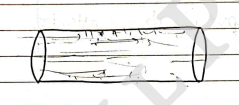
Hagen Poiseuille equ:
where,
friction loss
Length of pipe
velocity of fluid
viscocity of fluid
Diameter
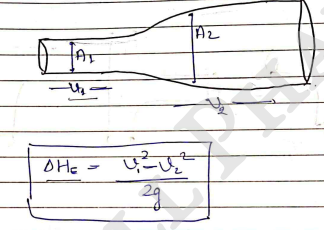
2) Enlargement Loss → When we increase the size of pipe, then there are changes of velocity, due to this some energy loss occurs.
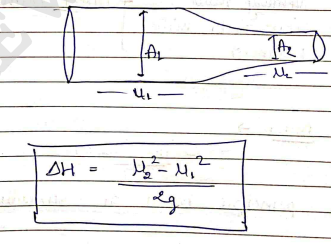
3) Constriction Loss → When we decreases the size of pipe, velocity increase, energy loss.
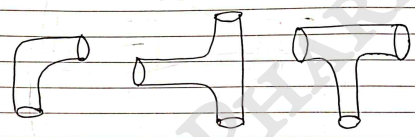
4) Fitting Loss → When we bend the pipe then flow of fluid's direction change, and for changes of direction there are some energy loss.
Rate of Flow of Fluids
- Orifice Meter
- Ventury meter
- Pitot tube meter 1v) Rotameter
1) Orifice Meter → Direct method. The principle based on Bernoulli theorem.
- An orifice meter is a device which used to measure the rate of flow (speed, velocity) through orifice plates.
Construction 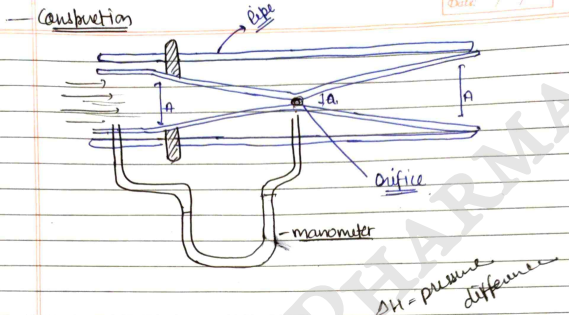
Formula →
where,
velocity of fluid
Constant
gravitation force
pressure difference
- So, we can find (pressure difference) through Manometer which we attached on pipe.
- Put the value of pressure difference on orifice meter formula & find out the velocity of fluid easily.
Uses → Used to measure velocity of fluid.
Advantages
- Simple to use.
- Low cost, especially on large sizes.
- No need to recalibration.
Disadvantages
- Maintenance Problem.
- Poor accuracy.
1). Venturi Meter → It is used to measure the rate of flow of liquid in a pipe. (speed, velocity)
Principle →
- It is based on the principle of Bernoulli's theorem.
- Venturi meter consists of two tappered section in the pipeline with a gradual constriction (throat) at its centre.
- When fluid is passed through venturi meter, their are change in pressure head ($\Delta H$) and increase in velocity due to constriction of venturi meter (Acc. to Bernoulli).
- By this formula: we can easily find out the velocity of fluid.
Construction 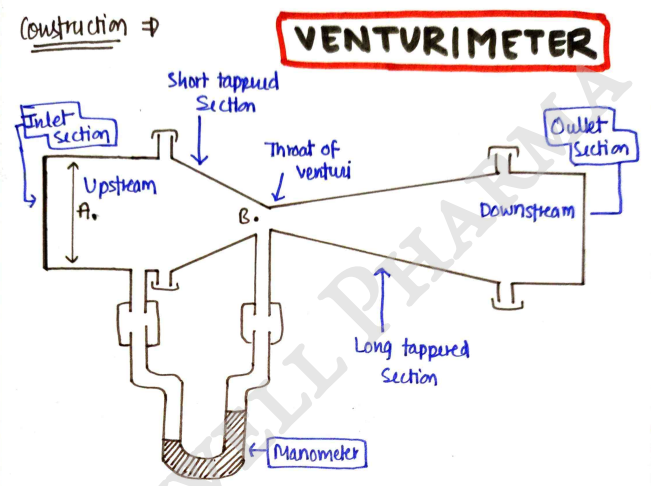
- It consists of two tapered section inserted in a pipeline with constriction at meter's centre.
- The upstream cone is normally shorter than the downstream.
- The tapers are smooth and gradual.
- A manometer is connected at point A & B to measure the pressure difference.
Working
- Firstly venturi meter is inserted between pipeline.
- When fluid is passed through venturimeter, the velocity of the fluid is increased at the throat, due to the constriction.
- This result in decreased pressure in the up-stream cone (or change in pressure head).
- Which further Calculated through manometer.
- Now,
where,
velocity of fluid through venturimeter
Coefficient of the venturi meter
Pressure head difference
- Now, put the value of (which is measured in manometer) in this eq. and find the velocity of fluid.
Uses
- It is commonly used for liquid (water) and also for gases.
2). Pitot Tube Meter → It is used to measure the rate of flow of liquid (speed, velocity).
Principle
- It measure the velocity at one point only.
- It is based on the principle of Bernoulli's theorem.
- When it inserted into the centre of pipe, the velocity of flow is increased at that point, and change in pressure head.
- Which Calculated through manometer which further
- Then put this value in eq. and find out the value of velocity head.
where,
velocity of fluid (velocity head)
coefficient of pitot tube
Pressure head difference
Construction 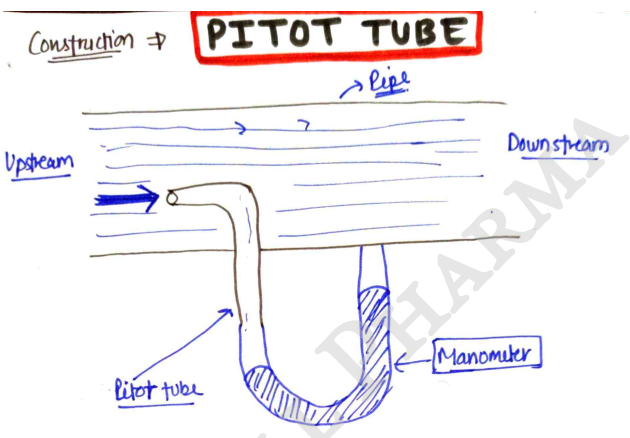
- Also known as insertion meter.
- Size is small compared to pipe.
- One tube is perpendicular to the flow direction and the other tube is connected parallel to the direction of flow.
- Manometer is connected with this to measure the pressure head difference.
Working
- Firstly insert the pitot tube in pipe.
- In tube, velocity of fluid is increased due to constrict (narrow) tube, results decrease (change) in pressure head ($\Delta H$) difference.
- The measured in manometer and than this value put in the formula and calculate velocity head or rate of flow of fluid. $$V_{act} = C_v \sqrt{2g \Delta H}$$
3) Rota Meter → It is a variable area meter, i.e. it varies area of flow, so as to produce a constant head differential. therefore, rotameters are known as area meters.
Principle
- It consists of a vertical, tapered and transparent tube in which a plummet is placed.
- During the fluid flow through the tube, the plummet rises and falls because of variation in flow.
Construction 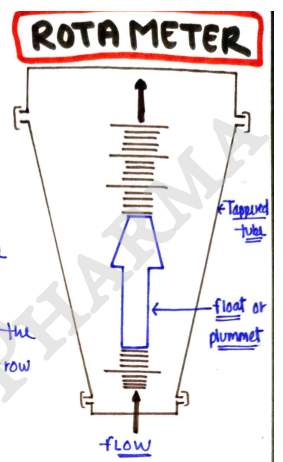
- It consists of vertical tapered tube, which is mounted with narrow end down.
- The tube is usually made of glass on which a linear scale is etched.
- A solid plummet is placed in the tube (diameter smaller than narrow end of tube).
- Plummet/float may be made of lead, aluminium, glass and plastic.
Working
- Firstly rota meter is fitted on the Pipe.
- As the flow is upward through a tappered tube, the flow of fluid varies.
- The plummet, which is surrounded by the fluid, rises and falls depending on the rate of flow.
- The greater the flow rate, the higher the plummet rise in the tube.
- In rotameters, the pressure drop is constant or nearly constant.
- The flow may be read as the upper edge of the plummet an index (linear scale).
- The reading may be transmitted for recording, integrating, and and...
Uses
- Used in chemical Industries, such as bulk drugs.
- In Supply of air is controlled through rotameter.
- Suitable for both gas & liquids.
SIZE REDUCTION
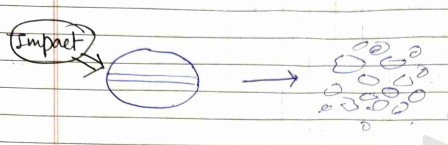
It is the process in which we convert a drug (bulk particles) into small particles through any impact.
Objective
- For increase surface area
- To increase absorption
Why we need of size reduction??
- Less energy in mixing
- Easy in mixing
- Easy to absorption in our body.
Mechanism
- Impact
- Attrition
- Combination of Impact & Attrition
- Cutting
- Compression
1) Impact → In this, drug molecules converted into small particles through any type of impact. Amount of drug remain constant. 
2) Attrition → In this method, Drug particles collide with each other and reduce there size from large molecules to small Molecules (particles). 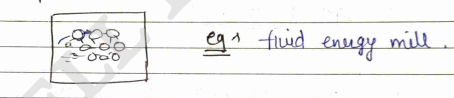
3) Combined Impact & Attrition → In this method, both Impact & Attrition apply simutaniously. 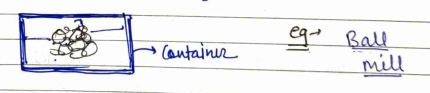
4) Cutting → In this method, we reduced large drug molecules into small through Cutting, it is mostly used for soft & fibrous drugs. 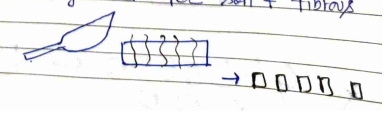
5) Compression → In this method Drug molecules reduces through compression or by applying pressure on it. 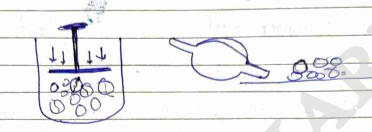
- It is mostly use for hard nature drugs.
Eg Roller mill
Law Governing Size Reduction
- Kick's law
- Rittinger's law
- Bond's law
- The more we reduce the particles, the more energy will be used to make it smaller.
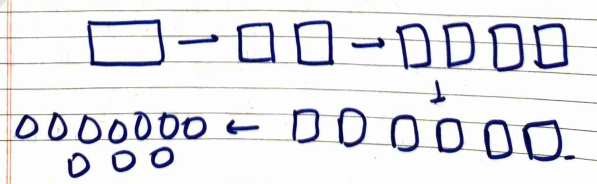
1) Kick's law → The energy required to reduce the size of particles is proportional to the ratio of the initial size of a typical dimension to the final size of that dimension.
Where,
Energy required ($J/kg$)
diameter of initial particles (size)
diameter of final particles (size)
Kick's constant
Ratio of change in size.
2) Rittinger's Law → The energy required for size reduction of unit mass is proportional to the new surface area produced.
Where,
Energy required ($J/kg$)
Rittinger's constant
initial size.
final size.
3) Bond's Law → Energy used for size reduction is proportional to the new cracks length.
Where,
the energy required ($J/kg$)
the Bond Work Index work required to reduce a unit weight.
Diameter of seive aperture that allow 80% of the mass of the feed to pass.
Diameter of seive aperture that allow 80% of the mass of the ground material to pass.
Factor Affecting on Size Reduction
- Hardness
- Material structure
- Softening temperature.
- Stickiness
- Soapiness
- Explosive
- Material yielding dusts that are harmful to the health.
Hardness → It is a surface property of the material. The harder the material the more difficult to reduce in size.
Material Structure → Substance's structure is also affect the size reduction process. eg. Long particles reduces through cutting. Small or hard particles reduces through impact.
Softening Temperature → Some substance melt at temp during reduction on increasing heat.
eg. Waxy substance. So, we use for overcome this Like cooling the mill, either by a water jacket or by passing a stream of air through the equipment.
Stickiness → A sticky material will tend to clog the grinding equipment and it should therefore be ground in a plant that can be cleaned easily.
Soapiness → This is a measure of the coefficient of friction of the surface of the material. If the coefficient of friction is low, the crushing may be more difficult.
Explosive → Such material must be ground wet or in the presence of an inert atmosphere.
Hammer Mill
Mill which used to reduce particles size through impact.
Construction 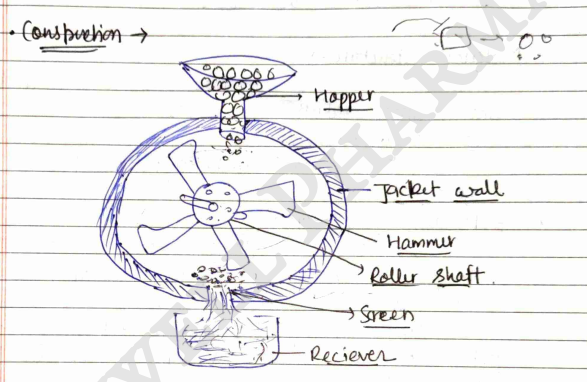
Principle
- The principle of Hammer mill is based on Impact.
Working
- Firstly bulky drug material store in Hopper.
- Then, through hopper it will start to fallen down.
- Start the machine, and Hammer will start to hit the drug particles.
- By the impact particles started to reduce.
- After reduction, particles stored in receiver through screen.
- And those particle which does not reduce, rolled again in mill.
Uses
- Used to reduce particles sizes.
Advantages
- Useful for Big particles.
- Useful for hard, tough particles.
- Easy & fast to use.
- Used to reduce in very small particle. Through screen.
Disadvantages
- Sound produce (Noisy).
- very Heat produce.
- Can't use fibrous material.
Ball Mill
Used to reduce particle size through Combination of Impact & Attrition.
Principle
- Combination of Impact & Attrition.
Construction 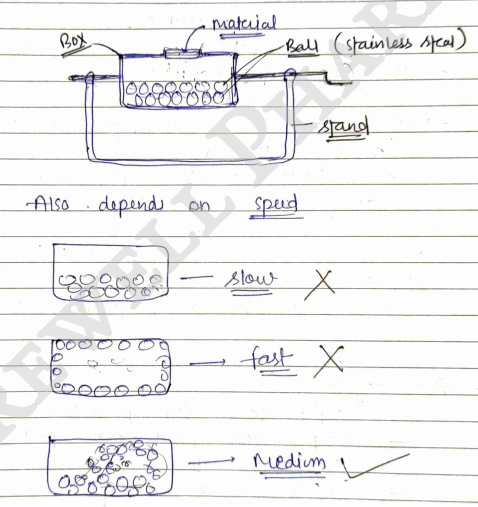
Working
- Open the Cap of box, and enter the drug molecules into it.
- Then start the machine, and adjust the speed of mill.
- On medium speed, it will start and reduce the particles size.
- After reduction, stop the machine then exist out the material.
- And separate out the ball from particles.
Uses
- It is used to reduce particles size through impact & attrition.
Advantages
- Without noise.
- Neat and clean.
- All types of particles reduce easily.
- Less energy Uses.
Disadvantages
- Can't reduces fibrous material.
- Not reduces in very big amount of particles.
Fluid Energy Mill
Principle
- It works on the principle of Attrition and Impact.
Construction 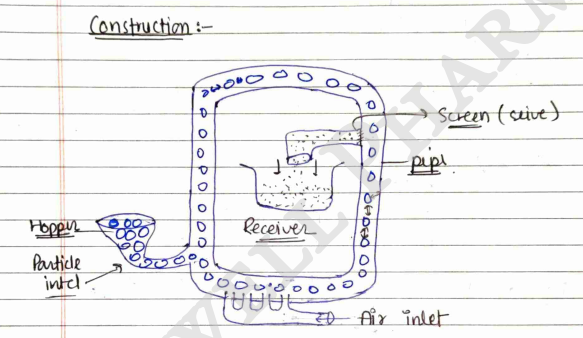
- It consist of a loop of pipe which has a diameter of 20-200 mm depending on the overall height of the loop, which may be upto about 2 meter.
- There is an inlet for air or any inert gas (fluid).
- Hopper for inlet of particles which we have to reduces.
- And one outlet from where we get (receive) reduced particles.
Working
- Firstly solid particles (Drug particles which we have to reduced) introduced into pipe through Hopper inlet with air introduced into pipe through air inlet. Then close it.
- Due to very high pressure and high degree of turbulence, impact and attrition forces occurs b/w the particles and the particles started to be smaller.
- Then it will passes through screen and received in receiver.
Uses
- The mill is used to grind heat sensitive material to fine powder.
- The mill is used to grind those drugs in which high degree of purity is required.
- Reduces the particle to 1 to 20 micron.
Advantage
- The mill is used to grind the material to fine powder.
- The particles size of powder can be controlled due to classifier.
- There is no contamination of the product.
- It is useful for grinding heat sensitive substances such as sulphonamides, vitamines and antibiotics.
Disadvantage
- High energy consumption.
- Generation of amorphous content due to high energy impact.
Edge Runner Mill
Principle
- It works on the principle of crushing (compression).
Construction 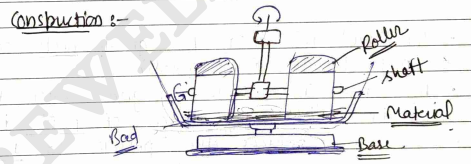
- It consist of a two roller which rolled on a bed, which is made of stone or granite.
- The roller move with the help of shaft.
- And heavy weight base which gives support to it.
- then, Roller and bed joined with shaft.
Working
- Particles (material) put on the bed, b/w roller.
- Then, the roller started to be rolled with the help of scrapper.
- And at same time bed revolve also. Bed is revolve with greater speed than roller. So particles will be sheared or crushed through roller.
- Then, Powder is collected and separated through sieve.
Uses
- This mill is used to grind tough material to very fine particles.
- This mill is used for plant based products.
Advantages
- We don't need to give attention during process.
Disadvantages
- Contamination of other materials.
- Not use for sticky material.
- More space than other mill.
- Time Consuming & Energy consumption high.
End Runner Mill
Principle
- It work on the principle of impact & Attrition.
Construction 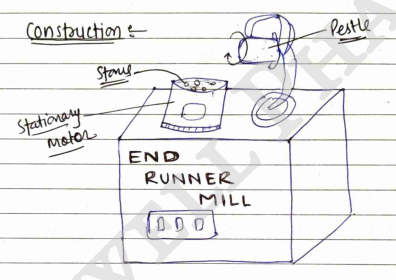
- It consist of one rotating pestle and one stationary motor.
- And there are some stone present inside the motor.
Working
- Firstly put drug particles in stationary motor which we have to reduced.
- Then start the mill, And Pestle started to rotate, and it fallen down in stationary motor.
- Create impact on drugs, which present in stationary motor.
- Then rotating it started crushing (attrition).
- So, through impact and attrition particles started to be smaller.
- After reduction, collect the fine powder.
Uses
- Used to reduce drugs material into very fine particles (powder).
Advantages
- Easy to handle.
- Less electricity.
- NO more heat produce.
Disadvantages:
- Not used for sticky material.
- Not used for big particles.
SIZE SEPARATION
It is the after process of Size Reduction, in which we separate out the mixture of various size particle into two or more portions by sieve. 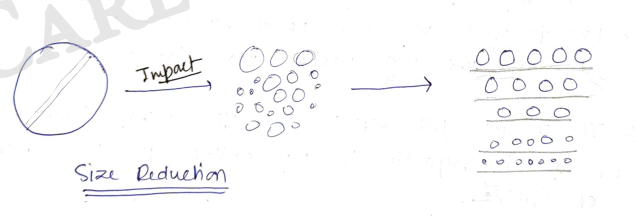
Objective
- Separation
- Suspension
- Granulation
- Improve Mixing
- Physiochemical properties
1) Separation → So, After reduction we have to separate out the drug particles into different sizes, it is important for any work.
2) Suspension → It is very important for suspension, because in Suspension we have to take very fine powder, so we have to separate out the fine drug particles into mixtures.
3) Granulation → It is the just before step for making tablets, so we have to separate the drug particles for better making of tablets.
4) Improve Mixing → Size separation is much more important for mixing. Same size particles mix well than different size particles.
5) Physiochemical Properties → Size Separation also helpful in physiochemical properties of drug molecules. eg. Surface tensions, Solubility etc.
Applications
- It is much more helpful in making of tablet because it helps in granulation.
- Capsule → making of tablet because it fill powder inside the capsule and that powder separate out through size separation.
- Suspension → In Suspension, the powder which is used, is separate out through size separation.
- Emulsion → It is also helps in making emulsion.
- Syrup → Also helpful in making syrup, helps in size separation for making syrup which is used for that.
Mechanism
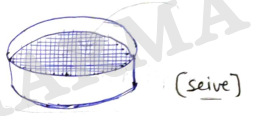
- The much more important thing for size separation is sieve.
- Agitation → In which we take drug particle into sieve with specific size then start to shake it.
 i) Oscillation $\rightarrow$ movement of sieve is upward and downward.
 ii) Vibration $\rightarrow$ movement of sieve is sideways.
 iii) Gyration $\rightarrow$ movement of sieve is clockwise & anticlockwise.
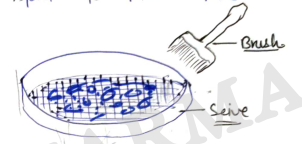
Brushing → In which sieve is fixed, and we put drug molecules in sieve, then start to shake the drug molecules with the help of brush.
Centrifugation → When a technique used for separation on basis of their shape, size, density and weight of substances. And it separate out with the help of medium & rotor speed. we revolve substance with high speed, heavy stuff falls too far and light stuff.
Official Standards of powders [Grading of Powders]
| Grade | Sieve No. to pass 100% | Sieve No. to pass partial limit |
|---|---|---|
| i) Very Coarse | 8 (100%) | 60 (20%) |
| ii) Coarse | 20 (100%) | 60 (40%) |
| iii) Moderately coarse | 40 (100%) | 80 (40%) |
| iv) fine powder | 60 (100%) | 100 (40%) |
| v) Very fine powder | 80 (100%) | - |
Mesh → It is the no. of partition in any sieve. Sieve No. = Particle size
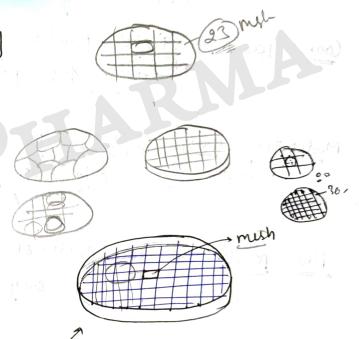
Very Coarse → Those powders which can pass 100% from sieve no. 8 and only 20% pass from sieve no. 60.
Coarse Powders → Those powder which pass 100% from sieve no. 20 and only 40% pass from sieve no. 60.
Moderately coarse → Those powder which pass 100% from sieve no. 40 and only 40% pass from sieve no. 80.
Fine Powders → The grade of powder which pass 100% from sieve no. 60 and only 40% pass from sieve no. 100.
Very Fine Powders → The grade of powder which pass 100% from sieve no. 80.
Sieve Shaker
Principle
- It is based on the principle of Agitation, in which sieve will be shake.
Construction
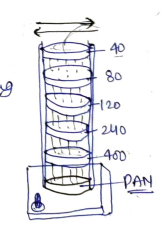
It consist a machine (device) with different sieve no sieve.
- One PAN (receiver) in which we get very fine powder or product.
- One switch which start it for vibrating and device is mounted with surface. And two long rod in which sieve will be fixed.
Working
- Firstly fixed all the sieve into device according to our need.
- Then start the machine, powder will be automatic separated out acc. to their sieve sizes (sieve no).
- Then collect it and use it.
Uses
- Used for separate out many sizes at same time.
Advantages (merits)
- Simple & easy in use. We can separate out many sizes at same time.
Disadvantage (Demerits)
- Can't separate out in very big amount. used only as a small scales.
Cyclone Separator
Principle
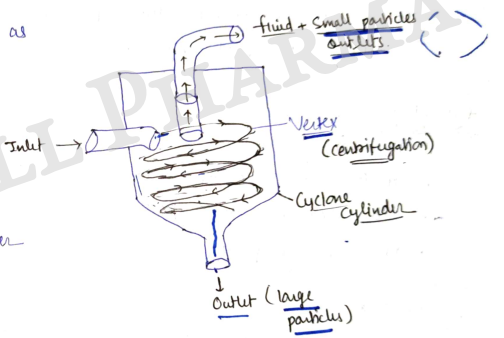
- It is based on the principle of centrifugation.
Construction
- It consist on look like as container, in which one inlet is present.
- And two outlet is present in which small particles receive from upper outlet and large particles get from lower inlet.
Working
- Firstly we enter particles (mixed) of different sizes with some air pressure.
- Then, inside it, Air create centrifugation force and due to this large particles fallen down and get from down side outlet.
- And small particles or fine powders expell out from the upper outlet with air and we get.
Uses
- It is an economical device for removing particulate solids from fluid system.
Advantages
- Low Capital costs.
- Small relative to other separation equipment.
- Can operate at high pressure.
- No moving parts.
Disadvantages
- Difficult to obtain good separation of substances of similar densities.
- Unable to tackle sticky material.
Air Separator
Principle
- It works on the same principle as that of cyclone separator. i.e... "Centrifugation".
Construction
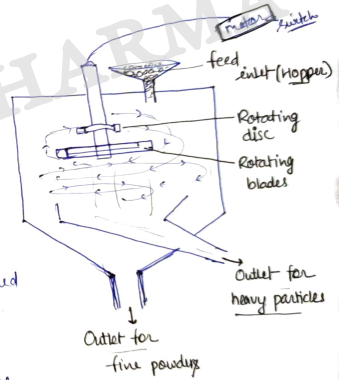
- It consists of a cylinderical vessels with a conical base.
- In the upper part, feed inlet is present and there are two outlet at base, one for fine particles and one for heavy particles.
- In air separator, the air movement is obtained by means of rotating disc and blades. To improve the separation, the stationary blades are used.
- By controlling these blades, and the speed of rotation, it is possible to vary the size at which separation occurs.
Working
- The mix particles (powder) is passed through the feed inlet, which falls on the rotating disc.
- The rotating blades are attached to the same shaft, these produce a current of air as shown by the arrows.
- So, it produce a centrifugal force.
- The fine particles are ultimately removed at an outlet meant for fine particles.
- And the heavy particles which falls downward at some distance and collected at an outlet meants for heavy particles.
Uses
- Often attached to the ball mill or hammer mill to separate and return oversized particles for further size reduction.
Bag Filter
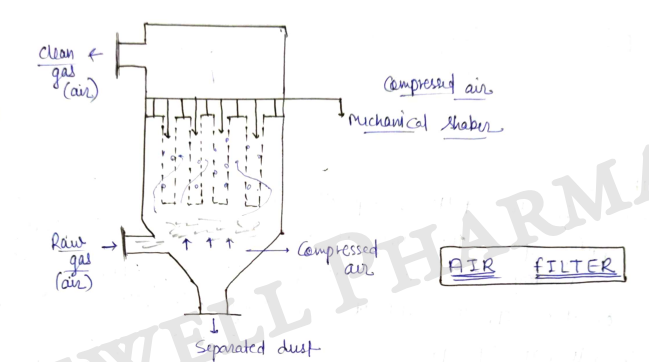
- In this filter, separation is occured in two step. firstly, pass the dirty powder air (air of milled powder) through a bags (which is made from cloth), by applying suction on the opposite side of feed entry. this facilitates the separation.
- In the next step, pressure is applied on that bag so adhesive powder fallen down, which is collected from the conical base.
Construction
- It consists of a number of bags made of cotton or wool fabric which is fixed in a metal container.
- There are one inlet in which feed enter.
- One outlet at downside, from which we get solid particles or our fine powder.
Working
- Firstly material is pass through bags and due to this particles are retained within the bags. because particle size is small but not small than bag. so it retained in bag.
- Then after air passed and we get cleaned air, with the help of mechanical shaker, bag is shaken and then attached particles fallen down and we get it (particles).
Uses
- Used to clean the air.
- Vaccum cleaner is based on that phenomena.
Elutriation Method
Principle
- It is based on the principle of sedimentation.
Construction 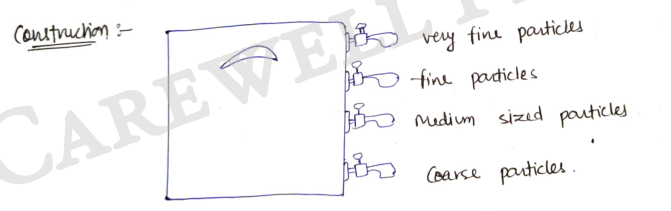
Working
- It is used to separate the coarse and fine particles of powders after levigation. The dry powder or paste made by levigation process are kept in elutriating tank and mixed with a large quantity of water. The solid particles are uniformly distributed in the liquid by stirring then it is allowed to settle down. Depending upon the density of solid particles, it will either settle down or remain suspended in water.
- These sample is withdrawn at different heights through the various outlets.
- These fraction are dried and thus the powder with collected sizes.
Uses
- For separation and separation of particles of different sizes.
Advantages
- Separation is quick as compare to other method of separation because it is an continuous process. Depending upon the number of fraction required same number of tubes of different area of cross section can be connected.
Disadvantages
- Sometimes the suspension of solid particles has to be diluted which may not be desired in certain cases.