Pathophysiology - Unit 4
Syllabus
Inflammatory bowel diseases, jaundice, hepatitis (A,B,C,D,E,F) alcoholic liver disease.
Disease of bones and joints: Rheumatoid arthritis, osteoporosis and gout
Principles of cancer: classification, etiology and pathogenesis of cancer
Diseases of bones and joints: Rheumatoid Arthritis, Osteoporosis,Gout
Scroll to Download
PATHOPHYSIOLOGY
UNIT-4
SYLLABUS
- Inflammatory Bowel disease, Jaundice, Hepatitis (A, B, C, D, E, F), Alcoholic liver disease.
- Disease of Bones and Joints: Rheumatoid Arthritis, Osteoporosis, Gout.
- Principles of Cancer: Classification, etiology and pathogenesis of cancer.
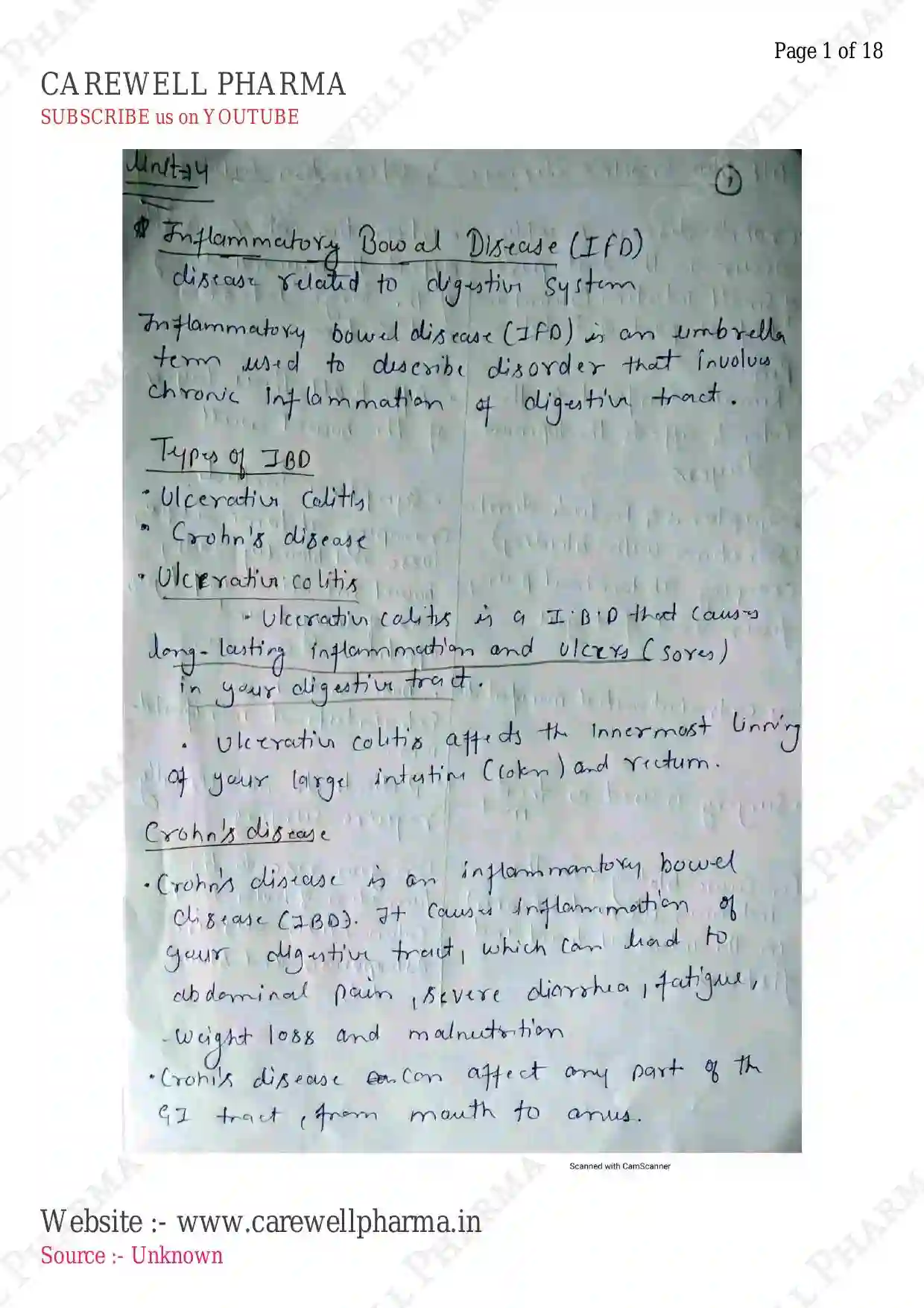
INFLAMMATORY BOWEL DISEASE
- These are group of disease which develop due to chronic inflammation of GIT (mostly occurs in intestines).
- Not able to digest food, absorb nutrition and eliminate waste.
- It is of two types:
- Crohn's disease
- Ulcerative Colitis
1. Crohn's disease
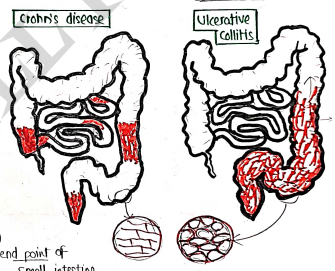
- It is a condition in which inflammation occurs in any part of GIT.
- It mainly starts from the end point of small intestine. (ileum) and forms skipping lesions. (appear in patches)
2. Ulcerative disease
- It is a chronic/long term condition in which inflammation occurs in large intestine, which mainly starts from colon rectum and this is continuous lesions.
- In this, the colon becomes inflamed and ulcers develop on the lining of colons (in severe case). These ulcers bleed and produce pus & MUCUS.
ETIOLOGY
- The exact causes are not known. But it can be caused due to:
- Genetic factors / predisposition
- GIT immune system
- Lymphatic obstructions
- Infections Mycobacterium paratuberculosis, infective diarrhoea, enteric microflora.
- Environmental factors Diet, stress, Allergies, smoking, Antibiotics etc.
- Fat intake, fast food, milk and fiber consumption.
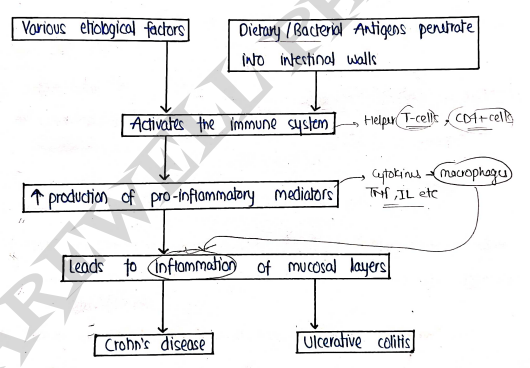
PATHOGENESIS
SIGN AND SYMPTOMS
- Chronic diarrhoea
- Weight loss
- fever
- Pain in abdomen
- Rectal bleeding
- fatique
- Anaemia
- Dehydration
COMPLICATIONS
- Bleeding
- Severe dehydration
- Colon cancer
- Bowel obstruction
- ulcers
- fistula
- Anal fissure
TREATMENTS
- Quality of life
- Avoid smoking, stress etc...
- Surgery (when no choice)
- Medications (Antibiotics, Immunomodulators)
JAUNDICE
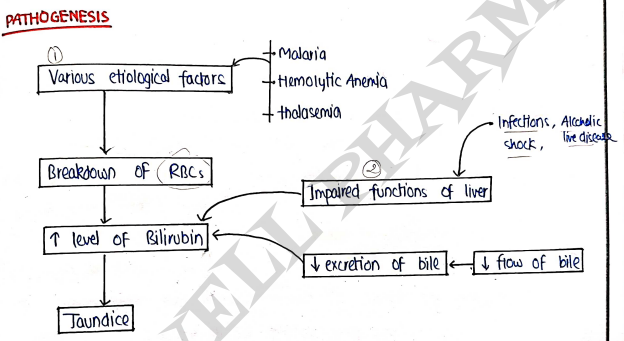
- It is defined as, it is the condition of yellowing of skin, mucous and sclera of the eye due to accumulation/deposition of bilirubin (Bile pigments).
- It is occurs due to condition of Hyperbilirubinemia i.e. increases level of bilirubin.
ETIOLOGY
These factors can be classified on the basis of their types:
1. Pre-Hepatic Jaundice: It is hemolytic Jaundice which occurs when the level of bilirubin increases due to breakdown and destruction of RBC (Hemolysis).
It is caused due to hemolytic anemia, malaria, thalassemia, toxins etc.
2. Hepatic Jaundice: It is occured due to defected liver cells or impaired functions of liver, when liver fails to metabolise/excrete bilirubin. Etiology Due to viral infections (Hepatitis A, B, C), tuberculosis, yellow fever, Alcohol, shock.
3. Post-Hepatic Jaundice: It is occured due to obstruction of biliary duct (blockage) which interrupt the flow of bile. It is caused due to Biliary atresia, gallstone in duct etc.
4. Neonatal Jaundice: It occurs in neonates.
SIGN AND SYMPTOMS
- Yellowing of skin and sclera of eyes
- weakness
- Gastrointestinal bleeding
- Diarrhoea
- Anemia
- Oedema
- weight loss
- itching of skin
- Dark Coloured urine
- fatigue
- Abdominal pain
PATHOGENESIS
TREATMENTS
- A high water intake and low diet of fact, helps to treat jaundice.
- Prevent breakdown/destruction of RBCs.
- Prevent further liver damage.
COMPLICATIONS
- Anemia
- Bleeding
- Electrolyte abnormalities
- Infections
- Liver cirrhosis
- Cancer
- Chronic hepatitis
HEPATITIS
- It is a condition of liver inflammation, which occurs due to any type of injury/infections.
- It is mostly caused due to viral hepatitis (hepatitis viral infections), toxic substances (alcohol, certain drugs) and autoimmune diseases.
TYPES
Hepatitis A
It is communicable liver disease which is caused by hepatitis A virus (single stranded RNA virus).
It can be transmitted via faecal-oral routes by consuming contaminated food or water.
Hepatitis B
It is a serious liver infection which is caused by infection of hepatitis B virus (double shelled spherical DNA virus).
This infection becomes chronic lasting for 6 months and more and mostly affects the infants and children and increases risk of liver failure, liver cancer or liver cirrhosis.
It is one of the sexually transmitted disease (STD) and it can be transmitted through contaminated needles, mother to infants, sex, close contact, blood transfusion and in hospitals.
Hepatitis C
It is liver inflammation or serious liver damage which is caused by infection of Hepatitis C Virus (Single stranded enveloped RNA virus).
It can be caused/spread through contaminated blood, blood transfusion, contaminated needles. It may cause liver cirrhosis, liver cancer or Liver failure.
Hepatitis D:
It is a liver disease which present in both acute/chronic forms and it is caused by infections of hepatitis D virus (small single stranded RNA virus) Delta virus.
It is self-replicating defective RNA virus, and only a person who is already infected with Hep-B can become infected with Hepatitis-D.
It can be spread through contaminated needles, blood transfusion, sex etc. Vaccination against hepatitis B is only method to prevent hep-D infections.
Hepatitis E:
It is a liver infection caused by infection of Hepatitis E Virus (small, single stranded, non-enveloped RNA virus).
It is spread through faecal-oral route, contaminated water supply and food supply, poor sanitation.
Hepatitis F:
It is also known as hypothetical virus.
It is non-existent, rounded, virus-like particles, and which is caused by infections of hepatitis virus.
SIGN AND SYMPTOMS
- fatique
- Nausea and vomiting
- Pain
- fever
- Appetite loss
- weight loss
- weakness
- Dark coloured urine
COMPLICATIONS
- Liver damage/failure
- Liver Cirrhosis (liver scarring improper liver functions)
- Liver cancer etc.
TREATMENTS
- No proper treatments.
- Vaccination for virus.
- Medications - acc to its types.
- Healthy diets, prevents risk factors.
ALCOHOLIC LIVER DISEASE
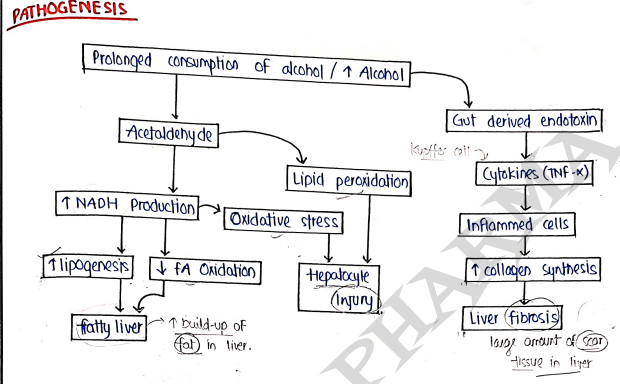
- It is a condition of a structural and functional changes in the liver which is mostly caused due to excessive consumption of alcohols.
- It is divided into three stages:
Alcoholic fatty liver : It is the initial and mildest stage which is caused by prolonged consumption of small amount of alcohols.
Alcoholic hepatitis : It is the second stage which is caused due to excessive consumption of alcohol which increases fatty changes and liver cell necrosis.
Alcoholic cirrhosis : It is the third and most advanced stage, which obstructs liver function and reduces blood flow through liver. Degeneration of cells, inflammation and fibrous thickening of tissue.
ETIOLOGY
- It is caused due to prolonged excessive consumption of alcohol (heavy drinking) resulting in Cirrhosis of liver tissue.
- It is mostly depends on how long alcohol consumed.
SIGN AND SYMPTOMS
- Initially, there are no symptoms but it become severe after prolonged heavy drinking.
- fatique and loss of energy
- Apetite and weight loss
- Nausea
- Pain in abdomen
- At advance stage
- Oedema and ascites
- Jaundice
- Redness on palms
- Impotence, shrinking of testicles, enlarged breasts in men etc.
PATHOGENESIS
COMPLICATIONS
- Ascites (abdominal swelling) and bacterial peritonitis
- Coagulopathy (bleeding disorders)
- Hypertension
- kidney failure
- Liver cancer / failure
TREATMENTS
- Less consumption of alcohol
- Healthy diet (low salt)
- vaccination for influenza, hepatitis A, B, pneumonia
- Antibiotics
- Surgery
- Liver transplant
DISEASE OF BONES & JOINTS
- These are those disease which are related to bones and Joints. Osteology is the study of bones and teeth.
- Joints are those sites where two or more than two bones are meet/join together to carry out the movement.
- Three main disease:
- Rheumatoid arthritis
- Osteoporosis
- Gout
RHEUMATOID ARTHRITIS
- It is chronic, inflammatory, autoimmune disorder which affects the wide range of Joints, connective tissue, tendons etc.
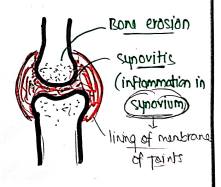
- It is autoimmune disorder, so immune system attacks the synovium.
- due to this, synovium becomes inflamed and thickens which ultimately destroys the cartilage and bone within Joints. (weak swollen and painful Joints).
- Synovitis (inflammation in Synovium lining of membrane of Joints) growth of tiny Inflammatory cells Bone erosion.
ETIOLOGY
- Womens are more susceptible than mans.
- Genetic factors Genes connected to Immune responses (HLA-A, HLA-B proteins). HLA-C, HLA-D. Other genes PTPN 22, PADI4, STAT4 etc.
- Environmental factors Smoking, Pollutants, Obesity.
- Bacterial and viral pathogens (eg. sarcoidosis).
PATHOGENESIS
- Various etiological factors Inflammation $\downarrow$
- Activation of T-cells and B-cells $\downarrow$
- Production of autoantibodies and cytokines $\downarrow$
- Overproduction of pro-inflammatory cytokines including TNF-$\alpha$ and IL-6, IL-1 $\downarrow$
- Inflammatory pathway initiated in joints $\downarrow$
- proliferation of synovial cells $\downarrow$
- Pannus formation $\downarrow$
- level of lipids in synovial membrane increased $\downarrow$
- Cartilage destruction and Bony erosion $\downarrow$
- Rheumatoid Arthritis (inflammation in joints)
SYMPTOMS
- Pain and stiffness in joints (in wrists)
- Swelling
- Deformity of joints
- fatique, weakness
- Depression
COMPLICATIONS
- Osteoporosis
- Dry eyes & mouth
- Infections
- Heart problems
- Lung disease
- lymphoma (risk of blood cancer in lymph system)
TREATMENTS
- Healthy diet
- Physical exercise
- Surgery.
- Medications Methotrexate, anti TNF agents, corticosteroids etc.
OSTEOPOROSIS
- Osteo Bones & Porosis Pores
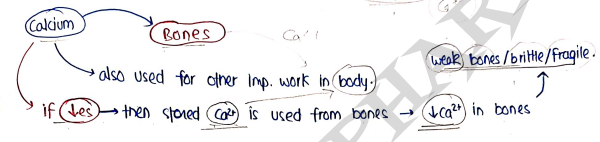
- It is a condition in which bones become weak and brittle.
- In this condition, the density and strength of bones are decreases which results in fragile bone. (Bones become porous).
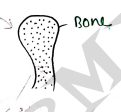
- It is caused due to Imbalance between new bone formation and old bone resorption.
ETIOLOGY
- Age (more in older age)
- Deficiency of oestrogen in females
- deficiency of androgen in males
- inadequate intake of calcium and Vit. D
- Thyroid disorders, Genetic disorders, Bone cancer etc.
SIGN AND SYMPTOMS
- No symptoms at early stage, but after this
- Back pain due to fractured/collapsed vertebra
- Easy bone fractures
- Loss of height over time
- A stooped posture
COMPLICATIONS
- Hip fractures on even small accident / easily by falling.
- Spinal fractures occur even without any accident.
- Back pain, Lost height, A stooped posture.
PATHOGENESIS
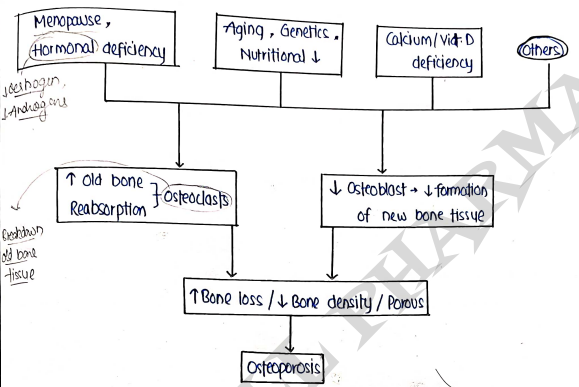
TREATMENTS
- Healthy life style
- Stop alcohol/smoking
- Calcium/vit.D Supplements to prevents
- Medications Raloxifene (effect similar to estrogen). Hormone related therapy. Monoclonal antibody.
GOUT
- It is a metabolic disorder occurs due to deposition of monosodium urate (uric acid) within the tissue, leads to the inflammation and pain (mostly in Joints).
- It is Inflammatory disease and a very painful form of arthritis due to deposition of uric acid crystals due to hyperuricemia (elevated levels of uric acid in blood).
TYPES
- Primary Gout: It is mostly occurs due to unknown reasons/results.
- Secondary Gout: It is mostly caused due to underlying disease.
ETIOLOGY
- It is caused due to overproduction of uric acid (Hyperuricemia).
- Genetic factors (mutation in genes involves purine metabolism).
- Underlying disease (hypertension, diabetes mellitus, obesity, renal disease, Sickle cell anemia, chronic kidney disease).
- Other drugs Cytotoxics, thiazides, hydrochlorothiazides etc.
- purine intake (Red meat, sea food, high fructose).
SIGN AND SYMPTOMS
- Joint pain (mostly at night)
- Redness, swollen, Inflammation
- Gout attack (severe pain)
- formation of tophi (large, hard nodules formed due to deposition of urate crystals in soft tissue).
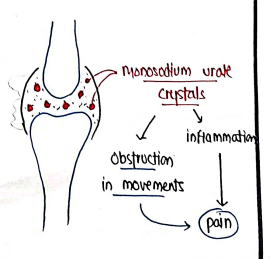
PATHOGENESIS
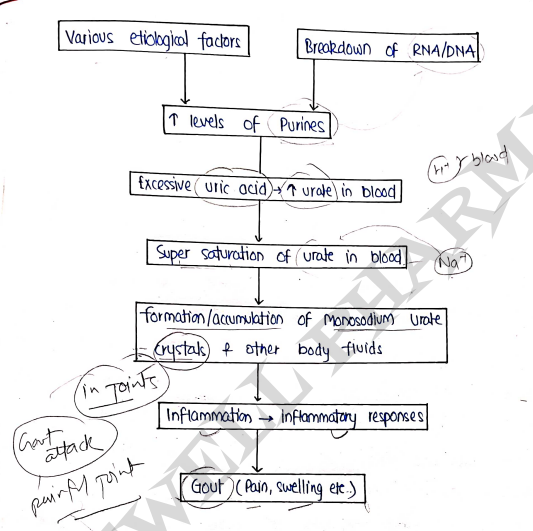
COMPLICATIONS
- Disability in patients due to chronic gout
- formation of tophi
- Hypertension
- Urate kidney stone
- Albuminuria
TREATMENTS
- Healthy lifestyle / ideal weight
- Avoids purines rich foods
- Increasing fluid intake
- Alcohol consumption
- Medications Colchicine, Corticosteroids, Probenecid, NSAIDs (Indomethacin, diclofenac etc.), Allopurinols etc.
CANCER
- It is a group of disease which involve an abnormal and uncontrolled cell division in body cells.
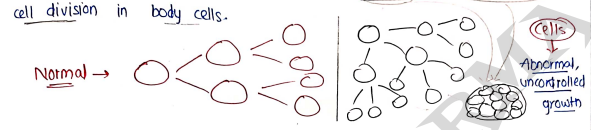
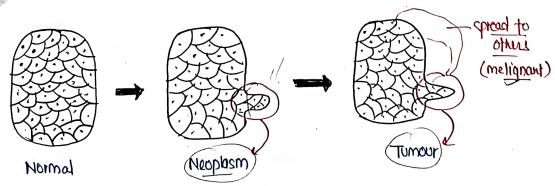
Neoplasm: An abnormal mass of tissue that forms when cells grow and divide more than they should or do not die when they should, it leads to formation of tumour, develop cancer.
It is of two types:
Benign: It is not a cancer (initial) and in this tumour develops in localised and do not spread to other body parts. (Can treat).
Malignant: It is a cancer which grow rapidly and also spread to other body parts. It is dangerous & leads to death. (no treatment).
Metastasise: It is a process in which the tumour spreads to other sites from the origin.
Carcinogenesis / Tumourigenesis: It is a multistep process which begins with conversion of normal cells into cancer cells.
ETIOLOGY
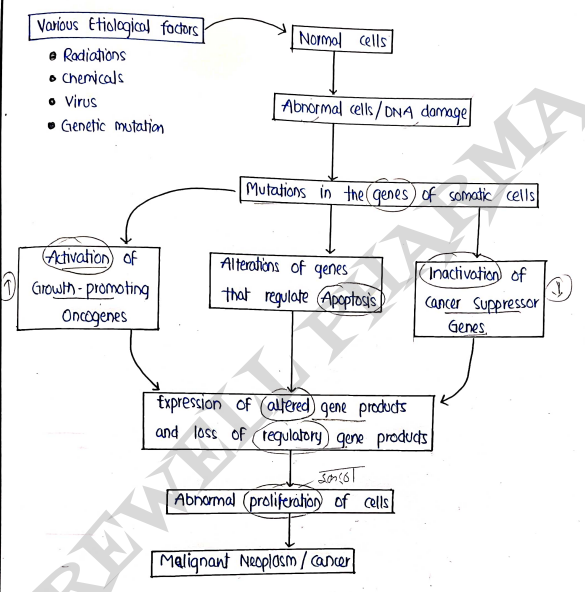
- Mutation in genes
- Heredity (from parents)
- Virus, Bacteria etc.
- Physical Agents Carcinogens, Radiations (UV rays etc) etc.
- Chemical Agents some toxic substances (eg. Benzene), plastic.
- Others Smoking, Tobacco, Air pollution, Diet, Alcohols, obesity, hormones etc.
TYPES
It can be classified as many way, it is mainly based on where it begins:
- Carcinomas: It begins in the Skin or the tissue that covers the surface of internal organs and glands. eg. Breast cancer, Prostate cancer, Lung cancer, Colorectal cancer etc.
- Sarcomas: It begins in the tissue that support and connects the body. A sarcoma can develop in fat, muscles, nerves, tendons, joints, blood vessels, Lymph vessels, cartilage/bones.
- Leukemias: It is blood cancer which begins when healthy blood cells change and grow uncontrollably.
- Lymphomas: It begins in the lymphatic system (helps to fight against infections).
SIGN AND SYMPTOMS
- Normal functions/work
- Shortness of breath
- Chest pain
- Cough
- Abdominal pain
- Heaviness
- Severe pain
- Anaemia
- Anorexia
- weight loss (changes)
- Sleeping disorder
- fatique
PATHOPHYSIOLOGY / PATHOGENESIS
COMPLICATIONS
- Weight loss
- Constipation
- confusion
- excessive thirst
- frequent urination
- Hormonal Imbalance
- Nervous System problem
- Breathing problem
- Death at last
TREATMENTS
- Radiotherapy: Burns that tumour (also burn some sideway cells).
- Surgery: Cut the tumor (most dangerous).
- Chemotherapy: through chemicals & medicines. e.g. Mechlorethamine, Mercaptopurines, Cisplatin and other antibiotics.