Pathophysiology - Unit 3
Syllabus
Haematological Diseases: Iron deficiency, megaloblastic anemia (Vit B12 and folic acid), sickle cell anemia, thalasemia, hereditary acquired anemia, hemophilia
Endocrine system: Diabetes, thyroid diseases, disorders of sex hormones
Nervous system: Epilepsy, Parkinson’s disease, stroke, psychiatric disorders: depression, schizophrenia and Alzheimer’s disease.
Gastrointestinal system: Peptic Ulcer
Scroll to Download
HAEMATOLOGICAL DISEASE
UNIT-3
SYLLABUS
- Haematological Disease: Iron deficiency, Megaloblastic anemia (Vit and folic acid), sickle cell anemia, thalasemia, hereditary acquired anemia,
- Endocrine system: Diabetes, thyroid disease, disorders of sex hormonus Hemophilia
- Nervous System: Epilepsy, Parkinson's disease, stroke, psychiatric disorders: depression, schizophrenia and Alzheimer's disease.
- Gastrointestinal System: Peptic ulcer.
Introduction
- These are those diseases which occurs in the haematological system.
- Haematology is the branch of science that deals with the study of blood components and blood-forming tissues.
- Blood is made up of: plasma and formed elements.
Blood Components:
- RBCs Hb
- WBCs
- Platelets
ANEMIA
- It is defined as, it is the reduction of Hemoglobin (Hb) and RBCs concentration in blood below the normal range.
- Due to deficiency of Hb/RBCs, there will be decreasement in the amount of in body, which can cause serious damage/diseases.
- Anemia is the low level of blood in body, mainy RBCs Hb .
* It is of following types: 1. Iron deficiency Anaemia 2. Megaloblastic Anaemia 3. Sickle cell Anaemia 4. Thalasemia 5. Hereditary acquired anemia 6. Hemophilia
IRON DEFICIENCY ANAEMIA
- It is the most common type of anemia in the word. It is occurs due to deficiency of iron ($Fe^{2+}$) in the blood.
- Iron ($Fe^{2+}$) is an essential mineral which forms Hemoglobin (Hb). These Hb contains and transported it into body.
- These Hemoglobin (Hb) further forms RBCs which forms blood.
- So, deficiency of Iron ($Fe^{2+}$) leads the deficiency of blood which decreases the supply.
ETIOLOGY
- It is caused due to:
- Blood loss (due to peptic ulcer, GI bleeding, MC, OTC medicines)
- Lack of Iron in Diet
- Inability to absorb Iron
- Pregnancy
SIGN AND SYMPTOMS
- Extreme fatigue
- Weakness
- Pale skin
- chest pain, fast heartbeat
- Headache, dizziness
- Cold hands and feet
- cracks in the sides of the mouth.
- Poor Apetite
- Brittle Nails
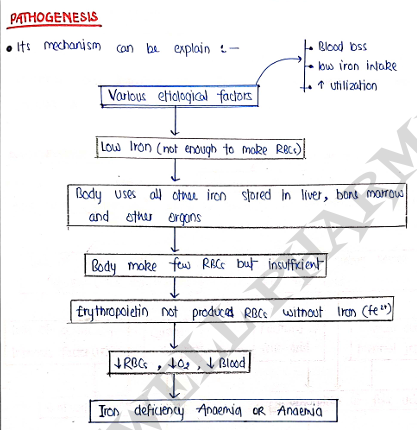
PATHOGENESIS
- Its mechanism can be explain-
COMPLICATIONS
- Heart problems
- Growth problems
- problems during pregnancy
- Angina (severe level)
TREATMENTS
- Iron supplements
- Iron replacement therapy
- Oral formulation of Iron
- Combination of iron with ascorbic acid.
MEGALOBLASTIC ANEMIA
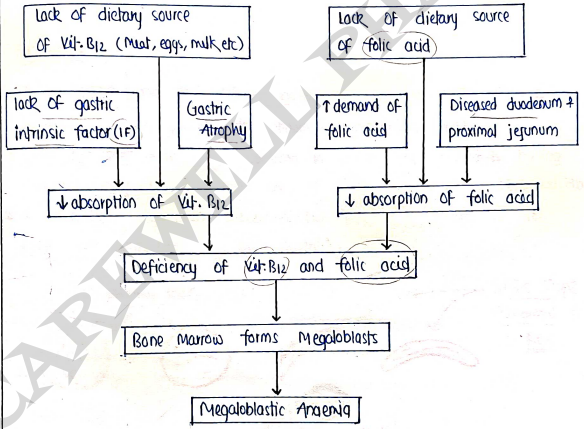
- It is a condition in which Bone marrow forms large, structurally abnormal and immature RBCs known as megaloblasts and this condition is known as Megaloblastic Anaemia.
PATHOPHYSIOLOGY
- It is mainly caused due to deficiencies of cobalamin (Vitamin $B_{12}$) or folic acid (Vitamin $B_9$), which is essential in the formation of RBCs.
SYMPTOMS
- fatigue
- Pale skin
- Breathlessness
- Dizziness
- fast/irregular heart beat.
TREATMENTS
- Oral supplements for Vit. and folic acid.
- Dietary sources for Vit. /folic acid.
SICKLE CELL ANEMIA
- It is also called as Sickle Cell Disease.
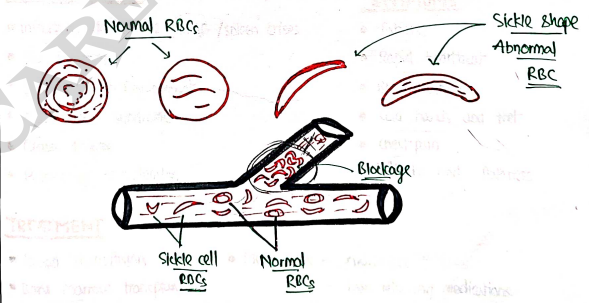
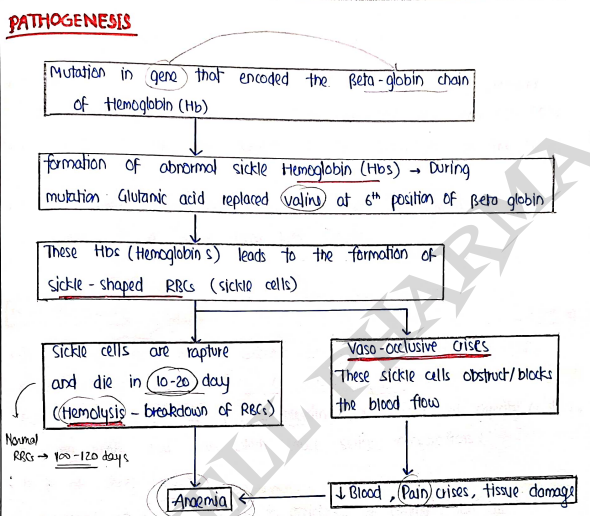
- It is genetic blood disorder/disease in which abnormal hemoglobin (HbS) causes the RBCs to attain sickle-like shape.
- Now, these sickle-shaped RBCs are rigid and sticky which blocks the small blood vessels which slow down the block flow and oxygen.
- this results in pain and organ damage. It is a life-long disease.
- It is caused when the abnormal Hemoglobins (HbS) is passed via genes from parents to their children.
ETIOLOGY
- It is caused due to defected genes in any individuals which is inherited from parents for abnormal hemoglobin S (HbS).
- Sickle cell trait It is a condition in which the individuals having only one copy of the gene are of sickle cell gene and abnormal Hb/RBCs.
- It is occured only when person/individual inherit two copies of the sickle cell genes (one from each parents).
PATHOGENESIS
COMPLICATIONS
- Infections - damage the spleen / spleen crises
- Eye Problem
- Growth and Development
- Acute Chest Syndrome
- Organ failure
- Pulmonary hypertension
SYMPTOMS
- fatique
- Rapid heartbeat
- Breathlessness
- Cold hands and feet
- Chest pain
- Headache and Paleness
TREATMENT
- Blood Transfusion
- Bone marrow transplant
- Prevent infections
- Medications - Antibiotics, Pain-relieving medications
THALASSEMIA
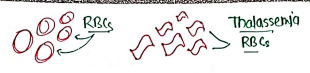
- It is an inherited blood disorder in which the body produces abnormal hemoglobin which forms abnormal Red blood cells (RBCs).
- This leads to the less number of Hemoglobin/RBCs in the blood which leads to anemia.
- It is mainly occurs due mutation in gene of hemoglobin, which is inherited to a person from their parents.
HAEMOPHILIA
- genetic clotting disease/disorder
- It is an inherited bleeding disorder in which blood does not clot proper/normally due to lack of clotting factors. (only cause & etiology)
- Due to this, their are internal bleeding, low blood clot capicity or slow, bleeding Joints and pain which cause serious complications.
- It is of three types:
- Haemophilia A (classic) due to deficiency of clotting factor VIII (Most common about 90% patients)
- Haemophilia B (christmas disease) due to deficiency of clotting factor IX
- Haemophilia C (Rosenthal's H) due to deficiency of clotting factor XI
ENDOCRINE SYSTEM
- It is the collection of glands that produce hormones that regulates many physiological functions in body such as growth and development, metabolism, sexual functions and many more.
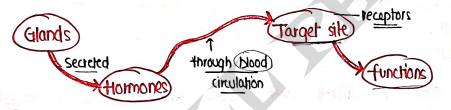
- Hormones are those substances which is produced by various specified cells (glands) in the body and then transported through blood circulation to their target site, where they perform their biological activity.
- Endocrine System Disorders are those conditions, which occurs due to imbalance secretion of hormones.
- Hyposecretion is a condition of low quantity of hormone secretion.
- Hypersecretion is a condition of overproduction of hormone ($\uparrow$ quantity).
Total Glands:
- Pituitary Glands
- Thyroid glands
- Parathyroid
- Adrenal gland
- Pancrease
- Testis
- Ovary
Disease/Disorder:
- Diabetes Mellitus (DM)
- Thyroid disease
- disorders of sex hormones
DIABETES MELLITUS
- It is a metabolic disease in which blood sugar level is high for a prolonged period of time i.e. condition of hyperglycemia (glucose).
- It is a serious disease in which a person's body cannot control the level of sugar in the blood.
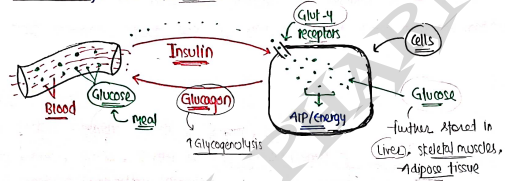
Insulin It is a hormone secreted from $\beta$-cells of islets of langerhans of pancrease which main work is to utilise the glucose present in blood (uptake of glucose).
- In case of Diabetes, Glucose is not utilised by cells causes chronic hyperglycemia (can cause multiple organs damage Liver, kidney, nerves) and starvation in cells for energy.
TYPES OF DIABETES
- It is mainly of two types:-
- Type I diabetes / Insulin dependent D.M. (IDDM)
- Type II diabetes / Non-Insulin dependent D.M. (NIDDM)
1. Type I diabetes
- It is also known as Insulin dependent diabetes.
- It is a chronic condition in which the pancrease produce little or no insulin. It is less common, about only 10% cases.
- It is mainly caused due to destruction of $\beta$-cells, which produce low or no Insulin, so no glucose uptake occured.
- It may be Juvenile-onset disease (begins in childhood) and radiopathy (autoimmunity).
2. Type 2 diabetes
- It is also known as Non insulin dependend diabetes.
- In this, pancrease make insulin but body cells does not uptake the glucose, may be due to impairment functions of receptor or insulin.
- It is most common, about 90% of diabetes cases. (also a chronic condition).
ETIOLOGY OF DIABETES
- Genetic factors (genetic defects in $\beta$-cells, mutation etc)
- Obesity, Age, stress, diet of carbohydrates (sugar)
- Alcohol, smoking (unhealthy lifestyles)
- Destruction of \beta$-cells, Injury to pancrease $\rightarrow Deficiency of insulin synthesis/secretion
- Infections etc. Autoimmune disease
- Environmental factors
PATHOGENESIS
FOR TYPE I DIABETES
- It is occurs when body cannot make sufficient/enough insulin.
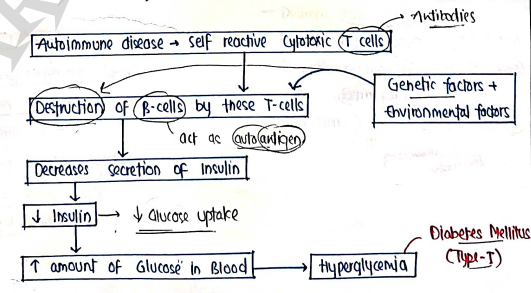
FOR TYPE II DIABETES
- It is occurs when insulin does not perform its functions.
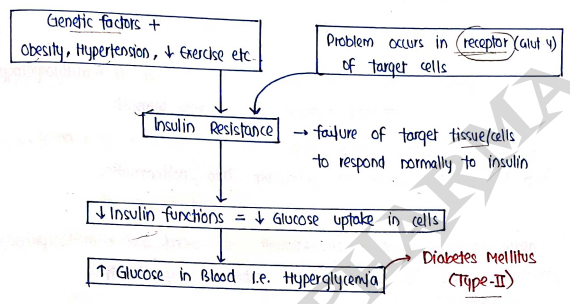
SIGN & SYMPTOMS
- Increases thirst (polydypsia)
- Increases in urination (polyuria)
- Extreme hunger (polyphagia)
- weight loss
- Extreme fatigue and Headache
- Blurred Vision
TREATMENTS
- Oral hypoglycaemic agents
- Insulin therapy
- Maintain diet
- Exercise, healthy lifestyles
- Avoid sugars, salt
- weight control etc..
COMPLICATIONS
- Short term complications
- Diabetes ketoacidosis
- Hyperosmolar Non-ketotic coma
- Hypoglycaemia
- Long term complications
- Atherosclerosis
- Diabetic microangiopathy
- Diabetic nephropathy
- Diabetic neuropathy
- Retinopathy
- Infections
THYROID DISEASES
These are those disease which occurs when their are any abnormality occurs in thyroid gland and their hormones.
Hypothyroidism It is a condition, when thyroid gland secretes decreased amount of thyroid hormones.
Myxoedema It is rare complicate skin disease which involves the inflammation and thickening of skin. It is caused due to severe hyperthyroidism.
Hyperthyroidism Also known as thyrotoxicosis. It is a condition, when thyroid gland secretes excess amount of thyroid hormones.
Graves' disease It is immune system disorder which leads to overproduction of thyroid hormones (overactive thyroid).
Goitre It is a condition, in which the thyroid gland enlarges abnormally. It is due to lack of dietary iodine.
DISORDERS OF SEX HORMONES
Those disorders which occurs due to imbalance in sex hormones.
Polycystic Ovary Syndrome (PCOS) It is hormonal disorder, which mainly affects the levels of sex hormones. It mainly affects the irregular or prolonged menstrual periods, excess male hormones, follicles on ovaries, failed to release eggs.
Hirsutism It is a condition in which unwanted, dark and rough hair grows on the face, back and chest of women due to excess/abnormal male hormones (androgen).
Erectile dysfunction (ED) It is a condition in which males are unable/fails to achieve the erection (occurs due to lack of blood in penis).
Gynecomastia It is a condition of benign enlargment of male breast due to proliferation of its glandular components. It may be due to low level of testosterone (as compared to oestrogen).
PEPTIC ULCER
Peptic ulcers are open sores that develop in the inside lining of the oesophagus, stomach and duodenum (upper portion of small intestine) due to increase level of acid.
It is of three types:
Gastric Ulcer Ulcer in stomach due to defective factors + H. Pylori
Duodenal ulcer ulcer in duodenum due to aggressive factors + H. Pylori
Oesophageal Ulcer ulcer in esophagus, due to reflex activity
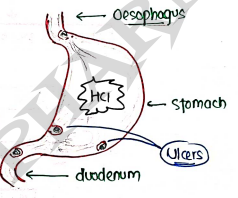
- Peptic ulcer is managed by balance between aggressive and the defensive factors.
- Peptic ulcer caused due to imbalance b/w these two types of factors.
ETIOLOGY
- H. Pylori infect stomach, causing inflammation, HCl
- NSAIDs Aspirin, ibuprofen increases the risk
- Genetic factors Zollinger-Ellison syndrome
- Smoking, stress, Alcohols
- Radiotherapy
- Cancer of stomach
AGGRESSIVE FACTORS ($\uparrow$) =
- Acids (HCl)
- Pepsin
- Bile acid
- Gastrin
- H. Pylori
DEFENSIVE FACTORS ($\downarrow$) =
- Gastric Mucus
- Bicarbonate
- Prostaglandin
- Nitric Oxide (N.O.)
PATHOGENESIS
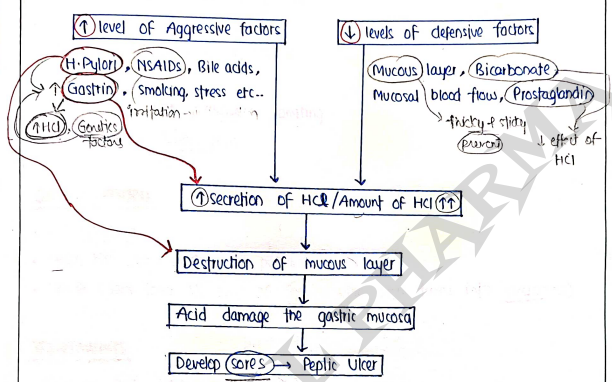
Peptic ulcer occurs, where there is imbalance b/w these factors.
H. Pylori Helicobacter pylori mainly found in gastric/duodenal mucosa. It increases the pH (Basic) damage local region of mucosa. It increases the Gastrin release secretion of HCl Ulcers.
NSAIDs activity of Prostaglandin, irritation in lining of GIT.
Genetics Zollinger-Ellison Syndrome (cause tumors as gastrinomas) which increase secretion of Gastrin release HCl Ulcers.
Mucosa, Bicarbonate, Prostaglandins they have preventive nature, but decreasement in their amount can leads to increases the effect of HCl which cause ulcers--
SYMPTOMS
- Stomach pain/burning pain (most common)
- Less common Heartburn, Bloating, Nausea, Vomiting
- Severe symptoms Dark or black stool, Blood in Vomiting, Weight loss, Severe pain
COMPLICATIONS
- Haemorrhage
- Obstruction (ulcer develop near pylorus)
- Cancer (less than 1% cases of gastric ulcers may turns into carcinoma)
TREATMENTS
- Healthy diets (avoid acidic foods)
- Prevent unwanted/more uses of NSAIDs
- Healthy lifestyles (avoid smoking, stress)
- exercise
- Medications:
- Antibiotics
- Antacids
- Acid suppressors etc--
NERVOUS SYSTEM
- It control and coordinate the human body and it gives the quick response to our body.
- Nervous system is made up from highly specialised cells i.e Neurons + Neuroglial cells.
- Problem related/occured in Nervous System:
- Epilepsy
- Parkinson's disease
- Stroke
- Psychiatric disorders (Depression, schizophrenia and Alzheimer's disease)
EPILEPSY
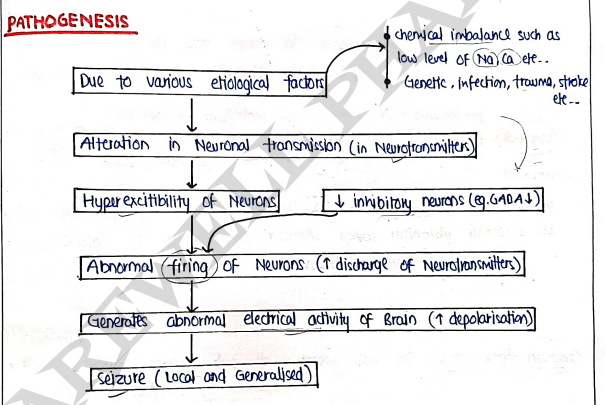
- Epilepsy is a group of disorders of brain, which mainly leads to periodic and unpredictable occurance of seizures.
- According to WHO, Epilepsy is a condition having a tendency for recurrent seizures (2 or more), due to disorder of brain cells.
- Seizures are (Convulsions) uncontrolled jerking, loss of consciousness and disturbance of sensation, movement, behaviour, perception due to excessive and temporary neuronal discharge (leads to abnormal electrical activity).
- These disorder comes under paroxysmal cerebral dysrhythmia.
SYMPTOMS
- Seizures
- Loss of consciousness
- Temporary confusion
- uncontrolled jerking
- Nausea, vomiting, sweating, flushing, dizziness, depression and anger etc.
ETIOLOGY
- It is caused due to abnormal and excessive discharge of neuron in the brain, which leads to increases electric activity and generate seizures.
- It may be caused due to:-
- Genetic factors (from parents)
- Head trauma (due to any type of accident & trauma)
- Brain damage (due to tumours / stroke)
- Infectious disease (Meningitis, AIDS, Viral encephalitis etc..)
PATHOGENESIS
TYPES
- Partial seizures There are local/focal seizure in which excessive neuronal discharge begins locally and remains localised. It includes involuntary muscle contraction, abnormal senses, or effects on mood and behaviours.
- Generalised seizures In this, the whole brain is involved including Reticular system. In this, discharge and electrical activity in whole brain results an Immediate loss of consciousness.
PARKINSON'S DISEASE
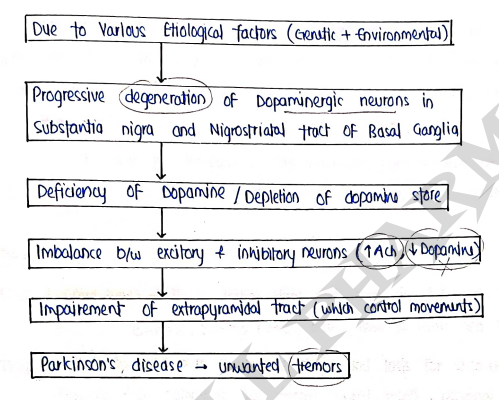
- It is a chronic neurodegenerative disorder of nervous system, which is categorised as movement disorder due to insufficiency of dopamine disease.
- In 1817, James parkinson find it as a movement disorder that's why its name is parkinson's.
- Generally, it affects the elderly.
Basic mechanism:
- Generally there are two types of neurons in our body, which maintain balance and facilates movements.

- Excitory/facilitatory Neurons Acetylcholine
- Inhibitory Neurons Dopamine
- Balance normal movement.
- In case of parkinson the level of dopamine decreases due to degeneration of dopamenergic neurons, which ultimately increases the level of acetylcholine leads to unwanted movement (tremor).
ETIOLOGY
- It is mainly caused due to degeneration of dopamenergic neurons in basal ganglia (control movements).
- It can be caused due to:
- Genetic factors
- Environmental factors such as Age, sex, dietary habits, infections, toxins etc.
- Head trauma
- Neoplasm (tumor)
- Atherosclerosis
PATHOGENESIS
SIGN & SYMPTOMS
- Tremors (shaking)
- Bradykinesia (slow movement)
- muscle rigidity (stiff)
- urge to move
- Abnormal posture
- Restless leg syndrome
- Loss of automatic movements
- Loss of sense of smell
- Pain, Mood / sleep disorder
COMPLICATIONS
- Depression
- Anxiety
- Dementia (impairment in memory, thinking & social abilities.)
- Behavioural disturbance
- Apathy (lack of interest, emotion, motivation)
- Dysphagia (difficulty in swallowing)
- Sleep disorders
- Sexual dysfunction etc..
TREATMENT
- Physical therapy such as PWSTT (Partial weight Supported Treadmill Gait training) + Wireless Vibratory feedback system
- Dopamine precursor
- Dopamine facilitator
- Dopaminergic Agonists etc..
ALZHEIMER'S DISEASE
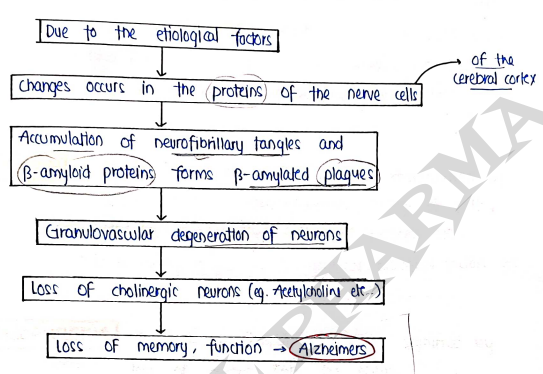
- It is an irreversible progressive and neurodegenerative disease in which severe impairement in cognitive and functional ability of patients.
- In this, patients slowly lose their memory, awareness, thinking ability and leads to dementia to perform easiest task.
- It is caused due to increase in the production/accumulation of $\beta$-amyloid proteins in the brain that leads to nerve cell death.
TYPES
Stage 1 (Mild type) It is initial stage and lasts for 2-4 years. Patients feels less energetics, minors memory loss, slow to learn and react.
Stage 2 (Moderate type) It is longest stage and lasts for 2-10 years. Patients feels symptoms like forget recent events, personal history, become disabled, difficulty in speech, reading and writing.
Stage 3 (severe type) It is last and severe stage. In this, Patients may lose the ability to feed themselves, impaired speech, uncontrolled body functions (bladder control).
ETIOLOGY
- The exact causes are not known, but these may be a causes:
- Deficiency of neurochemical agents (Acetylcholine, Nor epinephrine, somatostatin, Substance P)
- Genetic factors (family history)
- Advancing Age
- Trauma (accident)
- Other disease (vascular disease, diabetes, hypertension, Stroke)
- Smoking, fat, obesity.
PATHOGENESIS
SYMPTOMS
- Memory loss
- Loss of memory, function
- forgetfulness/absent mindedness
- feeling confused
- Depression
- weakened vision
COMPLICATIONS
- Aspiration (inhaling food/liquids into lungs)
- Pneumonia and other infections
- fractures
- Bedsores (injury to skin tissue / pressure ulcer)
- Malnutrition or dehydration
- Aggressiveness
TREATMENT
- To maximise the patient's ability to function in daily life.
- maintenance of quality of life.
- Avoids alcohol, sedatives, Antihistamines
- Treatment and management of cognitive (thinking, memory & perception).
- Cholinesterase inhibitors
- Glutametergic Agents
STROKE
- It is a life-threatening condition that occurs when brain does not get enough amount of blood flow.
- Also known as Cerebrovascular accident (CVA).
- It is occurs due to occlusion/rapturing of blood vessels (haemorrhaging).
DEPRESSION
- It is a common mental disorder, characterised by sadness, loss of interest/pleasure, feelings of guilt, disturbed sleep/appetite, feeling of tiredness etc..
- It is mainly caused due to biological factors etc..
SCHIZOPHRENIA
- It is a psychotic condition signified by loss of contact with the reality.
- It is mental disorder which includes extreme imaginary thinking, behaviour, hallucinations and delusions. Thoughts.