Biochemistry - Unit 5
Syllabus
Enzymes
Introduction, properties, nomenclature and IUB classification of enzymes Enzyme kinetics (Michaelis plot, Line Weaver Burke plot) Enzyme inhibitors with examples Regulation of enzymes: enzyme induction and repression, allosteric enzymes regulation Therapeutic and diagnostic applications of enzymes and isoenzymes Coenzymes -Structure and biochemical functions
Scroll to Download
ENZYMES
UNIT-5
SYLLABUS
Introduction, properties, nomenclature and IUB classification of Enzymes, Enzyme kinetics (Michaelis plot, Lineweaver Burke plot), Enzyme inhibitors with examples, Regulation of enzymes: Enzyme induction and repression, Allosteric enzymes regulations, Therapeutic and diagnostic applications of enzymes and isoenzymes, Coenzymes - structure & functions.
INTRODUCTION
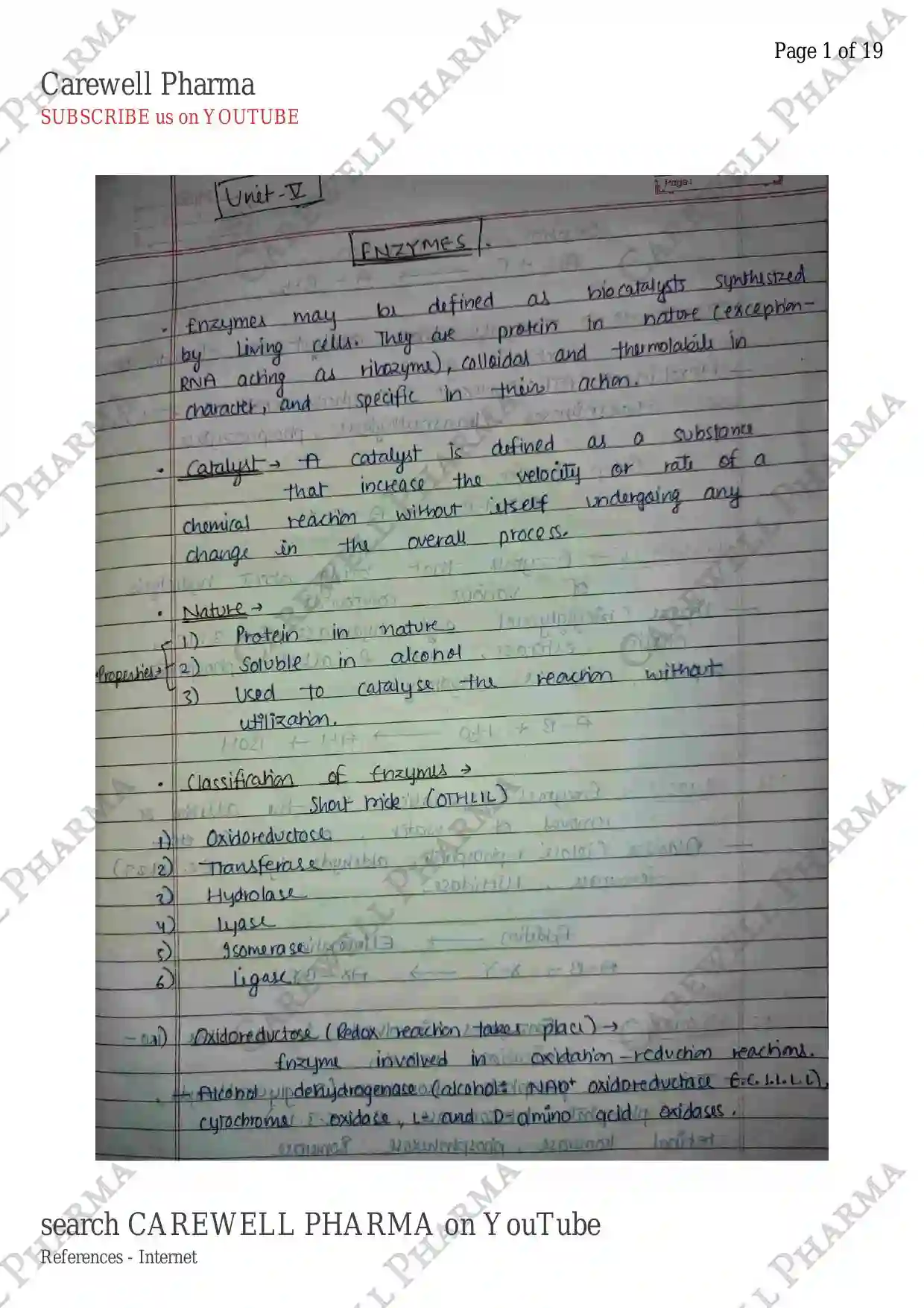
- Enzymes are biocatalyst present in cells that alter the rate of biochemical reactions without getting itself involved in the reactions (mostly speed up).
- These are made up of proteins, and all types of biochemical reactions required enzymes.
- These are highly specific to its substrate.

PROPERTIES OF ENZYMES
- Enzymes are complex macromolecules with high molecular weight. or more.
- All enzymes are proteins, except group of catalytic RNAs.
- They catalyze biochemical reactions in a cell. They helps in the breakdown of large molecules into small molecules or small to large, vice-versa.
- Enzymes donot start a reactions, they help in accelerating it.
- Enzymes are highly specific to its substrate.
- Enzymes affects the rate of reactions, not the direction.
- Enzymes also specific to temp and pH (required optimum). 5-7.
- Enzymes accelerates the reaction, but itself remains unchanged.
- Mostly enzymes work alone but some enzyme needs cofactor & coenzymes.
NOMENCLATURE & IUB CLASSIFICATION OF ENZYMES
- Earlier, enzymes were assigned names based on the one who discoverd them and some enzymes were named on the basis of functions e.g. Pepsin a digestive enzymes (pepsis means digestion).
- Now, enzymes were named by adding the suffix "ase" to substrate or to a word defining the activity. e.g. polymerase enzyme performs polymerisation, Urease urea hydrolysis.
- With further research, classification become more comprehensive. for this IUB organised.
- According to IUB (International Union of Biochemistry), Enzymes are classified into six major classes based on the types of reactions in which they catalyze.
- Each enzyme is given a systemic name and a specific four part classification.

Classes (OTHLIL):
- Oxidoreductase
- Transferases
- Hydrolases
- Lyases
- Isomerases
- Ligases
1. Oxidoreductase
- These are those enzymes which catalyze redox (oxidation and reduction) reactions. + transfer of electrons.
- e.g. dehydrogenase (removal of H), Oxidase (addition of $O_2$).
2. Transferase
- These are those enzymes which catalyze the transfer of chemical group/functional group from one molecules to another.
- e.g. Transaminase. Amino acids + $\alpha$-keto acids
3. Hydrolase
- These are those enzymes which catalyze the hydrolysis of substances by addition of water.
- e.g. Pepsin, Lipase. Proteins Lipids
4. Lyase
- These are those enzymes which catalyze the breakage of bonds without water.
- e.g. Aldolase. Fructose-1,6-biphosphate (6C) Glyceraldehyde-3-phosphate (3C) + Dihydroxyacetone phosphate (3C)
5. Isomerase
- These are those enzymes which catalyze the conversion of one isomer into another by transferring a group of b/w them.
- e.g. Isomerase. $G-3-P \rightleftharpoons DHAP$ (helps in isomerisation)
6. Ligase
- These are those enzymes which catalyze the association/synthesis of two molecules. $A + B \rightarrow A-B$
- e.g. DNA Ligase, joins two fragments of DNA.
MECHANISM OF ENZYME ACTION
- The basic mechanism of enzyme action is to catalyze the chemical reactions, which begins with the binding of substrate with the active site of the enzyme.
- The active site of enzyme is a specific area that combines with the substrate.

Enzyme-Substrate interactions/complex
- An enzyme-substrate complex is formed when a substrate is acted upon by an enzyme.

Mechanism of action can be explained by two models:-
- Lock and key Model
- Induced fit model
1. Lock and key Model
- Emil fisher proposed the lock and key model in 1890s.
- According to this, the active site of enzyme has a rigid shape which allow substrate of a matching shape can fit in enzyme and performs action, Just like key fits into a lock.
- In this, enzyme work as a lock and key work as substrate.

- In this, only a specific type/shape of substrate can bind to active site of enzyme.
2. Induced fit Model
- D. Koshland proposed the induced fit model in 1966.
- Acc to this model, the active site of enzyme is flexible.
- When substrate binds to active site of enzyme, substrate change the shape of molecules which proceed substrate enzyme interactions.
- Now, changed shape can put strain on substrate which may help to proceed the breakdown and formation of product.

ENZYME KINETICS
- It is defined as it is the study of rate of reactions which is catalyzed by the enzymes.

- Enzyme kinetics is the study of enzyme catalysed reactions.
- It can be explained by two methods:-
- Michaelis - Menten equation
- Lineweaver - Burk plot (significance of M.M.E.)
1. MICHAELIS MENTEN EQUATION
- Also known as Michaelis menten kinetics or plot.
- It is a hypothetical model, which is basically used to explain determine the velocity ($v$) of the enzyme catalysed reactions.
- Generally, it is the relationship b/w , and .
General reaction:

- It derived on the basis of "Steady state Assumption".
- In this, it assumed at remains constant and Rate of formation = Rate of breakdown


- on rearranging, $$V_0 = \frac{V_{max}[S]}{K_m + [S]}$$ $\rightarrow$ It is called the Michaelis menten equation.
where,
- measured velocity
- maximum velocity
- Substrate concentration
- Michaelis menten constant
- It has following three conditions

Lineweaver - Burke plot

FACTOR AFFECTING ENZYMES
- These are those factors which affects the activity of enzymes.
- Enzyme concentration
- Substrate concentration
- Product concentration
- Temperature and pH
- Inhibitors and Activators
1. Enzyme concentration
- Concentration of enzyme is directly proportional to the activity of enzymes as greater will be the enzyme, greater will be its activity.
2. Substrate concentration
- It is also directly proportion, as greater the substrate, greater will be enzyme activity but at certain limits. When enzyme reaches its saturation, then concn of substrate decreses the enzyme activity.

3. Product concentration
- The enzyme activity declines on the accumulation of reaction products.
4. Temperature and pH
- Enzymes requires optimum temperature and pH for their action.
- The temperature or pH at which a compound shows its maximum activity is called optimum temp and pH.
- Enzymes show their activity in optimum temp and pH. At greater temp and pH enzyme decreases its activity or even denatured.
- Optimum temp (35-45)
- Optimum pH 5-7

5. Inhibitors and Activators
- Inhibitors decreases the catalytic action of enzymes. e.g. Ritonavir etc.
- Activators are those substances that increases the catalytic activity of enzymes. (enzyme induction).
ENZYME INHIBITORS
- These are those molecules or substances which inhibits the action of enzymes by interfering with enzyme.
- It is of three types:-
- Reversible inhibitors (Competitive inhibitors, Non-competitive inhibitors)
- Irreversible inhibitors
- Allosteric inhibitors
1. Reversible Inhibition/Inhibitors
- These are those types of inhibition, in which bond formed b/w enzyme and inhibitors is non-covalent.
- thus inhibition can be reversed on the removal of the inhibitors.
A) Competitive inhibitors/inhibitions
- These are those inhibition, in which the structure of inhibitors and substrate are same and compete with each other for the active site of enzyme.
- In this, competitive inhibitors binds to the enzyme and block them, which prevent the attachment of substrate to enzyme. so, no product formed. e.g. Allopurinols for xanthine oxidase.

B) Non-Competitive Inhibition/inhibitors
- These are those inhibition in which the structure of inhibitors and substrate are not same but when these non-competitive inhibitors binds to enzyme it inhibits the binding of substrate to enzyme.
- In this, very less or no product formed.

- e.g. Pepstatin inactivates renin.
2. Irreversible inhibition/inhibitors
- These are those type of inhibition in which bond formed b/w inhibitors and enzymes is covalent, which can not reversed.
- It forms covalent bond with the amino acid residue at the active site and inactivates the enzyme permanently.
- e.g. penicillin binds to Glycopeptide transpeptidase Active site (serine residue) inside bacterial cell wall.
3. Allosteric inhibition/inhibitors
- These are those type of inhibition in which inhibitors binds to the allosteric site of enzyme, which changes the shape of enzyme and inactivates the enzyme, so no product formed.

CO ENZYMES
- These are those substances which binds to the active site of certain enzymes to assist or enhances the action of enzyme.
- coenzymes are non-proteinous and small molecules, that associates with enzyme during reaction to increases the enzyme actions.

- Coenzymes transports the chemical group from one enzyme to another.
e.g. thiamine, riboflavin, folic acids. ATP, NADH, FAD, FMN, CoA-SH etc..
STRUCTURE AND BIOCHEMICAL FUNCTIONS OF COENZYMES
- these are of mainly two types:-
1. Derived from B-complex (Vitamines)
- Thiamine Pyrophosphate (TPP): obtained from thiamin. Main function is cleavage or formation of Carbon-Carbon bond. Biochemical function performs in decarboxylation.

- FMN (Flavin Mono Nucleotide): coenzyme derived from riboflavin ($B_2$) and the main function is to catalyse oxido-reductase reactions.

- NAD (Nicotinamide Adenine Dinucleotide): coenzyme also involves in the oxido-reductase and derived from Nicotinic acid.

- CoA: from pantothenic acid, performs transfer of acyl group.
- Lipoamide: from lipoic acid, performs oxido-reductase.
- Biotin: is a B-complex, known as Vit. . performs in Carboxylation and transcarboxylation.

- Folic acid: Tetrahydrofolic acid (coenzyme) performs transfer of carbon units.
2. Non-Vitamin Coenzymes
- some other coenzymes made up of organic substances and no relation with Vitamines.
e.g.
ATP (Adenosine Triphosphate),
CDP (Cytidine Diphosphate),
UDP (Uridine Diphosphate),
SAM (S-Adenosyl methionine),
PAPS (Phosphoadenosine phosphosulphate).