Biochemistry - Unit 2
Syllabus
Carbohydrate metabolism
Glycolysis - Pathway, energetics and significance Citric acid cycle- Pathway, energetics and significance HMP shunt and its significance; Glucose-6-Phosphate dehydrogenase (G6PD) deficiency Glycogen metabolism Pathways and glycogen storage diseases (GSD) Gluconeogenesis- Pathway and its significance Hormonal regulation of blood glucose level and Diabetes mellitus
Biological oxidation
Electron transport chain (ETC) and its mechanism. Oxidative phosphorylation & its mechanism and substrate phosphorylation Inhibitors ETC and oxidative phosphorylation/Uncouplers
Scroll to Download
CARBOHYDRATE METABOLISM
UNIT-2
SYLLABUS :
Glycolysis - Pathway, energetics and significance, Citric acid Cycle - Pathway, energetics & significance, HMP Shunt and significance Glucose-6-phosphate dehydrogenase (G6PD), Glycogen Metabolism pathway and Glycogen storage disease (GSD), Gluconeogenesis pathway and its significance, Hormonal regulation of blood glucose level and Diabetes mellitus.

INTRODUCTION
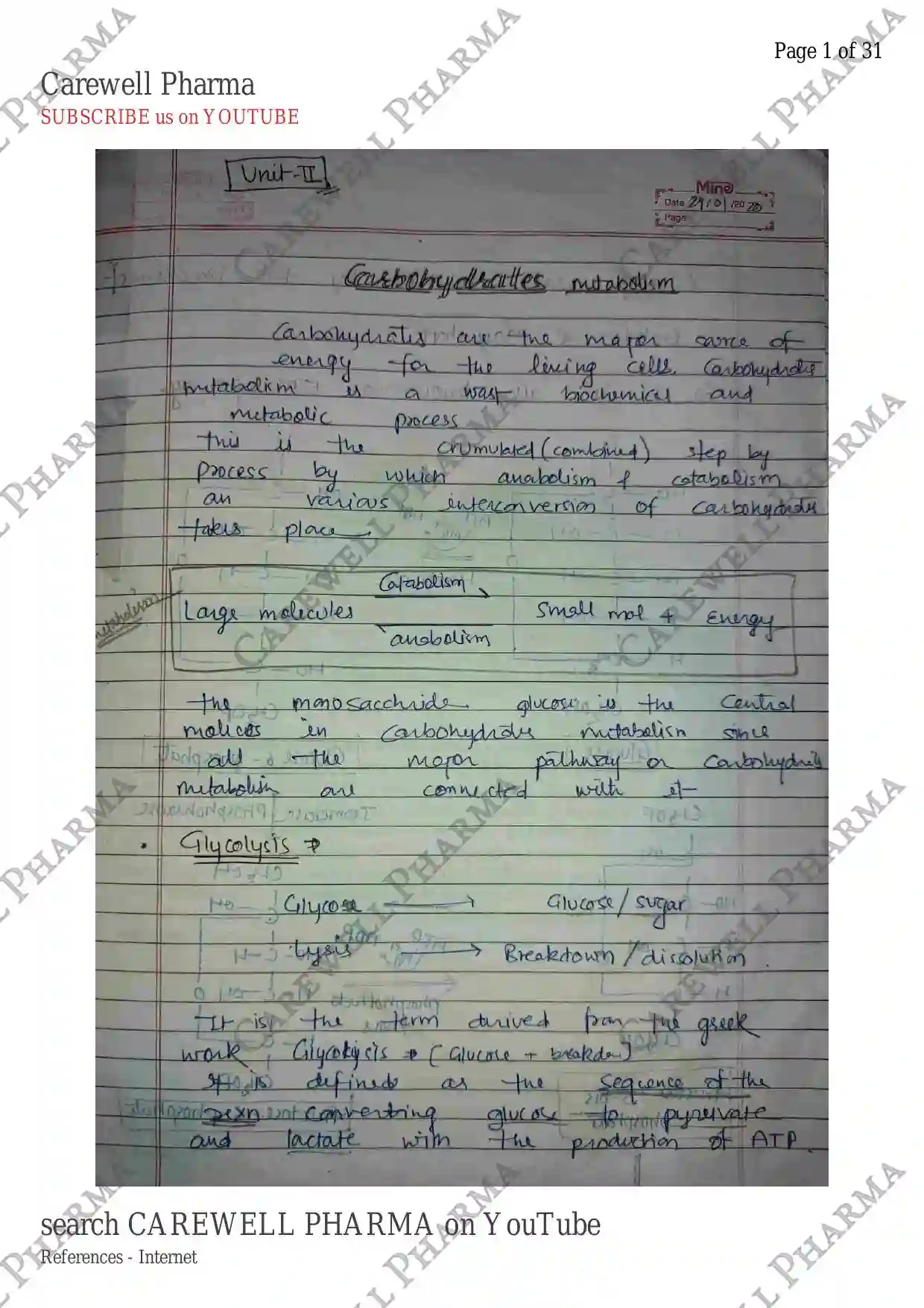
- Carbohydrates are the major source of energy for all the living cells.
- Carbohydrate metabolism are the combined process of anabolism and catabolism of carbohydrates, in which synthesis, breakdown and inter-conversion of carbohydrates take place and release or generate energy (ATP).
- It is simpler than that of fat and amino acids therefore it is used as immediate source of energy.

GLYCOLYSIS
- It is defined as, it is the sequence of the reaction converting glucose into pyruvate and lactate with the production of ATP.
- Glyco Glucose/sugar, Lysis Breakdown
- It was discovered by two Bio-chemist Embeden and Mayerhof. So, it is also called E.M. Pathway.
- It takes place in the cytosol of cells.


This pathway is divided into three phases:-
- Energy Investment Phase
- Splitting Phase
- Energy generation phase
I. Energy investment phase :- It requires 2 ATP molecules for phosphorylation.
- In this step, Glucose is phosphorylated to Glucose-6-phosphate with the help of enzyme hexokinase, and utilization of one ATP.
- Glucose-6-phosphate isomerised into fructose-6-phosphate in the presence of phosphohexo isomerase.
- Fructose-6-phosphate is phosphorylated to fructose-1,6-biphosphate by phosphofructokinase enzyme.
II. Splitting Phase :-
- Now, fructose-1,6-biphosphate splits into two equal 3 carbon containing compounds i.e. Glyceraldehyde-3-phosphate and dihydroxyacetone phosphate (DHAP) by Aldolase enzyme.
- DHAP undergoes isomerisation to Glyceraldehyde-3-phosphate under phosphotriose isomerase.
III. Energy generation phase :-
- Glyceraldehyde-3-Phosphate is converted into 1,3-Biphosphoglycerate with the help of enzyme dehydrogenase.
- 1,3-Biphosphoglycerate is convert into 3-phosphoglycerate with the help of enzyme phosphoglycerate kinase.
- These two step generate 2 NADH and ATP.
- 3-phosphoglycerate is convert into 2-phosphoglycerate with the help of enzyme phosphoglycerate mutase.
- 2-phosphoglycerate converts into phosphoenol pyruvate (PEP) by enzyme enolase.
- Now, PEP convert into pyruvate with the help of enzyme pyruvate kinase and generate ATP.

SIGNIFICANCE (Glycolysis)
- Occured in all the cells of the body.
- Only source of energy in erythrocytes (RBCs).
- Anaerobic glycolysis.
- Reversible, also used for gluconeogenesis.
- Pyruvate used for TCA cycle etc..
CITRIC ACID CYCLE
- It is also known as Krebs cycle or TCA (Tricarboxylic Acid) cycle.
- Albert Szent-Gyorgyi and Hans Krebs established the components and reactions of TCA cycle.
- It is aerobic process and occurs in mitochondrial matrix.
- It is the most important metabolic cycle which generate high amount of energy which fulfill about 65-70% of ATP requirements.
STEPS
- It starts when pyruvate from aerobic glycolysis convert into acetyl co-A which further enters into mitochondria and starts the citric acid cycle.

- It involves the formation of citrate, in which acetyl co-A reacts with oxaloacetate in the presence of citrate synthase and form citrate.
- Now, citrate isomerised and form isocitrate in the presence of enzyme aconitase.
- This isocitrate converts into \alpha$-ketoglutrate by releasing $CO_2 in the presence of isocitrate dehydrogenase and generate one energy.
- Now, This \alpha$-ketoglutrate converts into succinyl-CoA in the presence of enzyme dehydrogenase and generate one $NADH_2 (3 ATP) energy.
- This succinyl-CoA converts into succinate in the presence of enzyme Succinyl-CoA synthetase and generate one GTP (ATP).
- Now, Succinate converts into fumerate in the presence of enzyme dehydrogenase and generate (2 ATP).
- This fumerate further converts into Malate in the presence of enzyme fumarase.
- Now, in last step, malate again form oxaloacetate in the presence of malate dehydrogenase and generate one . Now, this oxaloacetate continue the cycle.
Energetics
- In step no. III, IV and VIII =
- In step V = 1 ATP
- In step VI,
- Total =
- There are 2 pyruvate molecules, so
- Pyruvate Acetyl Co-A = total 2 NADH = 6 ATP.
- Total with pyruvate = 30 ATP gained.
Significance
- Most important metabolic pathway for energy supply to body, about 65-70% of ATP is synthesized.
- Also helps in the synthesis of Non-essential A.A.
- Common Oxidative pathway for carbohydrates & fats.
HMP SHUNT
- Hexose Mono Phosphate shunt is also known as Pentose phosphate pathway.
- It is an alternative pathway for glucose oxidation (i.e. alternate to glycolysis and TCA).
- This pathway occurs in cytosol of cells.
- This pathway is divided into two phases:-
- Oxidative phase
- Non-oxidative phase
STEPS
I. Oxidative phase :-
- It involves the synthesis of NADPH.
- It starts when Glucose 6-Phosphate converts into 6-Phosphoglucolactone in the presence of G-6-P dehydrogenase and form NADPH.
- This 6-phosphoglucolactone converts into 6-phosphogluconate through Glucolactone hydrolase.
- Now, This 6-phosphogluconate converts into Ribulose-5-Phosphate, in the presence of Phosphate dehydrogenase and synthesized NADPH.
II. Non-oxidative phase :-
- It mainly involves the synthesis of pentose sugars.
- It starts when Ribulose-5-Phosphate converts into Xylulose-5-Phosphate in the presence of enzyme ribulose 5-phosphate-3-epimerase.
- On other hand, Ribulose-5-Phosphate converts into Ribose-5-phosphate in the presence of enzyme ribose-5-phosphate ketoisomerase.
- Now, sedoheptulose-7-phosphate and glyceraldehyde-3-phosphate formed by the transfer of carbon from xylulose-5-phosphate to ribose-5-phosphate, in the presence of enzyme transketolase.
- Now, Sedoheptulose-7-phosphate and Glyceraldehyde-3-P convert into fructose-6-phosphate and erythrose-4-phosphate in the presence of transaldolase enzyme by transferring of carbon.
- Now, again erythrose-4-phosphate converts into Glyceraldehyde-3-P, which further form/convert fructose-6-phosphate (if needed).


SIGNIFICANCE
- It is unique and generate two important products:
- Pentose sugars It is useful for the synthesis of Nucleic acids (RNA, DNA) and many nucleotides such as ATP, , FAD and Co-A etc.
- NADPH It is useful for the biosynthesis of fatty acids, steroids, amino acids etc..
- It helps in the engulfment of foreign particles (phagocytosis).
- Also helps to preserve the transparency of lens.
GLYCOGEN METABOLISM PATHWAY
- Glycogen is a one form of glucose i.e. stored form of glucose in liver & muscles, which is also a main source of energy.
- Glycogen is mainly stored in liver (6-8%) and muscles (1-2%) but due to more muscle mass, the quantity of glycogen in muscles (250 gm) is about three times more than that in liver (75 gm).
- Glycogen metabolism is a process of synthesis and breakdown of glycogen & takes place in cytosol of cells.
- The main function of glycogen:-
- to maintain blood-glucose level
- supply energy during starvation
- muscle glycogen is utilised to supply ATP during muscle contraction.
GLYCOGENESIS
- It is the synthesis of glycogen from glucose.
- Glycogenesis :- Glyco Glycogen, Genesis formation/synthesis


STEPS
- It mainly involve four steps:-
I. Synthesis of UDP-Glucose
- Glucose is converted into Glucose-6-P in the presence of enzymes hexokinase (in muscles) and glucokinase (in liver).
- Glucose-6-P converts into Glucose-1-P in the presence of enzyme phosphoglucomutase which further form UDP-Glucose in the presence of UDP-glucose pyrophosphorylase.
II. To initiate glycogenesis
- Glycogen synthesis is initiated by small fragment of pre-existing glycogen (act as primer) or glycogenin (a protein) accepts glucose from UDP-glucose.
- First glucose molecule is transfer with the help of enzyme glycogen initiator synthase to glycogenin, then glycogenin itself capture glucose.
III. Glycogen synthesis by Glycogen synthase
- $1,4-\alpha$-glycosidic linkages are formed by the glycogen synthase enzyme.
IV. Formation of branches in Glycogen
- Now, glycogen are formed by adding branches with the help of enzyme glycogen synthase and glucosyl transferase.
- The overall reaction of the glycogen synthesis for the addition of each glucose residue can be written as:
- In this, two ATP molecules consumed.
GLYCOGENOLYSIS
- It is the conversion of stored glycogen in liver and muscle into glucose, in the presence of glucagon and epinephrine.

GLUCOSE-6-PHOSPHATE DEHYDROGENASE (G6PD) DEFICIENCY
- It is an X-linked genetic disorder mostly occuring in males.
- In this disease, deficiency of G6PD occurs, which causes breakdown of premature RBCs in body (also known as haemolysis).
CAUSES
- It may be caused due to any type of bacterial or viral infection.
- It is a heredity condition which is passed from one or both parents to their child.
- It may also cause mild to severe jaundice in newborns.
Symptoms: Haemolytic anaemia, paleness, jaundice, dark urine, fatigue, breathlessness, tachycardia--
- It can be treated by removing the factors responsible for haemolytic conditions.
GLYCOGEN STORAGE DISEASES (GSD)
- These are genetic disorder of glycogen metabolism occuring due to accumulation of large amount of glycogen and its metabolites.
- Von Gierke's disease: It is the deficiency or complete absence of enzyme glucose-6-phosphatase in liver, kidney & intestine. It may caused enlarged liver.
- Pompe's disease: It is a fatal disease arising due to decrease in lysosomal $\alpha$-glucosidase. Cardiomegaly occurs if glycogen accumulates in heart and death is evident due to cardio respiratory failure.
- Cori's disease: It is the stored of metabolites of glycogenolysis in liver due to deficiency or absence of de-branching enzymes called limit dextrinosis.
- Anderson's disease: In this, an intermediate product like amylopectin deposits in liver, spleen and heart. Also occurs due to absence of branching enzymes.
GLUCONEOGENESIS

BIOLOGICAL OXIDATION
CHAPTER-2 UNIT-2
SYLLABUS :
Electron transport chain (ETC), and its mechanism, Oxidative phosphorylation & its mechanism, and substrate level phosphorylation. Inhibitors ETC and Oxidative phosphorylation/uncouplers.
Biological Oxidation
- It is the transfer of electrons which produce energy (in the form of ATP) from NADH and (co-enzymes).
- It is the combination of oxidation-reduction transformations of substances in living organism.
ELECTRON TRANSPORT CHAIN (ETC)
- It is also known as 'Electron transport system'.
- It is a series of protein complexes, that involve the transfer of electrons through redox reactions, which generate proton gradients that leads to the formation of ATP.
- It is the most essential part of oxidative phosphorylation.
- It occurs in the inner site (membrane) of the mitochondria.

Components:
- It consist of four protein complexes for ETC and one for oxidative phosphorylation.
- It also consist of some enzymes.
- Mostly constituents embedded in cristae (infoldings).
Complexes:
- Complex I
- It is NADH Co-Q oxidoreductase / NADH dehydrogenase.
- It is flavoprotein, contains FMN and also linked with FeS proteins.

It transport 2e- from NADH to Co-Q and transport 4H+ proton into intermembrane space.
Complex I It transport from NADH to Co-Q and transport proton into intermembrane space.
Complex II It transport from to Co-Q.
Complex III It is Co-Q cytochrome c oxidoreductase. It take electron from Co-Q and also transport .
Complex IV It is Cytochrome C oxidase. It take electron from Cyt-c to mitochondrial matrix. It pumped proton.
Complex V It is ATP synthase. It transport protons from intermembrane space to mitochondrial matrix and generate ATP from ADP.
MECHANISM
- Firstly NADH and are obtained from glycolysis and citric acid cycle.
- Now, NADH release to complex I which further transported to Co-Q and also transport protons.
- Then, these electron ($e^-$) released from complex IV and formed water (H_2O$). $[2H^+ + 1/2 O_2 + 2e^- \rightarrow H_2O]
- These electrons generate proton gradient.
- Approx. protons transported to intermembrane space, then these protons transported to matrix through complex V.
- During this transport, ATP synthase convert ADP to ATP (energy) through oxidative phosphorylation.
SIGNIFICANCE
- Regenerating Electron Carriers:- NADH and Oxidise into NAD and FAD which again utilised in glycolysis & TCA cycle.
- Generating Proton Gradient:- Generate proton gradient which used to make ATP.
OXIDATIVE PHOSPHORYLATION
- It is the final step in the formation of ATP.
- It is defined as it is the process in which ADP is phosphorylated to ATP by using ATP synthase and Electron transport chain (ETC).
- Oxidative phosphorylation involves ETC and chemiosmotic hypothesis.
- mechanism same as ETC (mainly complex V).
- This hypothesis was proposed by Peter Mitchell. $ADP + Pi \rightarrow ATP$ (Pi = inorganic phosphate)
Inhibitors
- These are those substances which obstruct or inhibits the electron transport chain by binding to any ETC components.
- eg. Cyanide poisoning - Cyanide is most potent ETC inhibitors which binds to ions of cytochrome oxidase.
Most probable sites of ETC inhibitions:
- NADH Co-Q (fish poison rotenone, antibiotic piericidin A, barbiturates etc).
- B/W Cyt. b Cyt. c
- Cyt. oxidase
UNCOUPLERS
- Also known as uncouplers of oxidative phosphorylation.
- These are those compounds which have ability to uncouple or delink the process of ETC (electron transport chain) and Oxidative phosphorylation.