Biochemistry - Unit 1
Syllabus
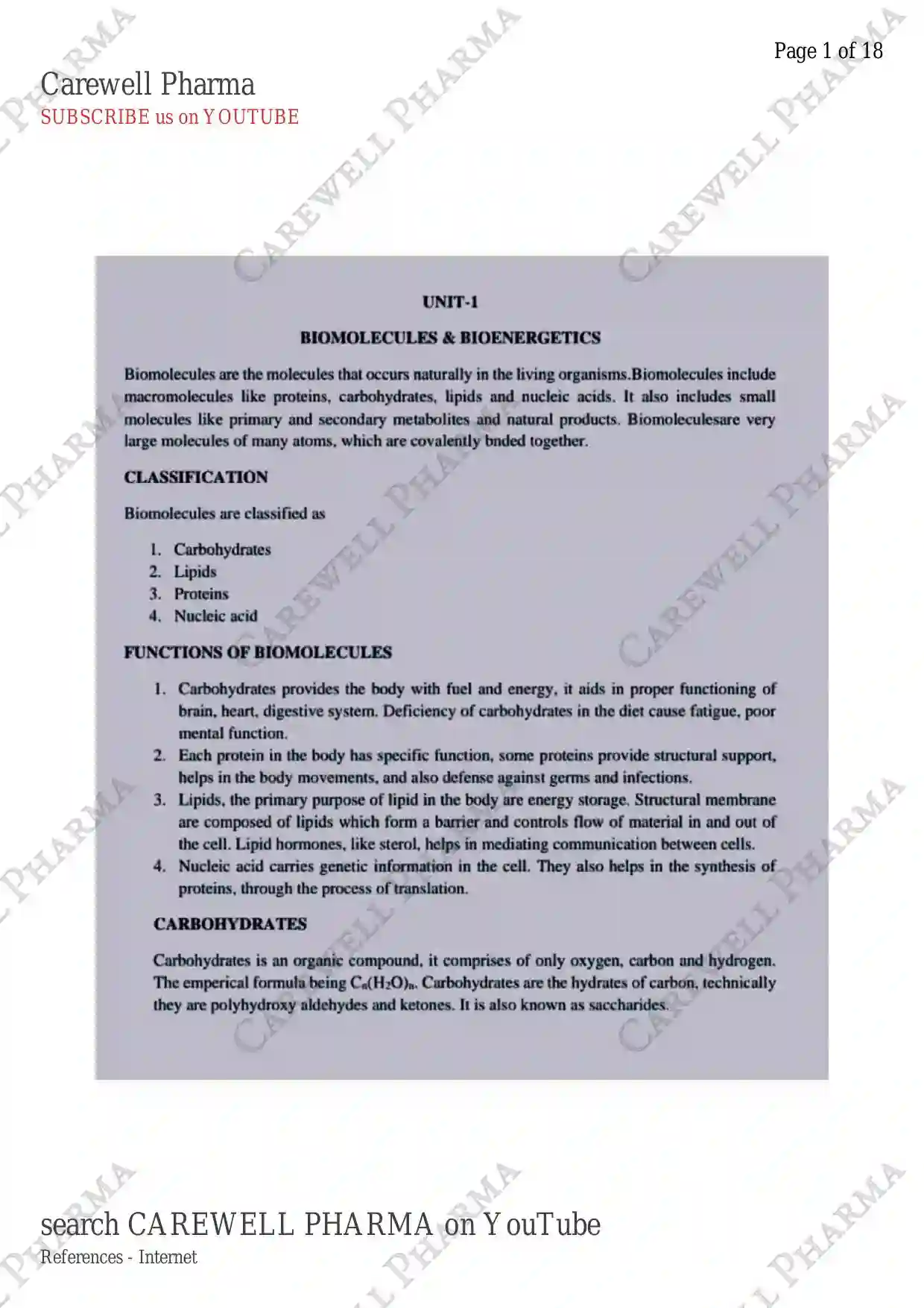
Biomolecules Introduction, classification, chemical nature and biological role of carbohydrate, lipids, nucleic acids, amino acids and proteins.
Bioenergetics Concept of free energy, endergonic and exergonic reaction, Relationship between free energy, enthalpy and entropy; Redox potential.
Energy rich compounds; classification; biological significances of ATP and cyclic AMP
Scroll to Download
UNIT-1
SYLLABUS :
- Biomolecules - Introduction, classification, chemical nature and biological role of carbohydrates, lipids, nucleic acids, amino acids and proteins.
- Bioenergetics - concept of free energy, endergonic and exergonic reactions, relationship between free energy, enthalpy and entropy; Redox potential.
- Energy rich compounds; classification; biological significances of ATP and cyclic AMP
BIOCHEMISTRY
- It is defined as it is the branch of science which deals with the study of chemical reactions and process occurs inside living body.
eg - Reactions Occurs during digestion conversion of food into energy.

- Chemical reactions inside the living body.
eg Conversion food Energy/ATP
BIOMOLECULES
- These are those molecules which Occurs inside living body and involves in the chemical reactions occurs inside living beings.

- These are building blocks of life and perform important functions in living organism.
- Mostly Carbon is present as biomolecules with hydrogen, oxygen, N, P, S etc--
Examples/types:-
- Carbohydrates
- Lipids
- Amino acids
- Nucleic acids
- Protein
CARBOHYDRATES
- These are those biomolecules or compounds in which carbon, hydrogen and oxygen are present in a fixed ratio.
- Also known as carbs, hydrates of carbon, sugar molecules.
- Also called as Saccharides.

Classification of Carbohydrates
They are generally divided into four types:-
- Monosaccharide
- Disaccharide
- Trisaccharide
- Oligosaccharide 2 to 10
- Polysaccharide more than 10.
1. Monosaccharides
- These are those carbohydrates molecules which further does not dissociates on hydrolysis.
- It is the single smallest sugar unit of carbohydrates.
- eg Glucose, fructose etc...
2. Oligosaccharides
They are those carbohydrates which contain more than two glucose/sugar (monosaccharide) units. [2-10 units].
Disaccharides It contains two monosaccharide and dissociates into two simple sugar on hydrolysis.
eg Sucrose, lactose etc--Trisaccharides It contains three monosaccharides units and dissociates into three simple sugar on hydrolysis.
eg Raffinose etc..others Tetra (4), Penta (5), Hexo (6), Hepta (7), Octa (8), etc..

3. Polysaccharide
- These are those carbohydrates which formed by polymerisation of more than ten monosaccharide units.
- In this, one molecule of polysaccharide dissociates into more than ten glucose/monosaccharide units.

Chemical nature of Carbohydrates
- These are aldehydes or ketones with multiple hydroxyl group.

- they contain Carbon, Hydrogen and oxygen at the ratio of 1:2:1
- .
- They yield characteristic reactions of hydroxyl functional group like esterification, oxidation, dehydration etc-

Biological role of Carbohydrates
- They are the important source of energy in human body (living being).
- They are served as stored form of energy as glycogen in the body.
- They helps in the breakdown of fatty acids and prevents ketosis.
- They helps in the control of blood glucose and insulin metabolism.
- It also takes part in the structural framework of DNA and RNA molecules (Nucleic acid).
- They also work as a spare protein which can be used for the growth and repair.
- also used in houses in the form of sucrose or sugar.
LIPIDS
- The word 'lipids' is derived from the greek word 'lipos' means fat.
- They are naturally occuring organic compounds in our body (living body).
- Also known as fats [in solid forms] and oils [in liquids].
- Lipids are hydrophobic in nature i.e. insoluble in water but soluble in organic [non polar] solvents. - cloroform, ether etc...
- example: fats, oils, fatty acids, triglycerides etc..
Biological role of Lipids
- They are important component of cell membrane and help in the formation of it - phospholipid etc..
- They work as source of high energy.
- They are used as stored form of energy in the form of triglycerides.
- They are also work as a source of fat soluble vitamines [A,D,E,K] and helps in its absorption.
- They also act as a signalling molecules. It also act as Hormones.
- Also used as a precursor of bile acids, Vitamins, and steroids..
- Also used in daily households.

1. SIMPLE LIPIDS
- These are esters of fatty acids and alcohols. OR
- These are those lipid compounds that did not have other substance, they are basically ester fatty acids of different alcohols.
- Fats and Olis Fats are esters of fatty acids with glycerol, commonly known as triglycerides.

- Oils are the liquid state of fats.
- Waxes These are esters of fatty acids with alcohol other than glycerol. eg Beeswax, Carnauba wax.
2. COMPOUND LIPIDS
- These are also ester fatty acids of alcohols, but they contain additional group such as phosphate, carbohydrates etc.
Examples
- Phospholipids These are ester fatty acid of alcohol and contain phosphate as additional group. fatty acids + Glycerol + Phosphate
- Glycolipids These contains fatty acids, alcohol [sphingosine] and a carbohydrate.
3. DERIVED LIPIDS
- These are those lipids which is derived from a simple and compound lipids through / by hydrolysis.
Examples fatty acids, glycerol, steroids, fatty aldehydes etc.... Terpenes, Carotenoids--

NUCLEIC ACIDS
- These are biomacromolecules, which is made up with monomeric chains of nucleotides building blocks.
- These are naturally occuring molecules or compounds which are present inside nucleus (nuclei) of cell and contain genetic information (in the form of DNA and RNA).
- It was discovered by Friedrich Miescher in 1869.
CHEMICAL NATURE
Nucleic acids are made up with nucleotides so, nucleotides are the building blocks of nucleic acid.
It is composed of three parts:
- Pentose Sugar (Carbohydrates)
- Phosphate group
- Heterocyclic nitrogenous base
1. Pentose sugars
- Those Carbohydrates which contain 5 carbon.
- Two type of sugar associates with nucleic acids.
- Deoxyribose [for DNA]
- Ribose [for RNA]

2. Phosphate group
- It is also part of nucleotides that connects with hydroxyl group of pentose sugar. It contain three hydroxyl group and one Oxygen attached with phosphorus.

3. Nitrogenous base
- These are nitrogenous heterocyclic compounds containing nitrogen (N).
- Purines these are double ringed nitrogenous compounds. eg Adenine, Guanine
- Pyrimidines these are single ringed nitrogenous compounds. eg Uracil, thymine, cytosine

NUCLEOTIDE
- Nucleoside = Pentose sugar + Nitrogenous Base
- Nucleotide = Nucleoside + Phosphate group
CLASSIFICATION
It is of two types:
i. DNA
ii. RNA
1. DNA Deoxy Ribo Nucleic Acid
- It contain deoxyribose sugar and are usually double stranded.
- It contain Nitrogenous bases Adenine, Guanine, Cytosine, Thymine ($A=T$, $G\equiv C$)
- It contain phosphate group.
Biological role

- It is a genetic material and contain genetic information. (eg. color of skin, eye etc).
- DNA transfer parents to daughter cells, which transfer information to childrens.
2. RNA Ribo Nucleic acid
- It contain ribose sugar and are single stranded.
- It contain phosphate group.
- It contain Nitrogenous bases Adenine, Guanine, Cytosine, Uracil.
Biological role

- mRNA (messenger RNA) transfer genetic information from nucleus to the cytoplasm.
- tRNA (transfer RNA) works as carrier of amino acids to the site of protein synthesis.
- rRNA (ribosomal RNA) is required for the formation of ribosomes.
AMINO ACIDS
- These are those biomolecules which are used in the formation of proteins as they are building blocks of proteins.
- It is made up with two word

- So, Acc to this any organic molecules (biomolecules) which contain atleast one amine and carboxylic acid group are known as amino acids.
eg Glycine, Serine, Lysine, Histidine etc...
CHEMICAL NATURE

Amino acids contain two groups :-
- Amino group ($-NH_2$)
- Carboxyl group ($-COOH$)
- Side chain (changes)
- Hydrogen atom
BIOLOGICAL ROLE
- They work as building blocks of proteins and helps in the formation of proteins.
- They also work as enzymes (catalyst), which helps in reactions.
- They also act as precursor for hormones, purines, pyrimidines, vitamines etc.
- They are important biomolecules which involves in many biological functions in our body.
CLASSIFICATION
- Amino acids can be classified:
- On the basis of structure
- On the basis of nutritional requirement
1. On the basis of structure
- Aliphatic amino acids It contain normal carbon chain. eg Alanine, serine, valine etc..
- Acidic contains acids. eg Aspartic acid, glutamic acid, glutamine etc.
- Basic eg Lysine, Arginine, etc.
- Aromatic amino acids It contain ringed aromatic structure. eg Phenylalanine, tyrosine etc..
2. On the basis of nutritional requirements
It is of two types:-
I) Essential amino acids These are those amino acids, which are not synthesized in human body instead these are obtained from dietary sources. eg Tryptophan, Leucine, phenylalanine, threonine, Lysine etc.. Histidine, arginine are semi-essential amino acids synthesized in the body in the little amount.
II) Non-essential amino acids these are those amino acids, which are synthesized in our body and we does not required it externally. eg Glycine, serine, threonine, aspartate, glutamate etc..
PROTEINS
- These are high molecular organic compounds which are made up with amino acids.
- It is an essential biomolecules because it presents in our body in large amounts.
eg : Albumins, globulins, receptors, antibodies are made up with proteins. - The long polymer chain of protein is derived from amino acid monomers.
CHEMICAL NATURE
- Proteins are made up with amino acids monomers.
- Amino acids are joined together by the peptide bond/linkage between Carboxyl group and amino group.

- It contains Carbon, Hydrogen, Nitrogen, Oxygen, Sulphur, phosphorus.
- It's structure can also be classified into four types:
- Primary structure simple, sequence of amino acids.
- Secondary structure In this, amino acids are connected but in different manners i.e. folded, twisted. eg \alpha$-helix, $\beta plated sheets..
- Tertiary structure twisted foam of secondary structure.
- Quaternary structure Contain two or more tertiary units. eg Heme units..
CLASSIFICATION
It is classified on the basis of:
1. Structure:-
It is classified into two types
- Globular Proteins These are those proteins which presents in spherical/oval shaped. These are water soluble. eg Albumins, globulins. etc.
- Fibrous Proteins These are those proteins which contains fibrous polypeptide chains and forms fibre or sheets like structure. These are water insoluble. eg Keratin, Collagens. etc.
2. Composition:-
It is three types -
- Simple proteins These are those which is only made up with amino acids by using peptide bonds. eg Albumin. etc.
- Conjugated Proteins These are those proteins which contains another group other than amino acids. (amino acids + some other group). eg Nucleoproteins, Glycoproteins, Lipoproteins etc.
- Derived Proteins These are those proteins which are derived from simple and conjugated proteins by denaturation or degradation. eg fibrins from fibrinogen, peptones, peptides etc.
Biological significance/role of Proteins
- It is used as a source of energy.
- It is the major part of cell membrane.
- It helps in blood clotting [by using fibrins].
- Most of the essential body parts are made up with proteins.
- antibodies are made up of proteins.
- enzymes, receptors, some hormones.
- It also play a role in oxygen transporters [Heme unit], nerve impulse transmission.
BIOENERGETICS
- It is the branch/part of biochemistry in which we study about the energy inside living body.

- Bioenegetics is the study of production and consumption of energy occurs during biological reactions inside living body.
- These energy involves in making and breaking of chemical bonds, for mechanical work and for growth.
LAW OF - BIOENERGETICS
- It is based on the law of thermodynamics:-
Acc to this -
"Energy can neither be created nor be destroyed, only transformed from one form to another".
Heat energy
change in internal energy
work done
- The energy is produced during biological reactions inside body i.e. phosphorylation or Oxidation of NADH coenzymes.
SPONTANEOUS REACTIONS
- These are those reactions which does not need energy instead they occurs itself and release energy.
- Spontaneous reactions
- Non- spontaneous reactions
CONCEPT OF FREE ENERGY
- It is the maximum amount of energy, which is available during chemical reactions.
- It is denoted by and write as .
- It is also known as Gibbs free energy, because it is given by W. Gibbs.
where,
- Gibbs free energy
- change in enthalpy
- change in entropy
- temp.
It is depends on Enthalpy and Entropy.
Enthalpy
- It is defined as it is the total amount of internal energy involve during chemical reactions at constant pressure and volume.
where,
- changes in enthalpy
- Total internal energy
- Pressure
- Volume

Entropy
- It is defined as it is the measurement of randomness or disorderness of the system
- It is denoted as .
- If Spontaneous reactions, Randomness , Energy released / Exothermic
- If Non-spontaneous reaction, Randomness , Energy absorbed / Endothermic
RELATIONSHIP B/W FREE ENERGY, ENTHALPY, ENTROPY
- This relationship can be defined by using Gibbs free Energy.
- Gibbs free energy is used to identify that reaction is spontaneous or not.

Exergonic Reactions
- These are those reactions which release energy during chemical reactions and give negative .
- These are spontaneous reactions.
- Also known as exothermic energy.
- .
Endergonic Reactions
- These are those reactions which required energy for completion of reactions.
- These are non-spontaneous reaction and have positive .
- Also known as endothermic energy.
REDOX POTENTIAL
- Also known as Oxidation reduction potential.
- It is the affinity of a substance to accept electrons i.e. it is the potential for a substance to become reduced.
- Oxidation Loss of electrons ($Fe^{2+} \rightarrow Fe^{3+} + e^-$)
- Reduction Gain of electrons ($Fe^{3+} + e^- \rightarrow Fe^{2+}$)
- The redox potential ($E_0$) is directly related to changes in free energy. $$\Delta G = -nFE_0$$ where Gibbs free energy, no. of electrons, faraday constant, Redox potential.
ENERGY RICH COMPOUNDS
- These are those compounds which contain high amount of energy [high energy compounds].
- It can also be defined that those compounds which release approx. of energy at pH 7.0 are known as high energy compounds.
- High energy compounds that have phosphate group are termed as high energy phosphate compounds.
- ATP is the currency of energy.
- Energy is released during breakage of chemical bonds.
Classification:
- Acyl phosphate (eg 1,3-biphosphoglycerate)
- Enol phosphate (eg Phosphoenolpyruvate [PEP])
- Thioesters (eg acetyl CoA)
- Phosphagens (eg Phosphocreatine)
| Reaction | |
|---|---|
| Adenosine Triphosphate (ATP) | -7.3 |
| Phosphoenol pyruvate (PEP) | -13.0 |
| Guanosine triphosphate (GTP) | -7.3 |
- Phosphocreatine + ADP ATP + creatine (via creatine kinase)
ADENOSINE TRIPHOSPHATE (ATP)
- It is the most common source of energy used for the biochemical reactions.
- It is also known as the currency of energy.

- energy is release from ATP through breakage of phospho anhydride/phosphate bond by hydrolysis.
Structure It consist of three part:
- Nucleotide base Adenine (nitrogenous base) Adenosine
- Ribose sugar
- Tri-phosphate group three unit.
ATP - ADP Cycle
- On hydrolysis, ATP release large amount of energy and converts into ADP (Adenosine di-phosphate) which further produce ATP by addition of phosphate group.

Biological significance
- It is the biggest source of energy for our body.
- It is generated by exothermic reactions and used by endothermic reactions.
- It is used as primary sources of energy for various metabolic reactions.
- It helps in the synthesis of DNA, RNA, proteins etc.
- It helps in the muscle contraction, which ultimately helps in the movement.
- It is also involved in cell signalling.
cAMP - Cyclic Adenosine Monophosphate
- It is an important secondary messenger and produced by activating adenylyl cyclase enzyme.

- Contains Adenine, Ribose sugar, and Monophosphate.
Biological significance
- It is a secondary messenger, used for intracellular signalling such as transferring the effects of hormones into cells, which can not pass through plasma membrane.
- It helps to regulate the cardiovascular function through channel.
- It shows various functions -
- reduces blood pressure
- reduces inflammation
- bronchodilation etc..