Pharmaceutics 1 - Unit 2
Syllabus
Pharmaceutical calculations: Weights and measures - Imperial & Metric system, Calculations involving percentage solutions, alligation, proof spirit and isotonic solutions based on freezing point and molecular weight.
Powders: Definition, classification, advantages and disadvantages,Simple & compound powders - official preparations, dusting powders, effervescent, efflorescent and hygroscopic powders, eutectic mixtures. Geometric dilutions.
Liquid dosage forms: Advantages and disadvantages of liquid dosage forms. Excipients used in formulation of liquid dosage forms. Solubility enhancement techniques
Scroll to Download
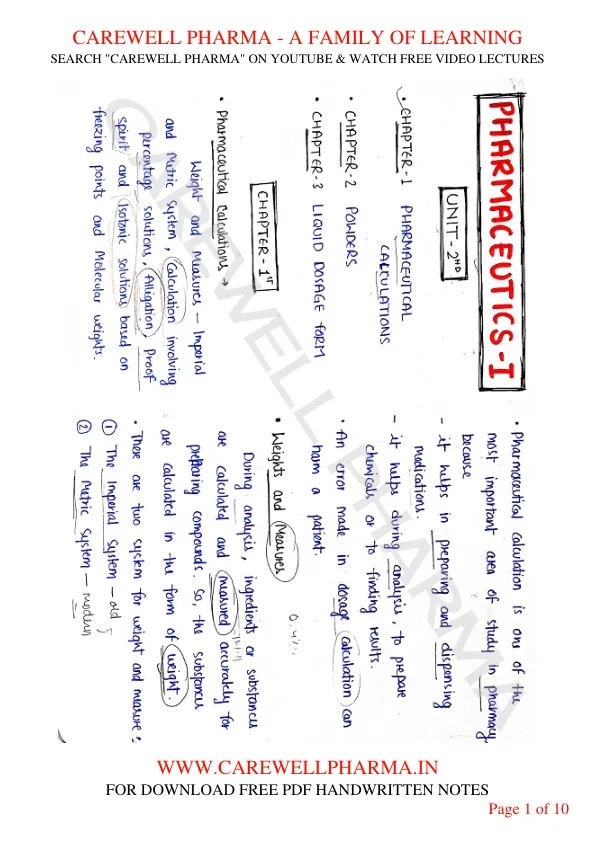
PHARMACEUTICS-I
UNIT-2ND
CHAPTER-1
PHARMACEUTICAL CALCULATIONS
Pharmaceutical Calculations
Weight and Measures - Imperial and Metric system, Calculation involving percentage solutions, Alligation, Proof spirit and isotonic solutions based on freezing points and molecular weights.
- Pharmaceutical calculation is one of the most important area of study in pharmacy, because it helps in preparing and dispensing medications.
- it helps during analysis, to prepare chemicals or to finding results.
- An error made in dosage calculation can harm a patient.
Weights and Measures : During analysis, ingredients or substances are calculated and measured accurately for preparing compounds. So, the substances are calculated in the form of weight.
- There are two system for weight and measure
- The Imperial System - Old
- The Metric System - Modern
1. Imperial system
- It is a very old system of weight and measures.
- It is firstly defined in British weights and measure act, 1824.
- It is not used to much, even in United states. In 1970s, this system was replaced by metric system.
- It is of two types
(i) Avoirdupois System
- It is used for commercial supply of bulk chemicals or other substances.
- Ounces / pounds are used as a standard units.
- (grain)
- (1 pound avoir)
(ii) Apothecaries system
- It was the first system to be used by physicians and pharmacists for measurement.
- this system originated in greece.
- pints, quarts and gallons are used as Units of volumes.
- Grains (gr) is taken as standard of weight.
- 1 pound apoth (lb) = 12 ounce
For Weight
- 1 ounce = 8 drachms/dram (3) = 480 gr
- 1 dram = 3 scruples ($\ni$) or 60 grains
- 1 scruples = 20 grains
- (lb) 1 pound = 5760 grains
For Volume
- 1 gallon = 4 quarts (8 pint)
- (qt) 1 quart = 2 pint (pt) or 32 fluidounces
- 1 fluid ounce = 8 fluid drachms
- 1 fluid drachm = 3 fluid scruples / 60 minims
- 1 fluid scruples = 20 minims (m)
2. Metric System
- It is created in france in 1799.
- It is widely used system, used for measurement of weight and volumes. It includes units i.e. meter, Litre or grams.
- It is basically a decimal system in which the division and multiplication is done by 10.
- Kg (kilogram) is taken as standard units.
Metric Volume
- 1 kilolitre (KL) = 1000 L (litre)
- 1 Litre (L) = 1000 millilitre (ml)
- 1 litre (L) = 1,000,000 (microlitre)
Metric Weight
- 1 kilogram (kg) = 1000 grams (gm)
- 1 hectogram (hg) = 100 grams
- 1 dekagram (Dg) = 10 grams
- 1 gram (g) = 1 gram
- 1 decigram (dg) = 1/10 or 0.1 gram
- 1 centigram (cg) = 1/100 or 0.01 gram
- 1 milligram (mg) = 1/1000 or 0.001 gram
- 1 microgram ($\mu g$) = 0.000001 gram
- 1 nanogram (ng) = 0.000,000,001 gram
Metric length
- 1 km = 1000 m (metre)
- 1 m = 1000 mm (millimetre)
- 1 m = 100 cm (centimetre)
- 1 cm = 10 mm
Conversion table:
- or
Calculation Involving Percentage Solutions
Percentage It means "parts per hundred". It can be expressed as 10%
- 10 percent
- 10 parts per 100 parts.
- 10/100
to make percentage, we have to multiply it with 100. During analysis, we have to compound sol$^n$ of desired percentage strength.
It is of three types :
i) Weight in Volume percent (w/v)
ii) Weight percent (w/w)
iii) Volume percent (v/v)
i) weight in Volume percent (w/v)
In this, the solute is weighed and the solvent is measured.
eg. Calculate the quantity of sodium Chloride required for 200ml of 0.9% solution.
ii) weight in weight Solutions (% w/w) In this, the solute and the solvent are measured by weight.
eg. What is the weight percent of glucose in a solution made by dissolving 4.6 gm of glucose in 145.2 gm of water?
- Solvent 145.2 gm (water)
- Solute 4.6 gm (glucose)
- Solution = 145.2 + 4.6 = 149.8
- glucose
iii) Volume by Volume Solution (% v/v) In this, the solute and solvent are measured by volume.
eg. Prepare 1000 ml of 5% v/v solution of ethylene glycol in water
- ,
ALLIGATION
It is a method, when the calculation involves mixing of two similar preparation of different strength to produce a preparation of Intermediate strength.
eg : 70% alcohol + 50% alcohol - 60% alcohol. so, find the amount of these alcohol used.


2. How much ml of 20% dextrose in water and 50% dextrose in water are needed to make 750 ml of 35% dextrose in water.
- 50% (35-20) 15 parts of 50%
- 35% (Mean)
- 20% (50-35) 15 parts of 20%
- Total = 30 parts
3. Calculate the amount of 70%, 60%, 40% & 30% alcohol that should be mixed to get 50% alcohol. Arrange in descending order:
- 70 20 parts of 70%
- 60 10 parts of 60%
- 50%
- 40 10 parts of 40%
- 30 20 parts of 30%
By mixing these parts, we will produce 50% alcohol.
4. How much ointment having a 10% drug conc$^n$ and 15% drug conc$^n$ must be used to make 1 kg of a preparation containing 12.5% drug conc$^n$. (1kg = 1000g)
Alcohol dilution
(Mixing in alcohol)
Calculate the amount of 95% alcohol required to prepare 600ml of 25%.
If 500 ml of 90% alcohol is diluted to 1000 ml, then calculate the % of dilute alcohol.
PROOF SPIRIT
It is the mixture of alcohol and water, in which the alcohol strength is generally calculated in terms of proof spirit.
- It is used for the purpose of excise duty i.e. tax on alcohol sale.
- In the U.S.A. 50% (by volume) (alcohol) is considered to be 100 proof.
- But in India, 57.1 Volumes of (alcohol) are considered equal to 100 volume of proof spirit.
- This means that "any alcoholic solution that contain 57.1% v/v alcohol is a proof spirit."
It is of two types :
- Over Proof ($^\circ O/P$): If the strength of alcohol is more than 57.1%, then it is called Over Proof.
- Under Proof ($^\circ U/P$): If the strength of alcohol is less than 57.1%, then it is called Under Proof.
Conversion:- conversion of proof spirit into percentage OR Conversion of percentage into proof spirit.
eg Convert 90% v/v alcohol into proof spirit.
- So, in
For 70% v/v
eg : What strength of and
For O/P
- For
For U/P
- For
ISOTONIC SOLUTIONS
These are those solution in which the solute concentration of one solution is same as the solute concentration of another solution.

eg : 0.9% w/v solution of NaCl
- The concept of isotonicity is used during preparation of medicaments/i.v. Fluids for body.
- Because, if the tonicity of these medicaments is different than blood or body fluids, then they cause irritation or maybe serious damage.

So, Isotonic solution are those solution which contain 0.9% w/v solution of NaCl.
It is of three types :
i) Hypertonic Solution : If the solute concentration of solution is greater than 0.9% NaCl solution.
ii) Isotonic Solution : When the solute concentration of any solution is equal to 0.9% NaCl solution.
iii) Hypotonic Solution : When the solute concentration of solution is less than 0.9% NaCl solution.
Determination by Hemolytic Method :

Method of adjusting tonicity : If the tonicity of solution is not isotonic, then we have to make it isotonic.
Two methods :
- Freezing point method
- Molecular weight method
i) Freezing point method : This method is basically used for hypotonic solution. In this, Sodium Chloride (adjusting sol$^n$) is added in solution to make it isotonic.
Where,
- = amount of adjusting substance (NaCl) to make isotonic.
- = freezing point of 1% solution of unadjusted sol$^n$.
- = freezing point of 1% sol$^n$ of adjusting sol$^n$ (NaCl).
- Freezing point of blood = freezing point of drug + freezing point of adjusting substance.
eg. find the conc$^n$ of NaCl required to make 1.5% sol$^n$ of boric acid isotonic with blood. (f.p. of boric acid , NaCl $-0.58^\circ$)
eg. for 1% sol$^n$ of cocaine hydrochloride (f.p. = $-0.09$)
ii) Molecular weight Method This method is basically used for hypertonic solution? (Context implies calculation for isotonicity)
where,
- = Gram molecular weight of substance
- = No. of ions into which the substance is ionized.
eg. Find the conc$^n$ of NaCl required to produce a sol$^n$ isotonic with blood plasma
- Molecular weight of
- ions (2)
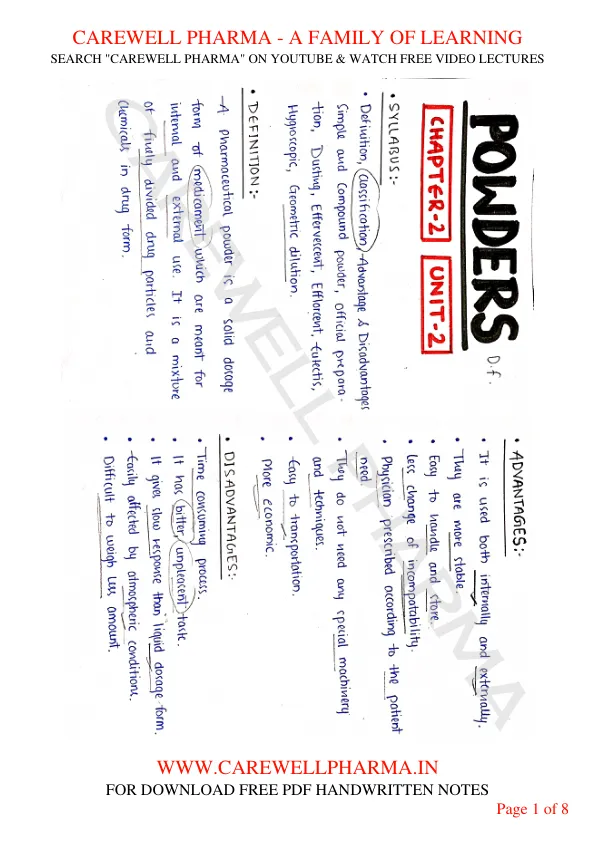
POWDERS
UNIT-2
CHAPTER-2
SYLLABUS :
Definition, Classification, Advantage & Disadvantages, Simple and Compound powder, Official preparation, Dusting, Effervescent, Efflorescent, Eutectic, Hygroscopic, Geometric dilution.
DEFINITION
A Pharmaceutical powder is a solid dosage form of medicament which are meant for internal and external use. It is a mixture of finely divided drug particles and chemicals in drug form.
ADVANTAGES
- It is used both internally and externally.
- They are more stable.
- Easy to handle and store.
- Less chance of incompatibility.
- Physician prescribed according to the patient need.
- They do not need any special machinery and techniques.
- Easy to transportation.
- More economic.
DISADVANTAGES
- Time consuming process.
- It has bitter, unpleasant taste.
- It gives slow response than liquid dosage form.
- Easily affected by atmospheric conditions.
- Difficult to weigh less amount.
CLASSIFICATION
Powder are of two types which are as follows
1. DIVIDED POWDER :
i. Simple powder
ii. Compound powder
2. BULK POWDER :
i. Dusting powder
ii. Effervescent powder
iii. Dentifrices
iv. Insufflations
v. Douche powder
vi. Snuffs.
1. DIVIDED POWDER
These are unit dose powders normally packed properly.
i) Simple Powder : These are those type of powder which contain only one ingredient. Which are packed in a folded paper and dispensed in small plastic bags.
- The powder should not be less than 100mg.
- Example: Aspirin
Rx Aspirin 300mg Make powder
Procedure:
- Powder the aspirin.
- Weigh accurately required quantity of aspirin.
- Weigh 300mg of aspirin for each wrap.
Direction: One powder to be taken after every 8 hours.
ii) Compound Powder These are those type of powder which contain more than one ingredient and are mixed together then divided into desired no. of individual dose.
- eg:- A.P.C
Rx Aspirin 300mg Paracetamol 150mg Caffeine 50mg Make a powder Wrap in paper and then packed.
Procedure :
- Powder each ingredient.
- Weigh accurately each ingredient.
- Mix them in ascending order of their weight.
- Weigh 500mg of mixed powder for each wrap.
2. BULK POWDER
These are those type of powder which are store or dispensed in bulk form i.e. powder are delivered in large quantity.
- They are mainly dispense in wide-mouth container. It contain non potent substance like Antacids, Laxatives, Purgatives.
i) Dusting Powder These are those powders which are meant for external application on the skin for local action.
They are applied in very fine state to avoid local irritation.
eg : Salicylic acid
Properties :
- Not produce any local irritation.
- It should be freely flowing.
- It should have good adsorption and absorption capacity.
- It should be homogenous.
- It provide protection to the skin.
- Good spread-ability and covering capacity.
Rx Purified talc, sterilized 50gm Starch powder 25gm Zinc oxide powder 20gm Salicylic acid powder 5gm
Labelling : For external use only.
Direction : Applied on the affected part two or three times a day.
Procedure :
- Weigh accurately all the powders.
- Mix them in ascending order of their weight.
- Passed them mixed powder through sieve no. 85 or 120.
- Mix them lightly & transfer to the container.
- Protect it form atmospheric contamination.
ii) Effervescent Powder : These are those powder which produce effervescence i.e. release . It contain medicament API mixed with acid and base which react together and it produce .
eg : ENO, Aspirin etc...
Advantages :
- It enhance the absorption of drug.
- It improved much stability.
- It is used to conceal the abnoxious taste of certain drugs.
- The effervescent salts exert a positive psychological effect on patients.
Rx Sodium Bicarbonate 35gm Citric acid 25gm Tartaric acid 15gm Anhydrous sodium carbonate 25gm
Procedure :
1). Heat Method
- Mixed all the constituents with 15-20% of acid ingredient (citric acid).
- Heat the mixture at on water bath.
- Water released from citric acid moistens the powder.
- Resulting in production of powder granules.
2). Wet Method
- After moistened the citric acid mixed with Sodium bicarbonate.
- Granulator is employed to obtain granules.

iii). Dentifrices : These are those substance which are meant for external use and applied with the help of tooth brush for cleaning the surface of teeth.
- They are available as tooth powder, tooth pastes, liquid and gels.
- eg : Saccharine sodium, fluoride toothpaste etc...
Rx Hard soap, fine powder 5gm Precipitated calcium carbonate 94gm Saccharine sodium 2gm Peppermint oil 4gm
iv) Insufflation : These are those powder which are meant for introduce into the body cavity and inhalation by nose with the help of insufflators.
- It sprays the powder into a stream of finely divided particles all over the site of application.
- eg : Nitrous oxide (anaesthesia) etc...
v). Douche Powder : These are those powder substance which are applied in body cavity for antiseptic and cleaning action. its main aim is to cleaning vaginal problems.
- eg : Boric acid.
vi) Snuffs Powder These are those powder substance which are inhaled into the nostrils for its anti-septic action.
- They mainly for the patients suffering from bronchial asthma due to its bronchodilatory action they dispensed in flat metal boxes with hinged lid.
- eg : Vicks inhaler, Asthma pump inhaler etc...

Stability Problems
"These are some stability problems which are face in preparation of powders."
- Efflorescent Powder
- Hygroscopic Powder
- Eutectic mixture

1. Efflorescent Powder : These are those substance which loses water to form a lower hydrate or become anhydrous is termed as efflorescent.
- Present in form of crystal granules.
- eg:- Sodium Carbonate .
2. Hygroscopic Powders : These are those powders which absorb moisture from the atmosphere are called Hygroscopic powders.
- eg: Ammonium chloride, Pepsin, NaCl etc...
3. Eutectic Mixture : It is the mixture of two solid particles [powder] in which their melting point is reduced due to mixing, and the mixture is converted into liquid form at room temperature (normal temperature).

Geometric Dilution
It is the method of preparation of drugs, which is basically used for potent drug substances. In this method, the potent drug substances is mixed with large quantity of diluents (excipients).

Now, in this, powders are prepared in a following way :-
- Firstly take less and small quantity of drug and diluents.

Now, 200mg mixture mix with equal amount of diluents.
200mg mixture + 200 mg diluents 400mg mixtures.
Follow further step in same way:
400mg mixtures + 400 mg diluents 800mg mixtures
- 800mg mixtures + Remaining portion of diluents = 1000 mg of drugs
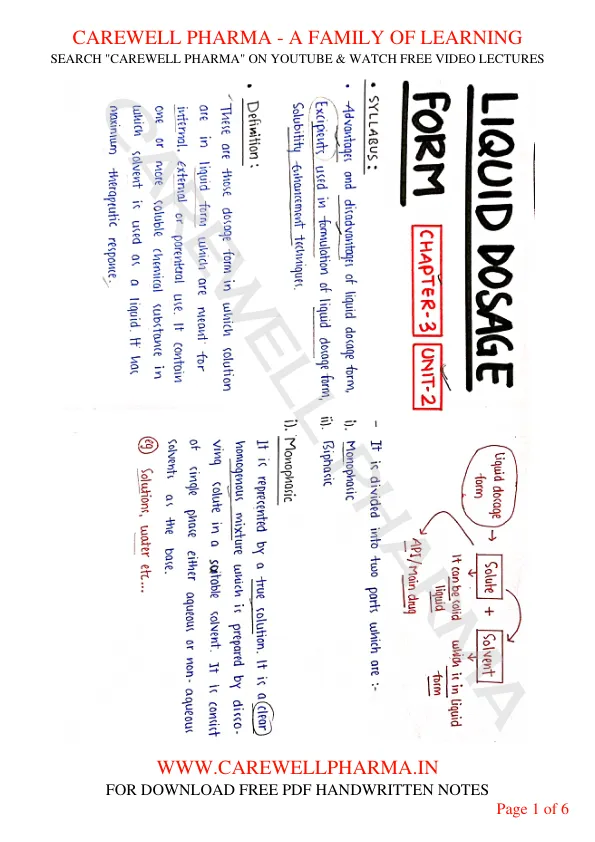
LIQUID DOSAGE FORM
UNIT-2
CHAPTER-3
SYLLABUS : Advantages and disadvantages of liquid dosage form, Excipients used in formulation of liquid dosage form, Solubility Enhancement techniques.
Definition
These are those dosage form in which solution are in liquid form which are meant for internal, external or parenteral use.
- It contain one or more soluble chemical substance in which solvent is used as a liquid.
- It has maximum therapeutic response.

It is divided into two parts which are :
i). Monophasic
ii). Biphasic
i). Monophasic
It is represented by a true solution. It is a clear homogenous mixture which is prepared by dissolving solute in a suitable solvent.
- It is consist of single phase either aqueous or non-aqueous solvents as the base.
- (e.g. Solutions, water etc...)
ii). Biphasic
These are those dosage form which contain two phase which are immiscible with each other.
- (e.g. Emulsion, Suspension)
Advantage
- It is easier to swallow, cheap
- More satisfactory and Convinient.
- Suitable for childs and old people.
- Reduce gastric irritation.
- The drug in solution is uniformly distributed.
Disadvantage
- Shorter life before expiration than other dosage forms.
- More difficult to administer. (i.v.)
- Harder to measure accurately.
- May be special storage requirements.
- Less stable.
- Chance of microbial contamination is high.
Excipient used in formation of Liquid dosage form.
Excipient are used in a preparation of drug dosage form to more bulk. Excipient have little or no therapeutic value but they are used in the preparation and compounding of several pharmaceutical formulations.

They are as following:-
- Sweetening agent.
- Vehicles
- Antioxidants
- Buffer
- Flavours
- Preservative
1. Sweetening Agent
These are those substance which are added to a drug formulation to mask its bitter taste and make dosage form sweet.
- Sugar is the most widely used natural sweetner.
eg : Sucrose, sorbitol, mannitol, Honey etc...
2. Vehicles
These are the solvents which are required in the preparation of liquid dosage form.
- They work as a solvents.
- They are of two types
- i. Aqueous liquid
- ii. Non-Aqueous liquid.
i. Aqueous Liquid : These are water soluble which are used for those drugs which are soluble in aqueous solvents.
eg : Water, Aromatic Water, Syrups etc...
ii. Non-Aqueous Liquid : These are water in-soluble which are used for those drugs which are insoluble or unstable in aqueous solvents.
eg : Oils, Alcohol, Liquid paraffin, Glycerol etc...
3. Antioxidants
These are those substances which prevent the oxidation of liquid dosage form which can be oxidized through environment air/$O_2$.
- It required to maintain the product stability.
eg:- Ascorbic acid, Propionic acid.

4. Flavours
Flavouring agents is used to mask the taste. It cannot be used in pediatric products.
eg : Menthol, Chloroform etc....
5. Preservative
These are those chemicals which is used to prevent the growth of micro-organism in solution.
- They prolong the shelf-life of the product.
eg : Phenol, Chlorocresol, Sorbic acid.
6. Buffers
A buffers solutions is one which maintain its pH fairly constant even upon the addition of small amount of acid or base.
resist the change of pH / make it constant.
They are of two types :-
i. Acidic buffer
ii. Basic buffer
- eg : Phosphates, citrates, acetates etc...

Solubility Enhancement Techniques
These are those techniques which are used to increase the solubility of any drug/solute, if their solubility is less in aqueous medium.
- For increase solubility, there are various techniques :-
- pH Change
- Co-Solvent
- Particle size reduction.
- Solid dispersion.
- Hydrotropy method.
- Complexation.
1). pH Change
A solubility of poorly soluble drug that is either a weak base or weak acid may altered by adjusting the pH of the solution.
- pH adjustment for improving the solubility in two ways:
- i. Salt formation
- ii. Addition of buffer to the formulation.
2). Co-Solvent
It is a technique to increase the solubility of poorly soluble drug in a liquid.
- By using co-solvent we can increase the solubility of poorly soluble drugs.
- eg : 2-Pyrrolidine, Propylene glycol
3). Particle size reduction
The solubility of a product is also depend on a particle size. So by decreasing the Particle size we can increase the solubility of Product.
- Particle size can be reduced by using micro-ionization, nanosuspension etc... / reduction (grinding).
4). Solid dispersion
In solid dispersion, A poorly soluble drug dispersed in a highly soluble solid hydrophilic matrix which enhance the solubility.
eg : Hydrophilic carrier.
5). Hydrotropy
In this method, By adding large amount of secondary solute increase the aqueous solubility of water insoluble drug. eg : Solubilisation of theophylline with sodium benzoate or sodium acetate.
6). Complexation
It is a process of association of two or more molecules to form a non-bonded entity.
- It is used to improve bioavailability of poorly soluble drug.
eg : Chelates-EDTA.
Chapter 1
Chapter 2
Chapter 3