Pharmaceutics 1 - Unit 1
Syllabus
Historical background and development of profession of pharmacy:
History of profession of Pharmacy in India in relation to pharmacy education, industry and organization, Pharmacy as a career, Pharmacopoeias: Introduction to IP, BP, USP and Extra Pharmacopoeia.
Dosage forms: Introduction to dosage forms, classification and definitions
Prescription: Definition, Parts of prescription, handling of Prescription and Errors in prescription.
Posology: Definition, Factors affecting posology. Pediatric dose calculations based on age, body weight and body surface area.
Scroll to Download
PHARMACEUTICS
UNIT-1
SYLLABUS
Historical Background and development of profession of Pharmacy
- Dosage form
- Prescription
- Posology
CHAPTER - 1st
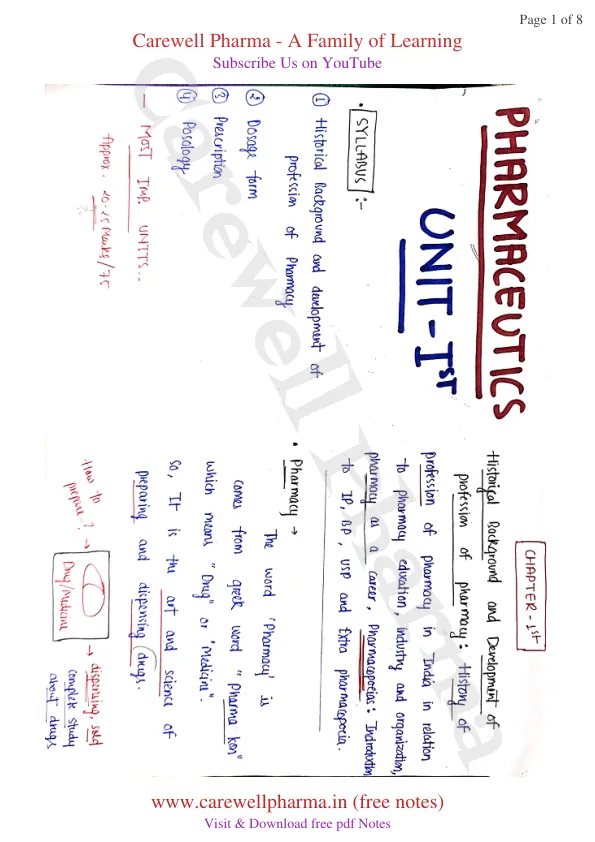
Historical Background and Development of profession of pharmacy: History of profession of pharmacy in India in relation to pharmacy education, industry and organization, pharmacy as a Career, Pharmacopoeias: Introduction to IP, BP, USP and Extra pharmacopoeia.
Pharmacy
The word 'Pharmacy' is comes from greek word "Pharmakon" which means "Drug" or "Medicine".
So, It is the art and science of preparing and dispensing drugs.

- OR pharmacy is a healthcare profession which deals with study of drugs, their main purpose is to ensure the safety and efficacy of pharmaceutical drugs.
Symbol of Pharmacy
The Bowl of Hygeia is a Symbol of pharmacy.
In consists of a snake wrapped around a bowl represents Aesculapius (the God of medicine), and the bowl represents Hygeia (his daughter & helper).

- Bowl Potion (Medicines औषधि)
- Snake Healing
History of profession of pharmacy in India
- The concept of Hospital was well-developed and practiced in India (in BC 226) during the period of Great Ashoka.
- That time leaves, cold water, animal extracts etc... are used in the treatment.
- The pattern of charaka for treating diseases was followed by all the medical works in 1000 AD.
- India has one of the world's oldest medical system i.e. Ayurveda...
- Charaka is called 'father of Ayurveda'. In his book 'Charaka Samhita' he had mentioned about 340 plant types and about 200 animal types.
- In 1500 century, Indian drugs and herbs influenced Europe.
- In 1664, the first general hospital was established in Chennai.
In relation to pharmacy education
The allopathic/western system of medicine came in India along with British traders, then it get popular in 19th century.
- 1824 - firstly London pharmacopoeia available in India in the form of Hindustani Version.
- 1840 - Goa Medical College at Panjim, Goa.
- 1843 - London pharmacopoeia made available in Hindi + Bengal.
- 1864 - Bengal pharmacopoeia.
- 1874 - Regular two years course for "Chemists and Druggists Diploma" was started in MMC.
- 1930 - Govt. of India appointed a committee under the chairmanship of late Col. R.N. Chopra for pharmacy problems.
- 1935 - the first pharmaceutical society with an education plateform was developed (UPPA United Provinces Pharmaceutical Association - which in 1936 replaced name with Indian Pharmaceutical Association (IPA).
- 1937-38 - Prof. M.L. Shroff (father of Indian pharmacy) started regular degree course of B. Pharm (3 years) at BHU (Banaras Hindu University).
- 1940 - Subhadra Kumar Patni (first pharmacy graduate).
- Prof. M.L. Shroff started M. Pharm in BHU.
- 1943 - Gorakh Prasad Srivastava (first post graduate).
- 1944 - The degree course in pharmacy was started in the University of Punjab, Lahore - currently Panjab University, Chandigarh. By Dr. Khem Singh Grewal.
- 1948 - Pharmacy Act established.
- 1949 - Pharmacy Council of India (PCI) was established.
- 1953 - First Education Regulations (ER) was framed and started D. Pharm.
- Sheovihari Lal (first PHD holder in pharmacy).
- 1955 - The first edition of Indian Pharmacopoeia.
- 1991 - NIPER in Mohali with Dr. C.L. Kaul as first director.
Pharmacy Courses In India
- Diploma in Pharmacy (D. Pharm) - 2 yr
- Bachelor of Pharmacy (B. Pharm) - 4 yr
- Master of Pharmacy (M. Pharm) - 2 yr
- Master of Science in Pharmacy [MS (Pharm)]
- Master of Technology in Pharmacy [MTech (Pharm)]
- Doctor of Pharmacy (Pharm.D.)
- Doctor of Philosophy in Pharmacy (PhD)

Pharmacy as a Career
A Career in pharmacy is one of the best Career across the world. Pharmacy is a part of healthcare services which completely deals with the drugs.
- So, Currently pharmacy is a emerging phase and it has great scope.
there are some following options :
- Academics
- Institute/College
- Regulatory department
- Chemist shop
- Pharmaceutical Industries
- Research & Development
- Production (Manufacturing of drugs)
- Analysis
- Marketing
- Pharmacovigilance.
1. Academics : A person who has done his/her studies in the field of pharmacy can work as a Ass. Professor, private teacher.
2. Institute/College : A qualified person can also open education institute to serve the students.
- Coaching
- They have also option to open pvt. Institutes.
3. Regulatory Department : A qualified person can also try his luck in the govt. sector and get Jobs. there are no. of Jobs :-
- Drug Inspectors
- Govt. Hospitals
- Govt. teacher
- Administration
- Railway Pharmacist - Army pharmacists
- Govt. Industries
- etc.
4. Chemist Shop : A qualified person can open his own chemist shop (medical store) by taking licensce.
5. Pharmaceutical Industries : A qualified person can also open his company but with lots of permission, documentation, but this provide the max. no. of Jobs.
Research and Developments (R&D) : It is a department which is present in mostly company which main aim is to develope new-new drugs and handle research work. A qualified person can take Job in it.
Production : This departments deal with the manufacturing of drugs, it requires a lots of experienced persons.
Analysis : It includes the analysis of drugs i.e. identification, determination and purification of drugs.
- It provide a Job in QA (Quality Assurance) and QC (Quality Control) department.
Marketing : This department is responsible for the marketing of the drugs which includes the sale of drugs to the retailers or whole sale.
Pharmacovigilance: It involves the collection, detection and monitoring of safety, efficacy and adverse effects of Pharmaceutical drugs.
Pharmacopoeia
It can be defined as "a book of standards applicable to drugs and their common dosage forms and pharmaceutical aids published in a country under the authority of its own Government.
eg: I.P. , B.P.
OR
The term pharmacopoeia comes from the greek word "Pharmakon" mean drugs and "poeia" means make.
So, It can be defined as It is a standard official book which contain a formula (monographs) to make a drugs authorized by Govt.
- It contain a complete details Information of drugs.
Types :
- Indian Pharmacopoeia [IP]
- British Pharmacopoeia [BP]
- United States Pharmacopoeia [USP]
- European Pharmacopoeia [EP]
- Extra Pharmacopoeia
1. Indian Pharmacopoeia (IP)
It is an official text responsible for the quality control and assurance of pharmaceuticals in India.
- It define the identity, purity and strength of drugs.
- This book got approval under the second Schedule of the Drug & Cosmetic Act, 1940 and Rules 1945.
- It is published by IPC (Indian Pharmacopoeia Commission).
Editions of Indian Pharmacopoeia
| Edition | Year | Addendum | Monographs | Volumes |
|---|---|---|---|---|
| 1st Edition | 1955 | 1960 | 986 | 2 |
| 2nd | 1966 | 1975 | 890 | 3 |
| 3rd | 1985 | 1989, 1991 | 261 | 2 |
| 4th | 1996 | 2000, 2002, 2005 | 1149 | 3 |
| 5th | 2007 | 2008 | 3 | |
| 6th | 2010 | 2012 | 3 | |
| 7th | 2014 | 2015, 2016 | 577 | 4 |
| 8th | 2018 | 2019 | 220 | 4 |
2. British Pharmacopoeia (BP)
It is the National pharmacopoeia of the United Kingdom (U.K.).
- In 1864, the 1st edition of British pharmacopoeia was published.
- 2nd 1867
- 3rd 1885, 4th 1898
- 5th 1914
- 6th 1932, 7th 1948
- 8th 1953, 9th 1958, 10th 1963
- 11th - 1968
- 12th 1973, 13 1980
- 14 1988
3. USP
The United States Pharmacopoeia is the National pharmacopoeia for United States published annually by United States Pharmacopoeial Convention.
- In 1820, the very 1st edition of USP was published.
CHAPTER-2ND
Dosage form: Introduction to dosage form, classification and Definitions
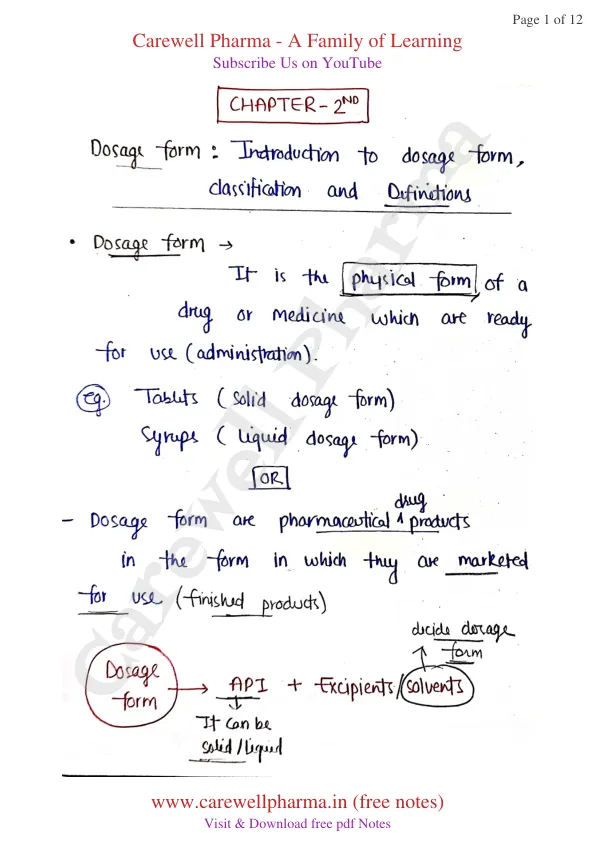
Dosage form : It is the physical form of a drug or medicine which are ready for use (administration).
Tablets (Solid dosage form)
Syrups (Liquid dosage form)
Drug from are pharmaceutical drug products in the form in which they are marketed for use (finished products).

- In dosage form, excipients/solvents decide the physical form of drugs.
eg: If solvent is Liquid, then i.e. Liquid dosage form.
Classification of Dosage form
Dosage form can be classified on the basis of physical state, administration route, application site and use.
1. Physical State : Solid, Semi-solid, Liquid, Gaseous
2. Route of Administration : Oral, parenteral, Rectal and Nasal.
3. Site of Application : Skin, eye, hand, foot, hair and nose.
4. Uses : Internal & External

(Solid dosage form)
Solid dosage formulations are important dosage form in pharmaceuticals, which medicament are in solid form.
1. Tablet - This is a solid unit dosage form of medicament prepared by moulding or compression.
- It is a mixture of active ingredients and excipient mix and compress to form a tablet by compression.
- e.g. Paracetamol, Dolo 650 mg.
2. Capsule - The capsule are solid unit dosage form in which one or more medicament enclosed within by a small soluble gelatin shell.
- It may be hard & soft.
- e.g. Evion (Vitamin E), Becasules etc...
3. Powder - These are the solid dosage form and made up with drug or mixture of drugs.
- In unit dosage form it is mean't suitable dose for one time.
- e.g. ENO....
4. Pills - Pills are the small, rounded solid dosage form containing medicament and are intended to be administer orally.
- It is widely use in birth control.
- e.g. Mala-D etc...
5. Fine powder - These are the Bulk solid dosage form and it is made up with very fine particles of medicament (like chalk powder).
- it is meant for acting "inside" the body.
eg: Sponge etc...
6. Granules - These are the aggregation of fine particles. These are bulk solid dosage form.
- On a mass of powder in spherical shape.
- e.g. Erythromycine.
7. Effervescent granules - These are the bulk solid dosage form and it is a combination of citric acid and sodium bicarbonate, converting them into granules.
- gives a delayed and long lasting sourness, bitter flavor impact.
- e.g. Urivin, Ural.
8. Dusting powder - These are the bulk dosage form and meant for external use and applied on the skin in very fine state to avoid irritation.
- e.g. Fluconazole, Candid.
9. Insufflation - These are bulk solid dosage form and they are medicated for introduction into body cavity such as nose, throat paint, ear & vagina.
- with help of apparatus called insufflator. It is a blower which stream the powder into site of action.
- Vapours or gases ($N_2$, $O_2$) etc.
10. Dentifrices - These are bulk solid dosage form and it is for cleaning of tooth surface.
- Applied with tooth brush or finger.
- Use this as softly not aggresively otherwise it damaged tooth surface.
- e.g. Saccharin Sodium, toothpastes, toothpowders etc.
11. Snuff - These are finely divided solid dosage form of medicament which are inhaled into nostril for its antiseptic action. And antiseptic, bronchodilator etc.
- It is a drug like tobacco which is smoked through into the nose.
- e.g. Tobacco etc...
12. Ear powder - These are bulk solid form and it is made up with fine particles of powder and meants for the ear cavity for cleaning purpose or for any infection.
- e.g. Sodium Bicarbonate.
Liquid dosage form
These are those dosage form in which medicines are in solution form (aqueous base or alcoholic base). Meant for internal, external or parenteral use.
Monophasic liquid dosage form
In which medicament is present in one phase system. It is represented by a true solution (homogenous mixture).
Internal:
1. Syrups - Saturated sol$^n$ of sucrose in purified water.
- The conc$^n$ of sugar is 66.7% w/w.
- It is sweet viscous preparation.
- e.g. Simple syrup etc.
2. Elixirs - These are sweet aromatic preparation & are usually coloured.
- These are alcohol base, water, glycerin, flavouring agent & some preservative.
- e.g. Digoxin elixir.
3. Linctus - These are liquid dosage form and meant for internal use and it is oral preparation.
- generally prescribed for relief cough.
- e.g. Codeine phosphate linctus BPC.
4. Drops - These are liquid dosage form and meant for internal use also for external and it contain medicament and administrate for orally use.
- e.g. Polio drop etc.
External :
5. Liniment - These are liquid and semi-liquid prep$^n$ and meant for external use.
- applied rubbing of the skin by friction.
- to the skin to reduces pain.
- e.g. Camphor Liniment etc...
6. Lotion - It is a liquid preparation meant for external application without friction.
- they are directly applied to the skin with help of some absorbant material such as cotton, wool.
- e.g. Calamine Lotion etc...
7. Gargles - Gargles are aqueous sol$^n$ used to prevent or treat throat infection.
- they are available in concentrated form with direction for dilution with warm water before use.
- e.g. Phenol gargles, Potassium chlorate etc...
8. Throat paint - They are viscous liquid preparation used as a throat infection.
- Glycerin is commonly used as a base due to its viscous property and sweet taste.
- e.g. Betadine antiseptic etc...
9. Nasal drop - These are sol$^n$ of drug that instilled into nose with dropper, usually aqueous.
- e.g. Ephedrine Nasal drops etc...
10. Sprays - These are preparation of drug in medicament aqueous, alcoholic or glycerin.
- which may be for nose, throat or mucous membrane of skin with atomiser.
- e.g. Move sprays, Perfumes etc...
11. Eye lotion - These are liquid dosage form and are aqueous sol$^n$ used for washing eyes.
- supplied in conc. form & eye lotions are required to be diluted with warm water immediately before use.
- e.g. Sodium chloride eye lotion etc...
12. Mouth washes - These are aqueous sol$^n$ with pleasant taste & odour.
- Used to make clean & deodorise buccal cavity.
- They contain antibacterial agent, alcohol, glycerin, sweetening agent, flavouring agent & colouring agent.
- e.g. Sodium chloride mouthwash.
13. Ear drops - These are sol$^n$ of drug that instilled into ear with dropper.
- These are generally used for cleaning ear, softening wax or for mild infection.
- e.g. Phenol ear drops etc.
Biphasic liquid Dosage form
Those liquid dosage form which contain two phase.
1. Emulsion - An emulsion is biphasic liquid preparation containing two immiscible liquid, one of which is dispresed as minute globule into the other.
- This is liquid is mixed with the help of emulsifying agent.
- e.g. Liquid Paraffin Emulsion.
2. Suspension - These are the biphasic liquid dosage form of medicament in which the finely solid particles ranging from 0.5 to 5.0 micron are dispersed in a liquid or semisolid vehicle.
- e.g. Barium Sulphate Suspension I.P.
Semi-Solid dosage form
External
1. Ointment - These are semi-solid preparation meant for application to skin or mucous membrane.
- They usually contain solid or liquid dissolved suspended or emulsified in ointment base. (it contain suitable antimicrobial preservative).
- e.g. Salicylic acid ointment etc.....
2. Creams - These are viscous semi-solid emulsion which are meant for external use.
- Two types, aqueous base or oily base.
- applied to the skin.
- e.g. Cold creams, vanishing creams etc....
3. Pastes- It is like ointment, these are semi-solid preparation meant for external application to skin.
- They are finely powdered solid such as starch, ZnO, calo, etc..
- e.g. Peplizate etc...
4. Gels - These are semi-solid dosage form of at least two constituents, consisting of a condensed mass enclosing by liquid.
- e.g. Volini gel (osteoarthritis).
Internal
5. Suppositories - These are semi-solid dosage form which is inserted into the body cavity other than mouth.
- It is rarely used when patient is not in the condition to take medicine orally.
- e.g. Dulcoflex suppository etc...
- Glycerin suppositories:
- Glycerin: 91 g
- Sodium stearate: 9 g
- Purified water: 5 g
- To make about: 100 g? (Text says 105g or similar calculation)
6. Pessaries - It is a types of suppositories, which is inserted into the vagina for the treatement.
- e.g. Contrimazole pessaries etc....
- Glycero-gelatin Base pessary:
- Gelatin BP: 7 g
- Glycerol BP: 35 g
- Purified water: 16 q.s.
- To make about: 50 g approx (Values in image: 14% / 70% roughly)
PRESCRIPTION
CHAPTER-3RD
UNIT-1ST
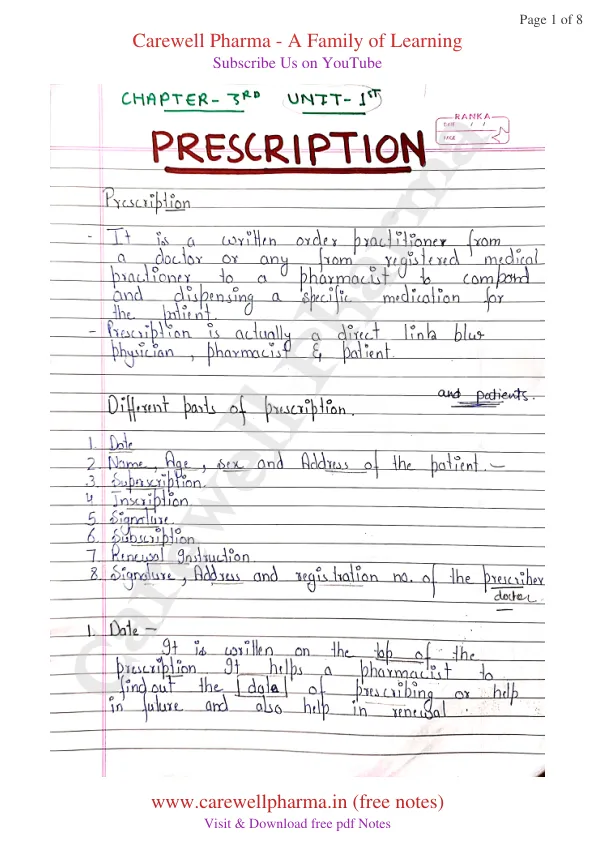
Prescription : It is a written order from registered medical practitioner to a pharmacist to compound and dispensing a specific medication for the patient.
- Prescription is actually a direct link b/w doctor, pharmacist & patient.
Different parts of prescription:
- Date
- Name, Age, Sex and Address of the patient.
- Superscription
- Inscription
- Subscription.
- Signature
- Renewal Instruction
- Signature, Address and registration no. of the prescriber (doctor).
1. Date : It is written on the top of the prescription. It helps pharmacist to find out the date of prescribing or help future renewal.
2. Name, Age, Sex and Address of the patient-
- Name and address of the patient is help in identification of patient and prevent mixing of prescription.
- Age and Gender is helps to decide the quantity and route of the administration.
- In some cases weight also be required in order to calculate the appropriate dose.
3. Superscription : It is represented by the symbol "Rx" which means "You take".
- In ancient time It is considered as a prayer to Jupiter "God of healing" for quick recovery of the patient.
- It is written before writting prescription.
4. Inscription : It is the main part of the prescription which contain the name and quantity of the drug / ingredients.
- It is divided into three parts:
- (i) Base - The active medicament which are intended to produce the active therapeutic effect.
- (ii) Adjuvants - These are include to enhance the action of drugs or to make preparation more palatable.
- (iii) Vehicle - It is a main carrier of drug in which main ingredients are dissolve or helps to increasing the volume of the preparation.
5. Subscription : In this part, the prescriber gives direction to pharmacist regarding dosage form to be prepared and "no. of dosage to be dispensed".
6. Signature : It is usually written as "Sig". It is the direction of the prescriber to the patient regarding for administration of drug.
- The quantity to be taken
- The route of administration
- Time of administration
- Special instruction (if any).
7. Renewal Instruction- The prescriber indicates it in every prescription whether it should be renewed or not and if renewal, for how many time.
- It is very important particularly for the case of habit forming drug to prevent its misuse.
Sample Prescription Format
| Sharma Nursing Home | New Delhi |
Date: __/__/____ | |
Name: ___________________ | Age: _____ |
Address: ________________ | Sex: _____ |
| Rx (Superscription) | |
| Inscription | |
| (Name of drugs & quantity of drugs) | |
| Subscription | |
| (Direction for pharmacist regarding dosage) | |
| Sig. | |
| (direction for patient regarding administer) | |
| Refill - (Renewal instruction) | |
| Doctor name | |
| Reg. no. | |
| Signature | |
| The prescription must be signed by prescriber own hand. Registration no. & address for prevent from habit forming drugs. |
Handling of prescription.
The following procedure should be adopted for handling a prescription for compounding & dispensing:
- Receiving
- Reading & checking.
- Collecting & weighing the material.
- Compounding, labelling and packaging.
1. Receiving
- The prescription should be received by pharmacist himself / herself.
- During receiving a prescription, the pharmacist should not change their facial expression that gives an impression to the patient that he/she is confused or surprised after seeing the prescription.
2. Reading & checking
- After receiving the prescription we have to read it carefully atleast twice and check if any incompatibility present.
- confirmed it or drug word not understand by consulting with doctor / prescriber.
3. Collecting & weighing of the material
- Then, After reading & checking. We have to collect all the drugs & doses on a table which is written in the prescription.
- Check the label which is mentioned in prescription and weigh it quantity.
4. Compounding, labelling and packaging-
- We have to completed one prescription at a time.
- The table should be neat and clean. And all extra equipment present on table.
- required equipment should be clean & dry.
- The preparation should be prepared according to the prescriber or by method given in pharmacopoeia.
- Then compounding preparation should be filled in suitable container.
- Then labelled it according to packed it.
- And delivered it to the patient with giving instruction to the patient and direction for use.
Sources of Errors in Prescription
- Abbreviation
- Name of the drugs
- Strength of preparation
- Dosage form of the drug prescribed
- Dose
- Instruction for the patient
- Incompatibilities.
1. Abbreviation : Some drugs abbreviation also have same means. After reading the prescription if any doubt then consult with another pharmacist or doctor.
- e.g. "Achro" means [Achromycin] or [Achrostatin].
2. Name of the drugs : It is due to some drugs have same name and looks or sound which leads to major danger to the patient.
- e.g. Digitoxin or Digoxin.
3. Strength of preparation : Drugs are available in various strengths. So a drug must not be dispensed if the strength is not written in the prescription.
4. Dosage form of the drug prescribed : Many medicines available in more than one dosage form e.g. liquid, tablet, capsule and suppository.
- it is reduced by written pharmaceutical dose (form) of the medicine in prescription.
5. Instruction for the patient : Some time, the instruction for the patient is incomplete.
- the administration, time, frequency of the drug to be taken. It should be clearly given in the prescription for avoid errors.
6. Dose : Unusually low or high doses should be discussed with the prescriber.
- e.g. Paediatric posology present a soln so pharmacist should consult to avoid any error.
7. Incompatibilities : Check all type of incompatibilities for prevent patient from any harmful effect (Response).
POSOLOGY
UNIT- 1ST
CHAPTER-4
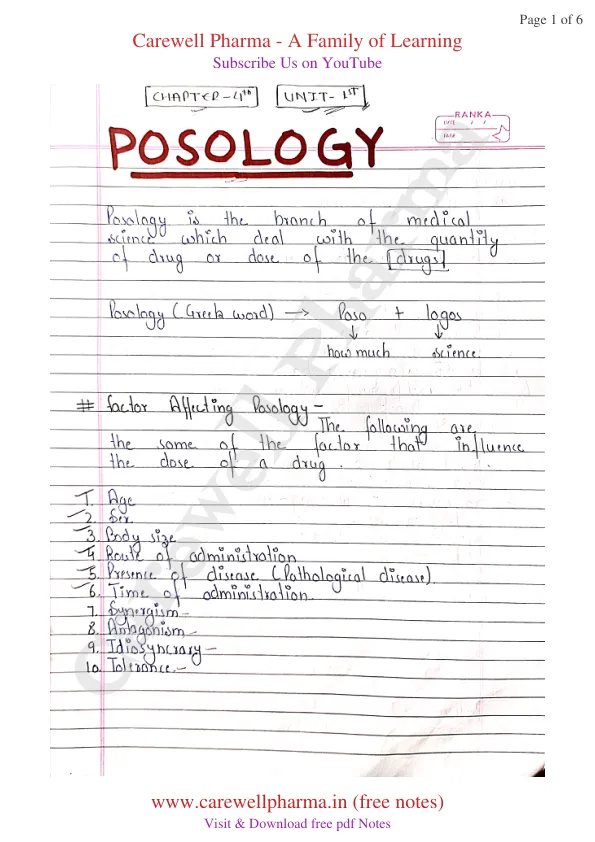
Posology : is the branch of medical science which deal with the quantity of drug or dose of the drugs.
Posology (Greek word)
Factor Affecting Posology
The following are some of the factor that influence the dose of a drug
- Age
- Sex
- Body size
- Route of administration.
- Presence of disease (Pathological disease)
- Time of administration.
- Synergism
- Antagonism
- Idiosyncrasy
- Tolerance
1. Age - The dose of drugs is given according to age of patients.
- Children's want less doses as compared to adult. If children take high dose then it have harmful effect.
2. Sex - It play an important role. It is also dependent or affected by sex because Males & females have different Criteria for doses. And In female at the time of pregnancy, menstruation and Lactation Doses will be given carefully.
3. Body size - It influences the concentration of drug in the body. Heavy weight person want more high doses & lean patient want less dose.
eg:
It can also be calculated from other method like surface area of patient.
4. Route of administration - The drugs amount is depended on route of administration of drug i.e. in case of intravenous have less dose or in orally larger dose.
5. Presence of disease - Disease already in the body that affect the action of drugs.
- In gastrointestinal disease like achlorhydria (reduce secretion of HCl acid in the stomach), the absorption of aspirin decrease.
- In liver disease (cirrhosis), metabolism of some drug (morphine, pentobarbitone) is decrease.
6. Time of administration - Time also affect i.e.
- In empty stomach, drugs responses quick than filled stomach.
- absorption of drug is delayed by presence of food in stomach.
- or irritant drug give in filled stomach that combine with food.
7. Synergism- When the effect and action of drug is increased or more by combination drug .
- e.g. Ephedrine + adrenaline.
8. Antagonism- When the action of one drug is decreased by another drug that phenomenon is called antagonism.
- e.g. Histamine + adrenaline.
9. Idiosyncrasy- Some person may produce abnormal reaction of standard dose of a drug. It is an exception due to genetic.
- In some patient (Aspirin) may cause...
10. Tolerance- Large amount of standard drug is required to produce normal response of a drug due to habit forming.
PEDIATRIC DOSE CALCULATION
1. Based on Age
Young's formula - This formula is used for children having age below 12 year. $$Doseforthechild = \frac{Ageinyears}{Ageinyears + 12} \times Adultdose$$
Dilling's formula - This formula is used for children having age from 4 to 20 years. $$Doseforthechild = \frac{Ageinyears}{20} \times Adultdose$$
Cowling's formula -
Freud's formula - For less than 12 years of age. $$Doseforthechild = \frac{Ageinmonths}{150} \times Adultdose$$
2. Based on Body weight
Clark's formula-
3. Based on Body Surface Area (BSA)
Veterinary Dose- The doses depend upon all posology factor (age of patient, idiosyncrasy, drug interaction, body weight).
- Compared to human being, animal required much higher dose than human due to high surface area & weight etc...
Clark's formula
Chapter 1
Chapter 2
Chapter 3
Chapter 4